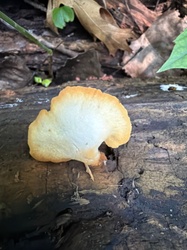
Chicken of the Woods
Laetiporus sulphureus
Also called sulphur shelf, sulphur polypore, crab of the woods
A vivid orange and sulphur-yellow bracket fungus forming large overlapping tiers on tree trunks, with a bright yellow pore surface and thick, soft flesh that fades to chalky white with age.
Overview
Chicken of the Woods (Laetiporus sulphureus) is among the most conspicuous fungi in temperate woodland. It erupts from the trunks of standing trees in broad, overlapping fans of flame-orange and sulphur-yellow, and a single fruiting can weigh several kilograms and be visible from a hundred metres away. Few fungi announce themselves so loudly.
The genus Laetiporus comprises a group of closely related brown rot bracket fungi distributed across the northern hemisphere and beyond, separated by host tree, geography, and the colour of the pore surface and cap. L. sulphureus in the strict sense is the European and western Asian species of broadleaves; North America holds several segregates including L. cincinnatus, L. conifericola and L. gilbertsonii.
Beyond its colour, the species is notable for the sheer scale of its effect on host trees. It is a heart rot agent capable of hollowing out the trunks of very old oaks over decades, and the hollow veteran trees it helps create are among the richest habitats for invertebrates, bats and hole-nesting birds in temperate woodland.
How to identify it
Fruiting body
A cluster of broad, fan-shaped or semicircular brackets, individually 10-40 cm across and 1-4 cm thick, arranged in dense overlapping shelved tiers or rosettes directly on the wood. There is no stipe; brackets are attached broadly along one edge, sometimes narrowing to a thick lateral point of attachment.
Upper surface
Suede-like and faintly zoned, bright orange to salmon-orange or apricot over most of the surface with a clear sulphur-yellow band along the thick, rounded, often wavy or lobed growing margin. The colours are most intense on young brackets and fade progressively with age to pale buff, dull ochre and finally a chalky off-white.
Pore surface
Bright sulphur-yellow, becoming paler and duller with age. Pores are minute and round, roughly 3-5 per millimetre, in a shallow tube layer only 2-5 mm deep. The pore surface may exude pale droplets in humid weather.
Flesh & spore print
The flesh is thick, pale yellow to whitish, and soft, moist and slightly rubbery when young, exuding liquid when squeezed. With age it dries and becomes crumbly, chalky and light, and old brackets break apart like plaster. The spore print is white.
Where and when it grows
Laetiporus sulphureus fruits on the trunks and large limbs of living, damaged and recently dead broadleaved trees. Oak is by far its most frequent host, and it is also common on yew, sweet chestnut, willow, cherry, beech, ash and various fruit trees. It appears on standing veterans, on fallen trunks, on old pollards, and sometimes on structural timber and posts in contact with the ground.
Fruiting is early relative to most fungi, typically beginning in late spring and continuing through summer into early autumn, with a second flush possible after autumn rain. The species is widespread across Europe, temperate Asia and North America, and a favourite of parkland and hedgerow as much as of closed woodland, since it exploits the large old open-grown trees such settings preserve.
Ecological role
This is a brown rot fungus and, in the early stages of its life on a tree, a parasite. It enters through wounds, broken limbs and pruning cuts and colonises the heartwood, digesting cellulose and hemicellulose while leaving the brown lignin residue behind. The decayed wood shrinks, cracks into rectangular blocks along the grain and finally crumbles to a reddish-brown powder, a pattern known as cubical brown rot.
Heartwood is dead structural tissue, so a tree can survive for many decades with an advanced Laetiporus rot, and the fungus continues as a saprotroph after the host dies. The hollow trunks that result retain their outer living sapwood and are structurally more flexible than solid ones, while providing roost and nest cavities for owls, woodpeckers, bats and countless invertebrates. Fruiting recurs on the same tree year after year, often from the same wound, sometimes for thirty years or more.
Similar species
Laetiporus cincinnatus of eastern North America forms a rosette at the base or on roots of oaks rather than shelving high on the trunk, and has a distinctly white to cream pore surface beneath a salmon-pink cap. Laetiporus conifericola and L. gilbertsonii are western North American species distinguished by conifer and eucalyptus or coastal oak hosts respectively.
Giant Polypore (Meripilus giganteus) forms similarly large tiered clusters at the base of beech and oak but is dull ochre-brown rather than orange, and every part of it bruises and ages blackish. Dyer's Mazegill (Phaeolus schweinitzii) grows at the base of conifers and is a rusty orange-brown with a dark brown centre and large angular pores that bruise brown. Hen of the Woods (Grifola frondosa) has many small grey-brown caps on a branched pale stalk rather than a few large orange shelves.
Common questions about Chicken of the Woods
What colour is the pore surface?
Which trees does it grow on?
Does it harm the tree?
How does it change with age?
Guides
Chicken of the Woods found by the community
Photos submitted through the app and matched to this entry.