Identification guide
Chicken of the Woods Identification Guide
A step-by-step read of Laetiporus sulphureus on standing hardwood: tiered orange fans with sulphur-yellow pore surfaces, soft young flesh, brown cubical rot beneath, and how to tell it from its sibling species.
The First Impression
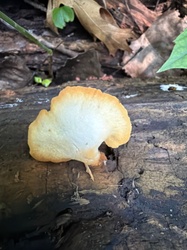
You see this one from further away than any other fungus in the wood. A block of orange and yellow appears on the flank of a standing oak, or on a fallen trunk, glowing against grey bark like a fluorescent object someone has stuck to the tree. Get closer and it resolves into a stack of overlapping fan-shaped brackets in tiers, sometimes a single shelf the size of a hand, sometimes a rosette a metre across weighing many kilograms. The upper surfaces run orange to salmon; the very edge is a bright, clean sulphur-yellow band; the undersides are yellow throughout. Laetiporus sulphureus is broadly attached to wood with no real stem, so the whole mass juts sideways out of the trunk.
Reading the Brackets
Arrangement. Individual caps are fan-, shell- or kidney-shaped, and they overlap in tiers like roof tiles, often fusing at their bases into a compound mass. They are attached broadly and laterally, sessile, or occasionally narrowed to a short thick lateral base. There is no central stem.
Size. Individual caps commonly 10 to 30 cm across and 1 to 3 cm thick at the base, thinning to the margin.
Upper surface. Suede-like and finely felted when young, smoothing and becoming almost bald in age. It is usually zoned in broad, faint concentric bands of orange, apricot, salmon and yellow, sometimes with a slightly wrinkled or lumpy texture near the attachment.
Margin. Thick, blunt and rounded in young specimens, becoming thin, wavy, lobed and often deeply incised with age. The sulphur-yellow rim band is one of the clearest field marks and is usually the last part to fade.
Ageing. Colours bleach dramatically. An old bracket runs pale buff, cream, chalk-white or dirty tan, becomes light and chalky in the hand, and finally cracks and crumbles in place. Very old material can be almost unrecognisable except by its shape and substrate.
The Pore Surface
Turn a bracket up, or crouch below the shelf. The fertile underside is a flat, even layer of tiny pores, coloured a vivid sulphur- or lemon-yellow when fresh and fading to pale cream or whitish with age.
Pore size. Small and round to slightly angular, around two to four per millimetre, so the surface reads as fine and smooth rather than mesh-like. A hand lens shows the neat round openings.
Tube layer. Shallow, only 1 to 5 mm deep, and the same colour as the pore mouths, in one layer only — this is an annual fungus and it does not build stacked perennial tube layers.
Bruising. Pressing the pore surface with a fingertip leaves a slightly darker yellow to faintly brownish mark, but there is no dramatic colour reaction.
The bright yellow underside is the single most useful confirming character. If the pore surface is white, grey or brown, you are looking at something else, or at a related species discussed below.
Flesh and Colour Change
Cut through a bracket from margin to base. Young flesh is soft, moist, thick and fibrous, pale yellow to almost white, and can be squeezed to release water. As the bracket matures it dries out, becoming firmer, then chalky, crumbly and light — the difference between a young and old specimen in the hand is enormous. There is no zonation in the flesh, no black line, no latex, and no significant colour change on cutting beyond a slow dulling. The odour is faintly fungal and slightly sharp in old material.
Taking a Spore Print
Prints are possible but often disappointing, because by the time a bracket is conspicuous it may already have shed most of its spores. Cut a section of fresh bracket that includes a good patch of pore surface, prop it pore-side down over black or dark paper, cover the whole arrangement to hold humidity, and leave it overnight.
The deposit is white to very faintly cream, which is why a dark background matters. Under the microscope the spores are smooth, hyaline, thin-walled and broadly ellipsoid to ovoid, roughly 5 to 7 by 3.5 to 5 micrometres, with a small apiculus. A white print from a bright yellow pore surface on wood is a strong confirmation.
Substrate, Rot Type and Season
This is a wood-decay fungus of living and dead hardwoods. Oak is the classic host across its range, but it also fruits on cherry, beech, sweet chestnut, willow, poplar and other broadleaves, typically from wounds, old pruning scars, branch stubs and the lower trunk of standing trees. It causes a brown cubical rot of the heartwood: broken-down wood in the trunk goes reddish-brown, crumbles, and cracks into cubes that can be pulled apart by hand. If you can see the rot in an adjacent cavity, that supports the identification.
Fruiting runs from late spring through autumn depending on climate, with a strong flush in early summer and often a second in autumn. The mycelium is long-lived inside the trunk, so the same tree fruits at the same wound for many years.
Separating It From Look-Alikes on Morphology Alone
Laetiporus cincinnatus. The closest relative in eastern North America. It fruits as a rosette on the ground at the base of an oak, arising from the roots rather than shelving off the trunk, its caps are paler salmon to peachy-pink, and — decisively — its pore surface is white to cream, not sulphur-yellow.
Laetiporus conifericola and Laetiporus huroniensis. Structurally similar shelving brackets with yellow pores, but they grow on conifers rather than hardwoods. Substrate alone separates them from true sulphureus, which is a broadleaf fungus.
Laetiporus gilbertsonii. A more southern and western species on oaks and eucalyptus, usually paler, with a washed-out pinkish-orange cap.
Phaeolus schweinitzii. Grows at the base of conifers, often on the ground from roots. Young margins are yellow, which causes confusion, but the cap is velvety and shaggy, the whole fungus matures to rust- and chocolate-brown, the pores are large, angular and maze-like, they bruise dark brown immediately, and the spore print is olive-brown, not white.
Pycnoporellus species. Orange and poroid, but with much coarser, angular, torn-edged pores, a tougher texture, and a habit of growing on conifer wood, often on previously rotted logs.
Grifola frondosa and Meripilus giganteus. Both form large clustered masses at the base of hardwoods, but their caps are grey-brown to fawn rather than orange, and their pore surfaces are white; Meripilus blackens where handled.
Hapalopilus and other small orange brackets. Much smaller, usually single, dull ochre to cinnamon rather than sulphur-yellow beneath, and often on dead branches.
A Field Sequence That Works
- Confirm the substrate: hardwood, usually standing, usually oak.
- Confirm overlapping fan-shaped brackets, broadly attached, no stem.
- Check the upper surface for orange-to-salmon zoning with a yellow rim.
- Check the underside is a fine-pored, sulphur-yellow surface.
- Cut the flesh: soft and moist when young, chalky when old, no zone lines.
- Take a white spore print if confirmation is needed.
Common questions
What separates Laetiporus sulphureus from Laetiporus cincinnatus?
Which trees does it grow on?
What kind of decay does it cause?
Why do old brackets look completely different from young ones?
Full reference entry for Chicken of the Woods
Cap and fruiting body, spore print colour, substrate, season, ecological role and the species most often confused with it.
Open the Chicken of the Woods entry →