Identification guide
Cracked Cap Polypore Identification Guide
A hard, hoof-shaped perennial bracket with a deeply fissured black upper surface and rusty brown pores, found almost exclusively on living black locust. This guide covers reading its layers, context and setae, and separating it from other woody brackets.
First Impressions and the Setting
The Cracked Cap Polypore, Fulvifomes robiniae, announces itself from a distance because of where it sits rather than because of any bright colour. You are usually standing beside a mature black locust, Robinia pseudoacacia, in a hedgerow, an old shelterbelt, a city park or roadside planting, and part-way up the trunk you see a series of dark, hard, hoof-shaped lumps projecting from the bark like blackened shelves. They are often several metres above the ground, frequently stacked one above another along an old wound or a branch scar, and they are unmistakably woody rather than fleshy. Because the fungus is perennial, the same brackets are there year after year, growing a little larger each season. In winter, when the leaves are down, a black locust colonised by this species is one of the easiest fungal sightings there is: a bare, deeply furrowed trunk with two or three charred-looking cushions clinging to it.
Reading the Upper Surface
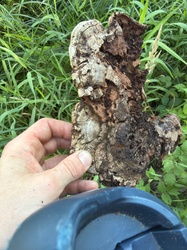
Work through the fruiting body from the top down. Individual brackets are 5 to 30 centimetres wide and can project 5 to 20 centimetres from the trunk, and they are thick, up to 15 centimetres or so at the point of attachment. The shape ranges from a broad hoof or ungulate mass on vertical trunks to a flatter, more shelf-like form on the underside of large limbs. Young growth at the margin is velvety and warm rusty brown to yellow-brown, forming a narrow soft rim only a few millimetres to a centimetre wide. Everything behind that rim ages: it hardens, darkens through dull brown to grey-black, loses its velvet, and then cracks. Those cracks are the character in the name. They form a coarse, irregular, blocky pattern of deep fissures across the older parts, sometimes arranged along faint concentric growth zones, so that the surface resembles baked mud or old charcoal. Moss and algae frequently colonise the cracked areas on long-established brackets.
Reading the Spore-Bearing Surface
Turn your attention to the underside, using a mirror or a phone camera on a stick if the bracket is high up. The pore surface is flat to slightly convex and inclined so that the tubes hang vertically regardless of the bracket angle. Fresh, actively growing pore surface is a warm rusty brown to yellow-brown, sometimes with a faint greyish bloom, and it darkens with age. The pores themselves are very small and circular, typically five to seven per millimetre, so that to the naked eye the surface looks smooth and suede-like, and you need a hand lens to resolve individual openings. Press a fingernail into it: it is firm and does not bruise to a contrasting colour.
Because the fungus is perennial, a vertical cut through the bracket shows a stack of distinct tube layers, one for each growing season, each a few millimetres deep, sometimes separated by thin bands of context. Counting them gives an approximate age for the bracket, and the layered structure is itself a diagnostic feature that separates perennial polypores from annual ones.
Flesh, Context and Simple Tests
This is not a fungus you slice with a pocket knife. A saw or a stout blade is needed. Once opened, the context between the upper crust and the tube layers is hard, woody, fibrous and a rich rusty tawny brown, often faintly zoned and shiny in streaks where the fibres run. There is no colour change on cutting and no latex. The single most valuable bench test is a drop of potassium hydroxide solution on the context: it turns instantly black, the reaction shared by the whole Hymenochaetaceae group to which this species belongs. Under the microscope, look for hymenial setae, dark thick-walled pointed sterile cells projecting among the basidia in the tube lining. Their presence, combined with the black KOH reaction and the rusty context, places the fungus firmly in this family. Spores are small, subglobose to broadly ellipsoid, smooth, thick-walled and pale yellowish to rusty, around 4 to 5.5 micrometres.
Attempting a Spore Print
Perennial brackets are awkward to print, but it can be done and it is worth trying during the active summer sporulation period. Cut a section including a good area of fresh pore surface, set it pore-side down on a sheet of dark card raised on matchsticks so the tubes are not compressed, and enclose the whole thing in a plastic box lined with damp tissue to hold humidity. Leave it a full twenty-four hours in a cool place. The deposit is scant and pale: whitish to pale yellowish or faintly rusty. In the field, look instead for a natural print, a pale bloom of spores dusted on the bark, leaves or lower brackets directly below an active fruiting body on a still summer morning.
Substrate, Host and Season
Host specificity is the strongest single character. This species is overwhelmingly associated with black locust, both in its native range in eastern North America and in the many regions where the tree has been planted, and it is uncommon to find it on anything else. It behaves as a heart-rot fungus of living trunks, entering through wounds, pruning cuts and broken branch stubs and decaying the coloured heartwood while the sapwood continues to function, which is why colonised trees can carry brackets for decades and still look leafy. The brackets persist all year, so there is no fruiting season as such, but new marginal growth and active spore release occur mainly in warm, humid weather in summer.
Separating the Closest Look-alikes
Fomes fomentarius is also hoof-shaped and perennial, but its upper surface is smooth, grey to grey-brown and banded rather than deeply cracked, its pore surface is dull greyish-buff not rusty, and it grows on birch and beech.
Ganoderma applanatum forms a flatter shelf with a warty grey-brown crust, a white pore surface that bruises brown instantly when scratched, and a brown context threaded with white lines. Its spore deposits are cocoa-brown and copious.
Phellinus igniarius is the closest structural match, sharing a black cracked crust and rusty context, but it grows on willow and aspen, has a more sharply hoof-shaped profile and a browner, greyer pore surface.
Fomitiporia everhartii and related species also crack and blacken but are associated with oak, and Fulvifomes species on other hosts are separated largely by host tree and by spore and setae dimensions.
Inonotus rickii and other annual rusty brackets are soft and fibrous when fresh, collapse within a season, and never build a stack of tube layers.
Field Checklist
- Hard, perennial, hoof-shaped bracket on a living trunk
- Upper surface blackening and deeply, coarsely cracked with a narrow rusty velvety margin
- Minute rusty brown pores, five to seven per millimetre
- Stacked annual tube layers visible in section
- Rusty tawny woody context turning black with KOH
- Almost always on black locust
- Present year-round, growing in summer
Common questions
What is the quickest way to recognise the Cracked Cap Polypore?
Why does it appear on the same tree for many years?
How do I distinguish it from Ganoderma applanatum?
What role does it play in the woodland or park?
Full reference entry for Cracked Cap Polypore
Cap and fruiting body, spore print colour, substrate, season, ecological role and the species most often confused with it.
Open the Cracked Cap Polypore entry →