Death Cap
Amanita phalloides
Also called deathcap
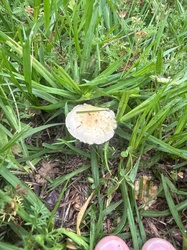
A medium to large Amanita with a smooth greenish cap streaked with darker radiating fibres, white free gills, a pendulous ring, and a conspicuous white membranous sac enclosing the stem base.
Overview
Amanita phalloides is one of the most studied and most widely distributed members of its genus. It sits in Amanita section Phalloideae, a group defined by smooth caps that usually lack loose veil warts, white spore prints, amyloid spores, and a well-developed membranous volva at the stem base. Where many Amanitas advertise themselves with warty, brightly coloured caps, this species is comparatively plain, and its identity rests on structural characters rather than colour.
Cap colour is variable and has misled many observers: the typical form is a metallic olive-green to yellowish-green, but the same species produces bronze, khaki, greenish-grey, pale straw and even near-white fruiting bodies. What stays constant is the silky sheen with darker innate radiating fibrils, the white free gills, the skirt-like ring, and the loose white bag at the base.
Originally a European fungus associated with oak, the species has been carried around the world on the roots of nursery trees. It is now established across much of North America, and in Australia, New Zealand, South America and southern Africa, where it fruits under planted oak, hornbeam, chestnut and birch and in places has begun forming associations with native trees.
How to identify it
Cap
5-16 cm across, at first egg-shaped and enclosed, becoming convex and finally almost flat. The surface is olive-green, yellow-green, bronze, greenish-grey or occasionally pale cream, always with a satiny sheen and fine darker radiating fibrils running from centre to margin, which give the cap a subtly streaked look. It is slightly sticky in wet weather and the margin is smooth and not grooved, even in age. Loose white veil patches are usually absent, though an occasional specimen carries a single large sheet of veil tissue.
Gills
Free from the stem, crowded, fairly broad, white, sometimes with the faintest greenish or cream cast in old specimens, and never becoming pink or brown. The gill edges are minutely floccose.
Stipe
7-15 cm tall, 1-2 cm thick, white to pale greenish-white and frequently marked with faint pale zigzag or chevron patterning on the upper part. A large, white, membranous, pendulous ring hangs from the top of the stem and is smooth rather than grooved above. The stem base swells into a bulb enclosed by a substantial, loose, white, sac-like volva with a free upper edge. This volva is often buried below the leaf litter and is lost if the stem is snapped off, so the base must be dug out to be seen.
Flesh & spore print
Flesh white and unchanging when cut, thin at the margin and thicker over the stem. Smell faint and slightly sweetish in young specimens, becoming stronger and sickly in age. Spore print white; spores broadly ellipsoid to subglobose and amyloid.
Where and when it grows
The Death Cap is ectomycorrhizal and in its native European range is strongly associated with oak, and secondarily with sweet chestnut, beech, hornbeam and hazel. It grows on a wide range of soils and appears in mature broadleaf woodland, in parks and along avenues of planted trees, on woodland margins and in gardens, usually singly or in loose scattered groups rather than in tight clumps.
Fruiting runs from midsummer through autumn, peaking after periods of warm rain, and extends into early winter in mild regions. Outside Europe the species is naturalised on the west coast of North America, in the northeastern United States, and in parts of Australia, New Zealand and South America, almost always tracking planted oak, chestnut, hornbeam and birch in urban and suburban plantings.
Ecological role
As an ectomycorrhizal partner the fungus forms a dense hyphal sheath around the short roots of its host and a Hartig net between the root cortical cells, trading mineral nutrients and water for photosynthetic sugars. It is comparatively flexible about its partners, which is one reason it has established so readily in new continents when moved as mycelium on the root balls of nursery trees.
In several introduced ranges it has been documented spreading beyond planted hosts to form associations with native trees, including oaks and, in the Southern Hemisphere, some non-native ornamentals. This host-shifting ability makes it a well-known case study in the accidental global movement of mycorrhizal fungi. Its fruiting bodies decay quickly and are attacked by fly larvae and moulds, returning nutrients to the litter layer.
Similar species
Green-capped Russula species such as Russula virescens and Russula aeruginea are similar in cap colour but have no ring and no volva whatsoever, and their gills and flesh are brittle and crumble rather than tearing in fibres; the cap of R. virescens is also broken into distinctly crazed patches. Volvariella and Volvopluteus species also have free gills and a sac-like volva but no ring at all, and their gills flush pink and produce a pink spore print.
Young, still-enclosed Death Caps resemble small puffballs; slicing one from top to bottom shows the outline of a miniature cap, gills and stem inside, whereas a puffball is uniformly white and undifferentiated. Agaricus species also have free gills, but their gills turn pink then chocolate-brown, they produce a dark brown spore print, and they lack a volva at the base. Straw-coloured forms of the Death Cap can suggest Amanita citrina, which is paler lemon-yellow, carries loose patchy veil remnants on the cap and has an abruptly rimmed rather than sac-enclosed bulb.
Common questions about Death Cap
How do I see the volva?
Is the cap always green?
What trees does it associate with?
How did it reach North America and Australia?
Guides
Death Cap found by the community
Photos submitted through the app and matched to this entry.