Identification guide
Enoki Identification Guide
A winter-woodland walkthrough for Flammulina velutipes, the tufted orange mushroom with a sticky cap and a dark velvety stem. Covers cap, gills, the crucial stipe surface, the white spore print, and how to separate it from ringed brown-spored wood mushrooms.
The Season Does Half the Work
Most fungal seasons are over when this one starts. You find Flammulina velutipes in late autumn, winter and early spring, on bare deciduous trees, often during a thaw between frosts, sometimes with snow still lying around the base of the trunk. Walking a hedgerow, a river bank, a park with old willows or a wood full of standing dead elm, you catch a patch of warm orange against grey bark that has no business being there in January.
The fruiting habit is the second half of the first impression: dense tufts, sometimes dozens of caps, their stems fused at the base and fanning outward from a crack, a wound, a stump top or the cut end of a log. Individual caps sit at different heights and angles, producing a shaggy, layered cluster rather than a neat ring. Frozen material thaws and carries on growing, so the same cluster can be productive for weeks.
Reading the Cap
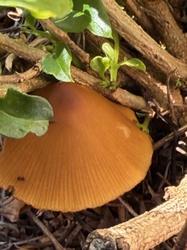
The cap is 2 to 8 cm across, convex at first and expanding to broadly convex or nearly flat, sometimes with a low broad hump. It is smooth and bald, and in damp weather it is distinctly viscid — run a fingertip across it and it drags slightly, and litter fragments stick to it. Dried out, the same cap becomes shiny and tacky-looking rather than slippery.
Colour is orange-brown, tawny, honey or yellow-brown, typically deepest at the centre and fading to a paler yellow-tan or almost cream at the margin. Older caps darken and can become reddish-brown. The margin is even, often faintly translucent-striate when very wet, and there is never a veil fragment hanging from it. There are no scales, no warts and no fibrillose patches on the surface: a bald, sticky, two-toned orange cap is the correct impression.
The Gills
Turn a cap over. The gills are attached but narrowly so — adnexed, sometimes almost free, occasionally with a small notch — and they are moderately broad, fairly well spaced rather than crowded, with several tiers of short gills between them.
Colour matters. They are white to pale cream or faintly yellowish when young and stay pale into maturity, at most developing a dull yellowish or slightly brownish tinge with age or from bruising. What they never do is turn cinnamon, rust or dark brown. If the gills under an orange cap are going rusty-brown, stop and take a print, because you have moved into a different group entirely.
The Velvet Stipe: the Character That Names the Species
This is the diagnostic feature and it deserves careful handling. The stalk is 3 to 8 cm long and only 3 to 8 mm thick, tough, cartilaginous and hollow, and it is frequently curved or bent because the tuft grows sideways from a vertical surface and turns upward.
The colour changes down its length. The apex is pale, yellowish or nearly cream. From roughly the middle downward it darkens through tawny brown to a deep reddish-brown or near black at the base. Overlaying that darkening, and this is the point, is a dense, fine, short-haired velvety coating that you can both see under a hand lens and feel as a suede-like nap under a fingertip. Against low sun the base of the stem looks matted and furry.
There is no ring, no ring zone, no cobwebby veil remnant and no volva. Slit a stem lengthwise: it is hollow, with tough elastic walls. The stems of a tuft are fused at the base into a common tough plug that is often buried in soft rotten wood.
Flesh, Colour Change and Odour
The flesh is whitish to pale yellow, thin in the cap and tough and stringy in the stalk. Cut it top to bottom and nothing happens: no reddening, no bluing, no darkening at the cut, no latex. The odour is mild and unremarkable. This complete absence of reaction is worth writing down, because several look-alikes are equally unreactive and the character carries you no further, but a reaction of any kind would take you out of the species.
Taking the Spore Print
The print is the confirmation step and should not be skipped, because it is the fastest way to close out the most serious morphological confusions. Cut a mature cap free of its stem, lay it gill-side down on paper that is half white and half black, cover it, and leave it two to six hours in a still, humid spot.
The deposit is white. Not cream, not buff, not rust: white. Against the black half of the sheet it shows clearly, and against the white half it should be nearly invisible. Any brown, ochre or rusty tone in the print rules this species out immediately.
Under a microscope the spores are smooth, colourless, narrowly ellipsoid and roughly 7 to 10 by 3 to 5 micrometres, with no germ pore.
Substrate and Season
Expect it on dead deciduous wood, and also on the wounds and dead patches of living broadleaf trees. Elm, willow, ash, poplar, hackberry, beech, maple and old fruit trees are all common hosts; conifer records are rare and belong mostly to related species. Look at stumps, standing dead trunks, fallen logs, exposed root flares, storm-broken limbs and the sawn ends of stacked wood.
Fruiting runs from late autumn through winter into early spring, peaking after cold snaps and during mild wet spells. Freezing does not destroy the fruitbodies; they thaw and resume growth. This cold-weather habit is genuine identification data, because the majority of superficially similar wood-dwelling mushrooms fruit in late summer and autumn instead.
Look-alikes, on Morphology Alone
Galerina marginata is the important one and the differences are clear if you look. Its cap is dull ochre to tawny-brown, hygrophanous, and dry to only slightly tacky rather than truly viscid; its gills become pale brown then cinnamon-brown; it has a membranous ring or at least a distinct ring zone on the stalk; the stalk below that zone is silky-fibrillose or finely powdery, never velvety-black; the base is not darkened into a suede boot; and the spore print is rusty brown. It also favours conifer wood and fruits mainly in autumn. Print colour alone divides them absolutely.
Kuehneromyces mutabilis has a two-toned hygrophanous cap that dries from the centre outward, a distinct ring, small upturned scales on the stem below the ring, brown gills and a brown spore print.
Pholiota species are scaly on cap or stem, often with a veil, and give a brown print.
Hypholoma fasciculare forms tufts on wood but has a dry sulphur-yellow cap, greenish-yellow gills that darken to purple-brown, and a purple-brown spore print.
Xeromphalina campanella is tiny, grows in swarms on mossy conifer logs, and has arching decurrent gills and a smooth, wiry, dark stem without a velvety nap.
Mycena species are fragile with conical striate caps, a white print, and smooth, often shiny stems.
Finally, several close relatives — Flammulina populicola, F. rossica, F. fennae and others — share the velvety stem and are separated on host tree, cap colour and microscopic characters, so a record of the substrate tree is always worth taking.
Common questions
What is the defining field character of Flammulina velutipes?
What colour spore print does it give?
What wood does it grow on and when?
How is it separated from Galerina marginata on structure?
Full reference entry for Enoki
Cap and fruiting body, spore print colour, substrate, season, ecological role and the species most often confused with it.
Open the Enoki entry →