Identification guide
False Turkey Tail Identification Guide
How to recognise Stereum ostrea on hardwood logs, with the underside test that separates a smooth-surfaced crust fungus from the pored true turkey tail.
The Setting and the First Impression
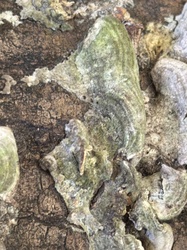
You find this fungus on dead hardwood: fallen oak limbs, cut stumps, storm-broken branches, and logs lying in leaf litter. It is one of the most abundant bracket-forming fungi in temperate broadleaf woodland, and it is present in some condition almost all year. The first impression is of thin, wavy fans arranged in overlapping tiers along the upper edge of a log, or of rosettes clustered on a cut end, banded in warm tans, buffs and rusty browns with a pale rim. Each fan is stiff and slightly springy, and the group as a whole often covers a substantial stretch of bark. If the wood is old and the fans are weathered, the upper surface may be tinged green with a bloom of algae, which is a normal condition rather than a separate species.
Reading the Upper Surface
Individual fans are 2 to 7 cm across, fan-shaped to shell-shaped or roughly semicircular, and only a millimetre or two thick. They attach broadly along one edge, either directly to the wood or by a narrow contracted base. The upper surface is the part people photograph: it carries concentric bands of colour running parallel to the margin, in tan, ochre, cinnamon, orange-brown and reddish-brown, generally warm in tone and often with a strikingly pale cream or yellowish outermost band. Young fans are finely velvety or silky-hairy over most of that surface; with age the hairs wear away from the base outward, leaving it smooth and slightly glossy, so a single specimen can be velvety at the rim and bare toward the attachment. The margin is thin, often wavy, lobed and inrolled when dry.
The Underside Is the Whole Identification
Turn a fan over. The lower surface is smooth. There are no pores, no gills and no teeth of any kind; under a hand lens it is an even, faintly waxy skin, sometimes very slightly wrinkled or bumpy near the point of attachment but never perforated. Colour is buff, cream or pale tan when fresh, ageing to ochre, greyish-buff or dull brown. This single observation separates the species from its main confusable, and it takes two seconds to make. Carry a lens and use it, because at arm's length a fine-pored surface can look smooth.
Flesh, Section and Bruising
Snap a fan across. The flesh is thin, tough and leathery, whitish to pale buff, and it bends before it breaks when fresh; dried material becomes hard and brittle and rehydrates when wetted. In cross-section under a lens you can often see a darker line separating a hairy upper layer from the fertile layer below. Scratch or cut the fresh underside with a fingernail: in this species nothing happens. Several related crust fungi exude red juice from damaged fresh tissue, so the absence of any red seepage here is a positive character worth testing on well-hydrated material.
Taking a Spore Print
Brackets print perfectly well if you give them a flat surface and humidity. Cut a fresh, flexible fan free of the wood with a knife, lay it fertile-side down on a piece of glass, foil or dark paper, cover it with a container, and leave it twelve to twenty-four hours. The deposit is white and often thin, so a dark background is essential. Very dry, weathered fans will produce nothing at all; look for pale, pliable material at the growing edge of a colony after rain.
Substrate, Season and Ecology
Stereum ostrea is a decomposer of dead hardwood and causes a white rot, breaking down lignin and leaving pale, fibrous, softened wood behind. Oak is the classic host, with many other broadleaved trees also used; conifer records are unusual. It colonises fallen branches, stumps, standing dead trunks and cut log ends, and it is a strong early coloniser of freshly dead wood, often forming extensive sheets before other fungi arrive. Fruit bodies are perennial in appearance and persist through the year, drying out and reviving repeatedly. The best-coloured, freshest material appears in autumn and after prolonged wet spells.
Separating It from Look-Alikes
Trametes versicolor, the true turkey tail, is the constant confusion. Its upper surface is more strongly velvety and its colour bands are usually more contrasting and can include grey, blue-grey, black and near-white in the same fan. The decisive feature is its underside: a white to cream layer of tiny round pores, roughly three to five per millimetre, clearly visible as pinpricks under a lens. Stereum hirsutum has a coarsely hairy, more uniformly yellow-orange to buff upper surface with weaker banding, and a bright yellow to orange smooth underside. Stereum complicatum is smaller, more crowded, and warmer cinnamon-orange, often fusing into long rows on twigs. Trichaptum biforme carries a violet-tinged margin and a lower surface that breaks into ragged pores and teeth. Lenzites betulina looks like a turkey tail from above but has true radiating gill-like plates beneath. Chondrostereum purpureum shares the smooth underside but is distinctly purple to lilac-brown there when fresh. Xylobolus frustulatus forms hard cracked tiles rather than free fans.
Notes on Names and Variation
Material passing under this name varies considerably in size, hairiness and banding, and mycologists have split it into several closely related species in different regions, with some populations placed under other names in the same group. For field purposes the working concept is stable: a thin, zoned, warm-brown hardwood fan with a smooth, poreless, pale underside and no red seepage.
A Field Sequence That Works
Confirm dead hardwood; note thin, tiered, zoned fans with a pale wavy rim; feel for velvety texture toward the margin; turn it over and confirm a completely smooth underside with a lens; scratch fresh tissue and confirm no red seepage; snap it to confirm tough leathery flesh; take a white print if you need final confirmation.
Common questions
How do I separate this from the true turkey tail?
What wood does it grow on?
What role does it play in the woodland?
Why are some fans tinged green?
Full reference entry for False Turkey Tail | Stereum ostrea
Cap and fruiting body, spore print colour, substrate, season, ecological role and the species most often confused with it.
Open the False Turkey Tail | Stereum ostrea entry →