Identification guide
Gem-studded Puffball Identification Guide
A field walkthrough for Lycoperdon perlatum, the pear-shaped woodland puffball studded with two sizes of detachable spines. Covers the reticulate scar pattern, the apical pore, what a vertical cut should reveal and how to split it from earthballs and stump puffballs.
First Impression
The Gem-studded Puffball is one of the most widespread woodland fungi in the northern hemisphere, and it usually announces itself as a scattering of small white to pale buff objects standing among conifer needles or beside a woodland path. From a few paces they look like pale eggs, but the outline is not spherical: each one is pear-shaped, top-shaped or like a tiny inverted light bulb, with a rounded head narrowing into a short stalk-like base. They cluster in loose troops of five to fifty, sometimes several dozen along a path edge, and they persist for weeks as they age and brown.
Get closer and the texture takes over. The upper surface is covered in short, detachable spines and granules of two clearly different sizes: scattered larger cone-shaped spines standing above a background of small crumbly warts. Those spines are the "gems" of the common name.
Reading the Outside
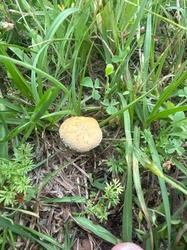
A mature fruit body is typically 2-6 cm wide and 3-7 cm tall. Young ones are pure white; with age they pass through cream, dull yellowish and ochre to a warm tan or greyish-brown, and old overwintered ones fade to grey-brown husks.
Rub the surface gently with a thumb. The larger spines detach easily, and where each has fallen away it leaves a pale circular scar. Because the spines are set in a regular arrangement, a rubbed or weathered fruit body ends up marked with a fine net of pale rings and polygons - a reticulate, faintly golf-ball-like pattern. That pattern on the bare skin is one of the single best characters for the species, and it is worth deliberately rubbing a patch to look for it.
Now check the apex. As the fruit body matures, a small circular pore, the ostiole, opens at the very top, with a slightly raised or nipple-like rim. Squeeze an old one gently and a puff of olive-brown dust escapes through this pore. The opening is a neat, defined hole, not an irregular tear.
Cutting It Open - the Substitute for a Spore Print
Puffballs have no gills, no pores and no exposed spore-bearing surface, so the usual spore print does not apply. The equivalent diagnostic act is a clean vertical cut from top to bottom, and it should be done on every puffball you want to name.
Slice one in half and read the internal structure from the top down.
The upper two-thirds is the gleba, the spore-producing tissue. In a young fruit body it is pure white, uniform, firm and slightly moist, with no pattern, no marbling and no dark zones. As it matures it turns yellowish, then olive-yellow, then a dry olive-brown powder shot through with fine threads of capillitium - a network of hair-like fibres that helps disperse spores in air currents.
Below the gleba is the sterile base, a distinct spongy region full of small chambers, like a fine cross-section of a sponge. It stays whitish for far longer than the gleba and is separated from it by a shallow boundary. The sterile base is what forms the stalk-like lower half of the fruit body, and it persists on the ground after the spores have blown away.
The rind is thin, and there is no thick leathery or corky outer wall.
Under a microscope the spores are globose, minutely warted, and small - about 3.5-4.5 um - and they are shed as a fine dust rather than deposited on paper.
Substrate and Season
This species is saprotrophic: it lives on dead organic matter and takes no part in a root partnership, which is why it is not tied to a single tree. It fruits on soil, on conifer needle duff, in leaf litter, along compacted path edges and in mossy banks, in both broadleaf and coniferous woodland; it also appears in parks, on grassy woodland margins and, occasionally, on very rotten, soil-buried wood, though it is not a wood fungus in the way that some relatives are.
Fruiting runs from midsummer through late autumn, with a strong peak after prolonged rain, and old dried fruit bodies can persist into winter. Its range covers Europe, Asia, North America and beyond, and it is one of the fungi most likely to be found in any patch of temperate woodland.
Its ecological role is straightforward decomposition - breaking down needle litter and buried plant debris - and its spore dispersal is a small piece of mechanical elegance: raindrops striking the elastic rind compress it and puff a jet of spores out through the apical pore.
Separating the Look-alikes
Apioperdon (Lycoperdon) pyriforme. The closest confusion. It grows in dense clusters directly on wood - stumps, buried logs, wood chips - and its base is attached to conspicuous white cord-like rhizomorphs that you can pull out of the substrate. Its surface bears fine granular warts, not the two-sized spines, and it never shows the reticulate ring pattern.
Lycoperdon nigrescens and L. foetidum. Dark chocolate to blackish-brown spines on a brown ground, giving a much darker overall appearance, and typically found in upland heath and conifer woods.
Lycoperdon molle and allies. Softer, more granular, less obviously spiny surfaces without the distinct larger cones, and generally duller from the start.
Lycoperdon excipuliforme (Pestle Puffball). Much larger, with a long, distinctly pestle-shaped sterile stalk, and it releases its spores by the whole top breaking away rather than through a neat pore.
Bovista species. Round rather than pear-shaped, with no developed sterile base; they often detach from the ground entirely and roll about, and the outer skin peels away in flakes.
Scleroderma citrinum (Common Earthball). Superficially puffball-like but structurally quite different: a thick, tough, leathery rind up to several millimetres deep, a coarse scaly ochre surface, no distinct sterile base, no apical pore, and a gleba that turns purplish-black very early and is already dark while the fruit body is still firm. A vertical cut separates the two instantly.
Amanita and Agaricus "eggs". Immature gilled mushrooms still enclosed in a veil can look like small white puffballs. Cutting one vertically reveals the outline of a developing cap, stipe and gills in silhouette, which no true puffball shows.
Field Checklist
Pear- or top-shaped fruit body with a stalk-like base; white ageing to tan; two sizes of detachable spines; a reticulate pattern of pale rings where spines have fallen; a neat apical pore at maturity; interior with a white then olive-brown gleba above a chambered sterile base; growing in troops on woodland soil and needle litter from summer to late autumn.
Common questions
Why is it called gem-studded?
How do you take a spore print from a puffball?
Where does it grow and what is it doing there?
How do I tell it from Lycoperdon pyriforme?
Full reference entry for Gem-studded Puffball
Cap and fruiting body, spore print colour, substrate, season, ecological role and the species most often confused with it.
Open the Gem-studded Puffball entry →