Identification guide
Golden Oyster Identification Guide
Bright lemon-yellow rosettes of thin, funnel-shaped caps on dead hardwood, fused into a common branched base. Learn the cluster architecture and the decurrent gills, because the colour fades.
The first impression
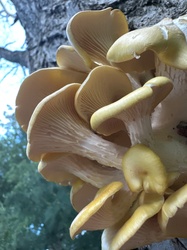
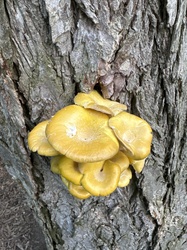
You come around a downed elm in high summer and a section of the trunk is glowing. There is a bouquet of two dozen small caps stacked in tiers on the upper surface of the log, each one a bright, almost artificial lemon-yellow, the whole cluster maybe 20 cm across. Individual caps are thin and floppy, shaped like shallow trumpets or fans, and if you look at where they attach you can see that they are not independent mushrooms at all: they arise from a common branched trunk of white tissue that emerges from a single point on the wood.
Golden Oyster is one of the easiest wood mushrooms to notice and one of the easier ones to misjudge, because the colour that draws you in is the least stable feature it has. Fresh caps in shade are vivid yellow; the same cluster in direct sun three days later can be pale buff, cream, or almost white at the margin with only a yellow tinge left in the centre. So the workflow below builds the identification on architecture first and colour second.
Reading the cluster
Before touching any single mushroom, read the whole group. Golden Oyster grows in a fused rosette: multiple stipes branching repeatedly from one basal stem, so caps overlap in tiers like a bunch of small flowers. Trace a cap down its stipe and you should meet other stipes joining it. Clusters that are truly separate mushrooms spaced along a log, each with its own independent attachment, point away from this species.
Note also where on the log the cluster sits. Golden Oyster fruits from the sides, top and end-grain of dead hardwood, from bark-covered and barkless surfaces alike, and often reappears at the same point over successive weeks.
Cap
Caps are 2 to 6 cm across, occasionally to 10 cm on well-fed logs. They start convex with an inrolled margin, then flatten and become depressed at the centre, finishing as shallow funnels or vases with an uplifted, often wavy, sometimes split margin. The surface is dry to slightly moist, smooth, sometimes minutely velvety at the centre, never slimy and never scaly.
Colour is the bright chrome-to-lemon yellow when fresh, fading as described. The margin becomes translucent-striate on old caps, showing gill lines through the thin flesh. Caps are notably thin-fleshed for their width, only a few millimetres through the centre, which contributes to their floppy, papery feel.
Gills
Gills are the strongest structural character. They are white to cream, sometimes with a faint yellow cast where they meet the cap surface, close to crowded, and conspicuously decurrent: they do not stop at the stipe, they run a long way down it, tapering as they go. In a well-grown specimen you can see the gill lines continuing halfway to the base. Many gills fork near the margin, and short gills of two or three lengths are interleaved between the full ones. Where several stipes are fused, the decurrent gills of adjacent caps sometimes anastomose into a low network across the shared stem.
Gill edges are even and unmarked, with no coloured band, no serration and no beading of liquid.
Stipe and base
The stipe is short, 1 to 5 cm, white to cream, dry, firm and often finely felted or hairy near the base. It is eccentric or lateral rather than central: a Golden Oyster hangs its cap off to one side of its stem, which is exactly what you would expect of a fungus growing sideways out of a vertical or overhanging surface. Caps forming on the top of a horizontal log can approach a central stipe, so judge this on the cluster as a whole.
The base is the fused white trunk already described, often with a mat of white mycelium binding wood fibres and debris. Slice the base lengthways and the tissue is solid white throughout.
Flesh and colour change
Flesh is white, thin, soft and slightly fibrous, with a pleasant, sweetish, faintly anise-like odour that many people notice at arm's length from a large cluster. Cut a cap and a stipe and watch: there is no blueing, no reddening, no browning beyond slow ordinary discolouration in old specimens, and no latex. That absence of any bruising reaction is itself diagnostic against several look-alikes.
Taking and reading a spore print
Cut a mature but not decayed cap free with a short section of stipe, set it gill-side down on a sheet that is half white and half dark, cover it with a bowl and leave it three to eight hours. Golden Oyster drops heavily and you usually get a dense print quickly. The deposit is white to very pale lilac or pale greyish-lilac; the lilac cast is subtle and shows best on white paper in daylight against a genuinely white reference. What matters most is what it is not: it is not rusty-brown, not cinnamon, not pink and not dark brown. A rusty print immediately excludes this species.
Substrate and season
The substrate is dead hardwood, with a strong preference for elm and also frequent on box elder and other maples, ash, and various other broadleaved trees. It fruits on logs, stumps, standing dead trunks and large fallen limbs, in warm humid weather from late spring through summer and into early autumn, typically flushing a few days after heavy rain. It is native to temperate and subtropical eastern Asia and has become established and locally abundant in parts of eastern North America, where it spreads readily through hardwood-rich riparian woodland.
Separating the look-alikes on morphology alone
Branched Oyster (Pleurotus cornucopiae). The nearest structural match: fused branched clusters, deeply decurrent gills forming a network on the stem, thin flesh. It is pale tan, ochre or buff, never lemon-yellow at any stage, and its stems are typically longer and more centrally attached with the gill network more pronounced.
Pearl Oyster (Pleurotus ostreatus). Grey, brown, tan or bluish, thicker-fleshed, with broader shelf-like caps and generally shorter, stouter, more strictly lateral stems. Colour and flesh thickness separate them.
Orange Mock Oyster (Phyllotopsis nidulans). Superficially similar shelving habit and orange-yellow colour, but it is entirely stipeless, its cap surface is densely covered with coarse orange hairs, its gills are orange rather than white, and its odour is strongly unpleasant.
Crepidotus species. Small, stipeless, white to buff shelving fans on twigs and sticks, with a brown spore print. The print settles it.
Elm Oyster (Hypsizygus ulmarius). Also on elm, but white to cream, much thicker-fleshed, with a nearly central stipe, gills that are adnate to only slightly decurrent, and mushrooms that grow singly or in small groups rather than fused rosettes.
A repeatable field sequence
Read the cluster architecture, then the decurrent gills, then the eccentric white stipe and fused base, then the absence of any bruising change, then confirm with a pale print. Colour comes last, precisely because it is the character most likely to have faded before you arrived.
Common questions
The caps I found are pale, not yellow. Is it still Golden Oyster?
What does the spore print look like?
What wood does it grow on and when?
How do I separate it from Branched Oyster?
Full reference entry for Golden Oyster | Pleurotus citrinopileatus
Cap and fruiting body, spore print colour, substrate, season, ecological role and the species most often confused with it.
Open the Golden Oyster | Pleurotus citrinopileatus entry →