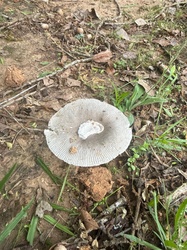
Grisette
Amanita vaginata
Also called common grisette, grey grisette, vaginate amanita
A slender grey Amanita with a strongly grooved cap margin, free white gills, no ring at all, and a tall white membranous sac enclosing the stem base.
Overview
The grisettes are the ringless Amanita species, traditionally grouped as section Vaginatae. They differ from the more familiar ringed members of the genus in lacking a partial veil, so the stem is bare from top to bottom, while the universal veil survives intact as a tall, white, bag-like volva at the base. Their caps are typically thin-fleshed with a strongly grooved or lined margin, a consequence of the gills pressing against the thin cap skin as the fruit body expands.
Amanita vaginata is the type and the archetype: mouse-grey to ashy, smooth, slender-stemmed, and widespread in woodland across the Northern Hemisphere. In the field it can look almost fragile compared with its heavier ringed relatives, and its brittle flesh means it is often found with the cap split or broken.
The name has historically been applied very broadly, and molecular work has shown that Amanita vaginata as used in the literature covers a complex of similar grey species differing in subtle ways in colour, volva structure and geography. For field purposes the combination of a grey grooved cap, free white gills, an unringed stem and a persistent white sac remains the working definition.
How to identify it
Cap
4-10 cm across, egg-shaped then bell-shaped, expanding to broadly convex or flat with a low central umbo. The colour is mouse-grey, ashy grey or brownish-grey, usually darker at the centre, and the surface is smooth, thinly fleshed and slightly viscid when wet. Most specimens are entirely free of veil patches, though occasionally a thin white membranous fragment sits on the disc. The outer third of the margin is conspicuously grooved with radial lines mirroring the gills beneath.
Gills
Free from the stem, crowded, fairly broad, white to very pale cream, with a finely floccose edge and numerous short gills between the full-length ones. They stay white through maturity.
Stipe
7-18 cm tall and 0.6-1.5 cm thick, slender, tapering upward, white to pale greyish, and often finely patterned with faint greyish fibrillose bands or a subtle zigzag scaliness. There is no ring anywhere on the stem, which is the single most useful character. The base sits in a tall, white, membranous, sac-like volva with a free upper rim, usually buried and easily left behind if the mushroom is pulled.
Flesh and spore print
The flesh is thin, white, brittle and unchanging when cut. The odour is mild. The spore print is white, and the spores are globose.
Where and when it grows
The grisette grows on the ground in a wide variety of wooded settings: broadleaf woodland with oak, beech and birch, conifer plantations, mixed woods, heathland with scattered trees, wooded parkland, and grassy areas near established trees. It tolerates a broad range of soil types, from acidic sands to more calcareous ground, and often appears along path edges and in mossy clearings.
The season is long, running from early summer through to late autumn, and it is one of the earlier Amanita species to appear in the year. Its distribution is broadly circumboreal and it is common through most of temperate Europe, northern Asia and North America, although some of the material recorded under this name elsewhere in the world represents separate species in the same complex.
Ecological role
Like other Amanita species, the grisette is ectomycorrhizal, forming a nutrient-exchanging sheath around the fine roots of trees. It is a generalist, partnering with a broad spread of both broadleaf and coniferous hosts, which explains its wide habitat tolerance and long fruiting season compared with more specialised relatives.
Development follows the standard Amanita pattern minus one step. The young fruit body is enclosed in a universal veil that ruptures as the stem elongates, leaving the persistent sac at the base. Because there is no partial veil in this section, the gills are exposed from an early stage and no ring is ever formed. The thin cap flesh dries and splits readily, so fruit bodies are short-lived and often found collapsed within a few days.
Similar species
Amanita fulva is the closest relative, differing in its tawny to foxy orange-brown cap and a white volva that becomes stained rusty brown. Amanita crocea has a brighter apricot-orange cap and a stem conspicuously banded or chevroned with orange-cream fibrils. Amanita ceciliae has a bronze-brown cap carrying large ashy-grey cottony patches and a fragile, crumbly volva that breaks into greyish rings around the base rather than forming an intact bag. Amanita battarrae shows a distinct darker zone near the grooved margin, giving the cap a two-toned look.
Ringed Amanita species such as Amanita porphyria are separated at a glance by the presence of a membranous ring on the stem. Volvariella and Volvopluteus species also have a sac volva and no ring, but their gills turn salmon-pink at maturity and they leave a pink spore print rather than a white one.
Common questions about Grisette
What is a grisette?
Why does the cap margin look lined?
Where should I dig to see the volva?
What trees does it grow with?
Guides
Grisette found by the community
Photos submitted through the app and matched to this entry.