Identification guide
Grisette Identification Guide
A practical route to naming Amanita vaginata: the grooved grey cap, the ringless tapering stem and the loose white sac buried at the base. Includes how to dig, how to print, and how to sort it from the other ringless Amanitas.
The First Impression
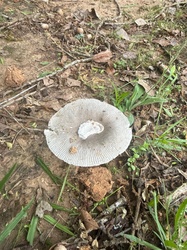
A Grisette announces itself by its proportions before its colour. It stands tall and thin for the size of its cap, so it looks slightly top-heavy, like a grey parasol on a wand. You are typically in deciduous or mixed woodland, on a path bank, a mossy verge or under birch and oak, sometimes in grass at the wood edge, and the mushroom is alone or in twos rather than in troops. The cap is grey, mouse-grey or occasionally with a faint brownish or ochre cast, and even from a couple of metres away you can often see that the rim is finely pleated, like the edge of a paper fan. That pleating and the absence of any skirt on the stem are the two things that set the identification going.
Reading the Cap
Caps are 5 to 9 cm across, sometimes to 11 cm. They start narrowly egg-shaped or bell-shaped, expand to convex and finally flatten, usually retaining a low broad umbo in the centre. The surface is smooth, matt to slightly greasy in wet weather, and either bare or carrying a single large, thin, white to grey patch of universal veil tissue near the middle. Because that patch is one sheet rather than many warts, and because it detaches easily, most caps you find are perfectly clean.
Now the important part. Hold the cap edge-on against the light. The outer quarter to third of the cap radius is deeply grooved, with sharp radial furrows that correspond to the gills beneath. This sulcate margin is strong and obvious, not a faint hint. The flesh in that zone is paper-thin, which is why the grooves form, and it also makes the cap fragile; specimens often arrive home with the rim split.
The Gills
Gills are white, sometimes with the faintest grey tint on the edge, crowded, broad in the middle and narrowing at both ends, and free from the stem. The gill edges look slightly floccose under a lens. Numerous short gills are interspersed. They stay white with age rather than turning cream, pink or brown. Because the cap is so thin, the gills detach cleanly from the flesh if you press them sideways with a fingertip, which is a small extra confirmation of the free attachment.
The Stipe
The stem is 8 to 18 cm tall and only 0.8 to 1.5 cm thick, tapering slightly upward, hollow or loosely stuffed, and distinctly brittle. Its surface is white to pale grey and is usually covered with fine greyish fibrils or scurf that may arrange itself into faint zigzag bands, giving a delicate watered-silk effect. There is no ring at any stage, and no ring zone either. If you see a skirt, a collapsed membranous collar or even a distinct fibrillose girdle part way up, you are not looking at a Grisette. The stem widens only gently at the very bottom, without forming a true bulb.
The Volva, and How to Get It Out
The base is the heart of the identification, and it is buried. Do not pull the mushroom; that will snap the stem and leave the crucial structure in the ground. Slide a knife or your fingers 5 to 8 cm into the soil, well clear of the stem, and lever the whole thing up with a plug of earth, then tease the soil away.
What you should find is a large, loose, membranous, bag-like sac, white or with faint grey to buff staining, wrapping the stem base and standing free of it as a collar with two or three lobes. It is thin, pliable, and feels like wet cloth. It is not attached to the stem except at the very bottom, and there is no swollen bulb inside it. That free saccate volva plus the total absence of a ring is the defining combination for the Grisette group.
Flesh and Colour Change
Cut the fruitbody lengthways. The flesh is white and thin, brittle in the stem, and stays white; there is no reddening, no yellowing, no bruising response even after ten or fifteen minutes. Larval tunnels are pale. The smell is faint and mushroomy to slightly earthy, without a strong potato or radish note.
Taking a Spore Print
Set the cap gills-down on dark paper under a cover for four to six hours; the thin flesh dries fast, so keep the humidity up. The print is pure white. Microscopically the spores are globose and smooth, and importantly they do not turn blue-grey in Melzer's reagent. That inamyloid reaction distinguishes the entire ringless grisette section from the ringed Amanitas, which are amyloid, and it is worth remembering if you ever have doubts about a battered specimen whose ring may have washed away.
Substrate, Partners and Season
The Grisette is ectomycorrhizal and forms partnerships with a wide range of trees, both broadleaved and coniferous: birch, oak, beech, hazel, willow, and pine or spruce in mixed stands. It tolerates a broad range of soils, from sandy heath to clay, and often appears in disturbed ground such as path edges, banks and open glades. Fruiting runs from late spring in warm regions but mainly from June to October, and single fruitbodies keep appearing through the season rather than flushing all at once. It always grows from soil, never on wood.
Separating It from Its Look-alikes
The other ringless Amanitas are the real work, and they are separated on colour and on the behaviour of the veil.
Amanita fulva, the Tawny Grisette, has the same architecture but is warm orange-brown to tawny, and its volva is usually stained rust or foxy brown on the inner surface. It leans strongly toward birch and damp acid ground.
Amanita crocea is larger and apricot to orange, with a stem covered in conspicuous orange-tinted zigzag scales and a persistent white sac.
Amanita ceciliae has a grey-brown cap loaded with irregular grey veil patches, and its volva is not a neat bag; it breaks up into grey bands and crumbly rings around the stem base, which is often the single quickest way to exclude it.
Among ringed species, Amanita phalloides also has a saccate volva but always carries a membranous ring, has a smooth, ungrooved cap margin, and shows greenish to olive tones with radial fibrils. Any mushroom with both a ring and a sac is outside the Grisette group.
Outside Amanita, Volvopluteus gloiocephalus grows in grass and disturbed soil with a sac at the base and no ring, but its cap is smooth and sticky rather than deeply grooved, and its gills turn salmon-pink as the spores mature, giving a pink print. Any pink flush in the gills settles it immediately.
Field Checklist
Grey cap with a strongly grooved outer margin and at most one large flat veil patch; free white gills; tall slender ringless stem with faint grey zigzag scurf; large loose white membranous sac at the base with no bulb inside; white unchanging flesh; white, inamyloid spore print; growing from soil with trees.
Common questions
How do I know I have a Grisette rather than another Amanita?
Which trees and soils does it favour?
Why do so many Grisettes look bare, with no patches on the cap?
When is the best time to look for it?
Full reference entry for Grisette
Cap and fruiting body, spore print colour, substrate, season, ecological role and the species most often confused with it.
Open the Grisette entry →