Identification guide
Half-free Morel Identification Guide
A field routine for Morchella punctipes, the early-spring morel whose pitted cap is attached halfway up the stalk and hangs free below like a short skirt. Built around the lengthwise slice test and the splits from Verpa and the true morels.
The setting and the season
Early spring, and you are in rich bottomland: a river floodplain, a creek terrace, a moist wooded slope with deep leaf litter and abundant spring wildflowers. The canopy is barely open. Tulip poplar, ash, elm, sycamore, cottonwood and old apple are the trees whose company matters. Morchella punctipes is typically among the first morels of the season in eastern North America, appearing as the ground warms and often overlapping with, or preceding, the black morels.
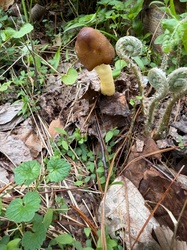
The first impression is a small, dark, pitted thimble on a surprisingly long pale stalk, standing in litter and mayapple. Early in its life the proportions look normal for a morel; later they become peculiar, because the stalk keeps elongating while the cap does not, and mature material can look like a small dark cap perched on top of a long white stem.
The cap
The cap is conical to bluntly conical, one and a half to four centimetres tall and rather narrow, seldom as broad as it is long. Its surface is a true morel surface: a network of raised ridges enclosing sunken pits. The pits tend to be elongated vertically and arranged in more or less parallel columns; the ridges are darker than the pits, running from tan or greyish-brown when young to dark brown or blackish with age, while the pit floors stay paler tan to olive-grey.
Ridges start pale and darken from the edges inward as the fruitbody ages, and in dried or older material the whole cap can look near-black. The lower edge of the cap is free and flares outwards slightly, forming a short skirt or curtain that hangs away from the stalk.
The defining lengthwise slice
This is the whole identification, and it takes two seconds. Slice the fruitbody vertically from the apex of the cap down through the base of the stalk and open it out like a book.
You should see three things. First, the interior is completely hollow — one continuous chamber running from the top of the cap to the bottom of the stalk, with no cottony filling, no pith and no internal chambers or folds. Second, the cap is fused to the stalk at a point roughly halfway up its own length, so that the upper half of the cap is attached and the lower half hangs free as a skirt. Third, that free skirt is short: it accounts for about half the cap's length, no more.
That middle attachment is the entire meaning of the name. A true morel is attached at the very bottom edge of the cap with no free skirt at all; a Verpa is attached only at the extreme apex, so the whole cap hangs free like a bell on a clapper. Half-free sits exactly between the two, and the sliced profile makes the geometry obvious in a way that no external inspection can.
The stipe
The stalk is white to cream, sometimes ageing yellowish or with a buff cast, cylindrical and often enlarging downwards. On young material it is short; on mature material it can reach ten to fifteen centimetres and dwarf the cap entirely, and it may become distinctly bloated or ridged and furrowed at the base.
The surface is the second useful character. It is granular-mealy, and under a hand lens the granules are darker specks scattered over the white ground — the dotted foot that the epithet punctipes refers to. The base often sits in a small hollow in the litter with white mycelial threads radiating from it. The stalk is hollow throughout, brittle, and breaks with a clean snap.
Flesh and colour change
The flesh is thin, whitish to pale tan, waxy-brittle and only a millimetre or two thick in the cap wall. It shows no colour change when cut, no bruising reaction and no fluid of any kind. There is no ring, no volva and no veil. The smell is faint and pleasantly earthy.
Spore deposit
As an ascomycete the fungus discharges its spores upwards and outwards from the pit surfaces, so a print is taken differently. Rest the cap on its side on dark paper inside a covered container, or suspend it above a glass slide, and leave it for several hours; a mature fruitbody brought into warm air will sometimes puff a visible cloud.
The deposit is cream to pale yellowish. Under the microscope the spores are large, smooth, ellipsoid and hyaline, roughly twenty-two to twenty-eight by fifteen to eighteen micrometres, without oil droplets, arranged eight to an ascus in a single row. Verpa bohemica is settled instantly by the same slide: its spores are enormous — around sixty to eighty micrometres long — and there are only two per ascus.
Substrate, ecology and season
Morels of this group are associated with disturbed, rich, moist soils in hardwood forest, and Morchella punctipes concentrates in floodplain and bottomland woods on alluvial soils. It is often found near dying or recently fallen trees and along the edges of old logging tracks and river terraces. Its ecology sits between litter saprotrophy and a root-associated phase, and fruiting is strongly triggered by soil temperature and spring rainfall.
Season is short: a few weeks in early to mid spring, earlier at low elevation and further south, and the fruiting window can close abruptly in a warm dry spell.
Separating it from the closest look-alikes
Verpa bohemica is the main confusion and shares the season, the habitat and the long pale stalk. Slice it: the cap is attached only at the very top, so it hangs entirely free like a skirt reaching the full length of the cap, and the stalk interior is stuffed with loose cottony fibres rather than being cleanly hollow. Its cap surface is also different — longitudinally wrinkled and folded, brain-like, rather than divided into true pits by a network of ridges.
Verpa conica has a smooth to slightly wrinkled thimble cap attached only at the apex, again with a stuffed stalk.
True morels such as Morchella americana and Morchella angusticeps have caps attached at their lower margin, with no free hanging skirt at all, and their caps are proportionally much larger relative to the stalk.
Morchella semilibera is the European counterpart with essentially the same architecture; it is separated by geography rather than by morphology, and the granular dotted stalk is more emphasised in the North American species.
Gyromitra species are ruled out at a glance: their caps are irregularly lobed, folded and brain-like or saddle-shaped rather than pitted, and a lengthwise cut shows a convoluted, chambered interior instead of a single hollow.
Old, weathered fruitbodies of any of these can be ambiguous externally, which is why the vertical cut is not optional. Make it on every candidate.
A field routine
Early spring bottomland hardwoods; small dark conical pitted cap on a long white granular stalk; slice lengthwise; confirm one continuous hollow, cap attached at its midpoint, free skirt about half the cap length; confirm granular dark specks on the stalk; cream deposit with eight-spored asci. Run that in order and Morchella punctipes separates cleanly from both Verpa and the true morels.
Common questions
What does 'half-free' actually mean, and how do I check it?
How do I separate it from Verpa bohemica?
What trees and soils should I be searching?
Why does the stalk look so long on some specimens?
Full reference entry for Half-free Morel
Cap and fruiting body, spore print colour, substrate, season, ecological role and the species most often confused with it.
Open the Half-free Morel entry →