Identification guide
Hare's Foot Inkcap Identification Guide
How to work through Coprinopsis lagopus in the field, from the woolly grey veil of the young fruitbody to the recurving, self-digesting cap of the adult, plus the fine points that separate it from other inkcaps.
The First Impression
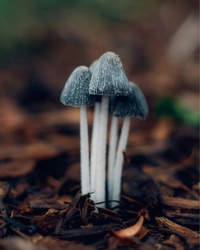
The usual setting is a bed of woodchip mulch in a park or garden, a heap of leaf litter behind a hedge, or a patch of rich, disturbed humus at a woodland edge. You arrive in the morning and find a scatter of slim grey mushrooms standing on stems that look far too long and thin for the caps they carry. Some are still tight cylinders furred all over with silvery-white wool; others are open and pleated like little grey parasols; the oldest have turned themselves inside out, their margins curled upward and their edges dissolving into a dark liquid line. Come back after lunch and half of them will have gone.
That compressed lifespan is the first identification cue and the main practical problem. Coprinopsis lagopus can go from an unopened woolly finger to a collapsed black smear inside twelve hours. If you want a clean identification you need to photograph and record more than one fruitbody at once, ideally a young, a middle-aged and an old one from the same troop, because no single stage shows every character.
Reading the Cap
Start with the youngest fruitbody in the group. At this stage the cap is a narrow cylinder or a tight ellipse, 1 to 2 cm tall, and it is completely clothed in a dense white to silvery-grey woolly covering. That covering is the universal veil, and its shaggy, hair-like texture is exactly what the common name records. Run a fingertip over it and it lifts away in loose flocks, leaving the grey cap surface underneath.
As the cap expands the veil cannot keep up. It splits into scattered fibrillose patches and hairs that thin out over the surface, greyest at the centre and sparsest near the margin, and it is often almost entirely lost by maturity so that an old cap looks bald and plain mouse-grey. Meanwhile the cap opens from cylindrical to conical to bell-shaped, and finally, in a movement rather few mushrooms perform, flattens and then turns its margin upward and outward. A mature cap can measure 2 to 4 cm across, occasionally more, and by then it is thin, deeply radially grooved or pleated to the centre and translucent enough to show the gill lines through it.
The surface itself is dry and never viscid. Colour runs from pale grey-brown at the disc to greyish and paler at the rim; there is no tawny or date-brown ground colour, and no glistening mica-like granules.
Gills, Stipe and Base
Underneath, the gills are crowded, narrow and free or very narrowly attached. In a young specimen they are white to pale grey. They darken quickly through grey to blackish, and then the process that defines the group begins: autodigestion. The gill edges liquefy from the margin inward, turning inky and dripping, and the cap dissolves along with them. In dry weather the digestion can be partial, leaving a shrivelled, blackened, upturned cap rather than a puddle, so absence of dripping ink does not rule the species out.
The stipe is disproportionately long, commonly 6 to 12 cm and sometimes more when the fruitbody has pushed up through deep mulch, but only 2 to 5 mm thick. It is white, fragile and hollow, and its surface is finely woolly or fibrillose from the same veil that covers the cap, becoming smoother and shinier with age. There is no ring and no ring zone. At the base look for a slight, gradual swelling and a small tuft of white downy mycelium binding chips or leaf fragments, but no sac-like volva and no rooting extension. Lift the whole thing with a trowel; the stipe snaps if you pull.
The flesh is almost nonexistent: a thin greyish layer in the cap, white and papery in the stipe wall, with no colour change on cutting. The whole fruitbody is so light that a mature one will bend under its own weight and hang.
Taking a Spore Print
A spore print here needs urgency. Take a freshly opened cap, before the margin has begun to liquefy, and set it gills-down on white paper or glass under a cup. Within thirty to sixty minutes you will have a deposit, and it will be jet black. If you leave the cap too long, the whole thing dissolves and you get a black smear rather than a readable print, which still tells you the colour but nothing about the pattern.
Under the microscope the spores are ellipsoid to slightly ovoid, dark brown to blackish in mass, roughly 11 to 14 micrometres long by 6 to 7.5 wide, smooth, and each has a distinct central germ pore. Veil elements from the cap surface are chains of thin-walled, elongated cells, which is what gives the covering its woolly rather than granular character.
Substrate, Season and Ecology
This is a saprotroph of rich organic matter. The classic substrates are wood-chip mulch and bark beds, garden compost, deep leaf litter, and nutrient-enriched soil in hedgerows and woodland margins. It responds explosively to fresh mulching, which is why municipal planting beds produce huge troops a few weeks after a top-dressing. Fruiting runs from late spring through to late autumn, with peaks after warm rain, and it can appear indoors in plant pots and greenhouses at any time of year.
Ecologically it is a rapid coloniser and a competitor for freshly available cellulose and lignin fragments, throwing up short-lived fruitbodies in enormous numbers rather than investing in long-lasting ones. The self-digesting cap is part of that strategy: by liquefying from the rim inward, the fungus exposes successive bands of spores to the air rather than trapping them between crowded gills.
Separating It From Look-alikes
Coprinopsis lagopides is the nearest relative and looks similar when young, but it is a fungus of burnt ground and old bonfire sites, tends to be greyer and less shaggy, and has broader, more rounded spores. If your collection is on a fire site, weigh this option heavily.
Coprinopsis cinerea is a compost and dung specialist with a browner, more felted cap covering and a stipe that is often slightly rooting; it also has a distinctly different, more granular veil.
Coprinopsis atramentaria is far more substantial, growing in dense tufts from buried wood, with a smooth to finely scaly greyish-tan cap, no woolly veil, and a much thicker stipe carrying a basal ring zone.
Coprinellus micaceus grows clustered on and around stumps, has a tawny to honey-brown cap covered when fresh in glistening mica-like granules, and never wears a shaggy white coat.
Parasola species, such as the pleated inkcaps of lawns, have thin, deeply pleated caps with no veil at all, gills that fade rather than fully liquefying, and a bare, polished stipe. If your specimen is completely hairless at every stage, look here.
Field Checklist
Dense white woolly veil on the young cylindrical cap; grey pleated cap that expands then recurves upward; free crowded gills darkening to black and self-digesting; long slim fragile hollow white stipe with fibrillose surface, no ring, no volva; jet-black spore print from smooth spores with a central germ pore; woodchip, compost or rich litter; fruitbodies gone within a day.
Common questions
Why does Hare's Foot Inkcap look so different from one hour to the next?
What substrates does Coprinopsis lagopus prefer?
How do I separate it from Coprinellus micaceus?
What is the purpose of the cap dissolving?
Full reference entry for Hare's Foot Inkcap
Cap and fruiting body, spore print colour, substrate, season, ecological role and the species most often confused with it.
Open the Hare's Foot Inkcap entry →