Identification guide
Horse Mushroom Identification Guide
A step-by-step field routine for Agaricus arvensis: the big white grassland mushroom with a cogwheel ring, slow yellow bruising, an aniseed odour and a chocolate-brown spore print, plus how to sort it from its white relatives.
The Setting and the First Look
Horse Mushroom is a fungus of open ground. You find it in old pasture, meadow, roadside verge, sports field margin, downland and grassy churchyard, very often near stables, paddocks or long-established grazing, and often in wide arcs or rings that reappear in the same place year after year.
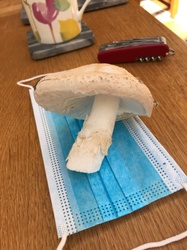
The first impression is of size and whiteness: a solid, clean, cream-white dome standing well clear of the turf, 8 to 20 cm across when fully open, with a stout stem and a heavy, drooping ring. Young buttons are almost spherical, tight and firm, and can be mistaken for golf balls in mown grass. In a good year they come up in dozens.
Before touching anything, note whether the mushroom is truly growing from grass and soil, whether there is any trace of a sac or cup at ground level, and whether there is litter or buried wood nearby. Those observations set up everything that follows.
Reading the Cap
The cap begins hemispherical, becomes broadly convex and finally almost flat, sometimes with a slightly depressed centre in very old specimens. The surface is dry and silky-smooth to very finely fibrillose, and it splits into faint radiating fibres or fine scales only with age or in dry weather.
Colour is white to cream, ageing to a warm ochre or pale buff, particularly at the centre. Rub or press a fingertip firmly on the cap surface and wait. In this species the tissue turns slowly and gently yellow: a soft, warm chrome or lemon tint that develops over seconds to a minute, and then fades toward ochre. Speed and intensity matter enormously here, and you should train yourself to time the reaction.
The cap margin often carries hanging fragments of the veil when the mushroom first opens, and it may extend a millimetre or two beyond the gills as a sterile rim.
Reading the Gills
Look underneath and note two things: attachment and colour sequence. The gills are free, stopping short of the stem and leaving a narrow gutter between the gill ends and the stipe apex. They are crowded, narrow and rather deep, with several tiers of shorter intermediate gills.
Colour changes progressively as the mushroom matures, and knowing the sequence prevents a great deal of confusion. In the button stage they are whitish to pale greyish-white. As the veil breaks they pass to a soft greyish-pink or dull flesh-pink. With maturity they darken through chocolate brown to a deep purplish or blackish-brown. That is a genuine three-stage progression, and the pale greyish first stage is characteristic of this species and its close allies rather than the bright clean pink of some relatives.
Stipe, Ring and Base
The stipe is 6 to 15 cm long and 1.5 to 3 cm thick, cylindrical, often tapering slightly upward, with a base that is somewhat swollen or club-shaped but never enclosed in a bag or sac. It is white, smooth above the ring and slightly fibrous or faintly scaly below, and it is stuffed or hollowing with age.
The ring is the best structural character on the whole mushroom. It is large, membranous, pendulous and clearly two-layered. Lift the skirt and look at its underside: it is broken into a ring of radiating, wedge-shaped patches or thickened segments arranged like the teeth of a cogwheel, or the rays of a star. This cogwheel ring is one of the most reliable field marks in the genus and is worth checking on every white grassland mushroom you meet.
Dig, do not pull. Excavating the base intact lets you check for the absence of a volva and lets you test the base flesh, which is where the most diagnostic colour reactions occur.
Flesh, Colour Change and Odour
Cut the mushroom vertically through cap and stipe. The flesh is thick, firm and white. Watch the cut face: in this species it stains a slow, faint yellowish tone in the cap flesh and shows little or no dramatic reaction in the stipe base, certainly not an instant, saturated chrome-yellow flush in the very bottom of the stem.
Then smell the cut surface. A clear odour of aniseed or bitter almonds should rise from it. This is a strong, pleasant, unmistakable scent, most obvious in fresh material and in the cap flesh. Combined with the cogwheel ring, it does most of the identification work.
Taking a Spore Print
Cut the stipe flush with the gills and set the cap gill-side down on white paper, since dark spores show best on a pale ground here. Cover it and leave it two to four hours. Horse Mushroom yields a dark chocolate-brown to purple-brown deposit. Under the microscope the spores are smooth, thick-walled, ellipsoid and around 7 to 9 by 4.5 to 6 micrometres, with a small apical pore.
A dark brown print immediately eliminates every white-spored grassland agaric, which is the most important single piece of laboratory-free evidence you can gather.
Substrate and Season
This is a soil-dwelling decomposer of grassland: pasture, meadow, verge, lawn, dune grassland and downland, thriving on nutrient-enriched ground near livestock. It does not grow on wood, and while it can occur at the edges of woodland it is not a species of deep shade or leaf litter.
Fruiting runs from early summer through to late autumn, with the heaviest flushes following warm rain. Rings and arcs are common, and mature rings can be several metres across.
Separating the Look-Alikes
Yellow Stainer (Agaricus xanthodermus) is the critical separation. Its cap is often squarish or blocky when young rather than rounded, its flesh flushes an intense, immediate chrome-yellow when the stipe base is cut or scratched, and the odour is unpleasantly phenolic or ink-like rather than aniseed. The bruising fades to brown but the initial flash is bright and fast.
Field Mushroom (Agaricus campestris) is smaller, has a simple, thin, single-layered ring without the cogwheel underside, gills that go through a vivid bright pink stage, and no aniseed odour.
Wood Mushroom (Agaricus sylvicola) shares the aniseed odour and the cogwheel ring but is more slender, has a bulbous stem base and grows in woodland among leaf litter rather than in open turf.
Macro Mushroom (Agaricus urinascens) is even larger and more massive, with a cap that cracks into coarse scales, thicker flesh, and an ammoniacal odour developing as it ages.
White Dapperling (Leucoagaricus leucothites) looks superficially similar in grassland but its gills stay white to faintly pinkish and never turn chocolate-brown, and its spore print is white to pale pinkish.
White Amanita species are separated by their persistently white gills, white spore print, and a sac-like volva or a rimmed bulb at the stem base, which is exactly why you dig the base out intact rather than snapping the stem.
Field Checklist
Large white cap in open grassland; free gills passing from greyish-white to greyish-pink to chocolate-brown; large pendulous double ring with a cogwheel pattern beneath; slow gentle yellowing of the cap surface; aniseed odour in cut flesh; no volva, no sac; dark chocolate-brown spore print; summer to late autumn.
Common questions
What is the cogwheel ring and why does it matter?
How should the yellow bruising behave?
What spore print does it give?
Where does it grow?
Full reference entry for Horse Mushroom
Cap and fruiting body, spore print colour, substrate, season, ecological role and the species most often confused with it.
Open the Horse Mushroom entry →