Identification guide
Parasol Mushroom Identification Guide
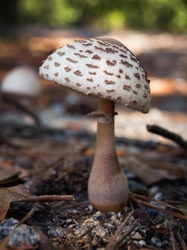
A tall grassland Macrolepiota with a shaggy scaled cap, a dark central umbo, a snakeskin-banded stipe and a thick double ring that slides freely up and down. This guide works through the characters in the order you would actually check them in the field.
Standing in the Right Place
Most encounters with this species start at a distance rather than at your feet. You are usually looking across rough pasture, a wide roadside verge, a grassy woodland ride, a dune slack or the scruffy margin where a hedge meets a field, and something pale and tall is standing clear of the sward like a small umbrella on a stick. Sheer stature is the first clue: a fully expanded fruitbody can stand twenty five to forty centimetres high, which is taller than nearly anything else growing in short grass, and a mature cap can be the width of a dinner plate. They rarely appear singly. Look around and you will often find a scattered troop, sometimes arranged in an arc or a broken ring, with younger drumstick-shaped individuals still closed among the open ones. The same patch of ground tends to produce fruitbodies year after year, so a spot worth remembering is worth revisiting.
Reading the Cap
Work from the youngest specimen you can find, because the cap tells its story in stages. A young fruitbody is closed, egg-shaped or shaped like a drumstick, with the cap surface still an unbroken dark brown skin over the top of a pale stalk. As the cap expands, that dark skin cannot keep pace with the swelling flesh beneath and tears apart, leaving coarse, shaggy, roughly concentric scales of dark brown on a pale buff or greyish ground. The centre never tears, so a mature cap keeps a smooth, distinctly darker disc at its middle, usually raised into a low broad umbo. At full expansion the cap is flat or slightly saucer-shaped, dry to the touch, never slimy or greasy, and the margin often carries a fringe of torn veil tissue. Push a fingernail under one of the scales: they lift as flaps of torn cuticle that are continuous with the pale surface below, which is quite different from the loose warty patches of veil tissue that sit on the caps of some other pale, large fungi.
The Gills and Their Collar
Turn the cap over. The gills are free, and it is worth confirming this rather than assuming it: there is an obvious clear channel between the inner ends of the gills and the top of the stipe. They are crowded, soft, fairly broad, and white to cream, sometimes developing brownish spotting or a dull edge with age. Run a fingertip along a gill edge and you will often feel a slight fringe. If you twist the stipe out of the cap, look at the point where the gills converge; in this species the inner ends are frequently attached to a cartilaginous collar, a raised ring of tissue around the stem socket, which pulls away cleanly with the cap. That collar, when present, is a helpful supporting character.
Stipe, Ring and Base
The stipe is the single most useful structure on the whole fruitbody. It is very long and slender in proportion to the cap, tapers gently upwards, and is hollow or loosely stuffed with fibres so that it snaps rather than bends. It arises from a distinctly swollen, bulbous base, but that base is a simple bulb sitting in the soil with mycelial threads clinging to it, not a sac or a cup, and there is no membranous bag enclosing it. Along the length of the stipe you should see the diagnostic banding: fine zigzag chevrons of brown on a pale ground, usually described as snakeskin, produced as the stipe surface cracks during elongation. The ring is thick, felty and double-edged, brown on the underside and paler above, and it is free-moving. Slide it gently with a finger and it will travel up and down the stipe. That combination of snakeskin banding plus a movable double ring is close to conclusive for the genus.
Flesh and Colour Change
Slice the fruitbody from cap centre to stipe base with a knife and watch the cut surfaces for several minutes. The cap flesh is white and soft, thin except over the umbo; the stipe flesh is fibrous and tough. In this species the cut surfaces are essentially unchanging, at most developing a faint pinkish or pale brownish flush low in the stipe after some minutes. There is no vivid reddening, no orange or saffron flush, and no yellowing. The odour is mild and mushroomy, sometimes faintly nutty.
Taking a Spore Print
Cut the stipe off flush with the cap and lay the cap gills-down on a sheet that is half white paper and half dark card, because the print here is pale and easily missed on white alone. Cover with an upturned bowl to hold humidity and leave it two to six hours, longer if the cap is old and dry. A good print is white to very pale cream. A print with any green cast points at a different genus altogether, and a chocolate or brown print rules the species out entirely.
Substrate and Season
This is a saprotroph of grassland soil and litter, drawing its nutrients from decaying organic matter rather than partnering with tree roots. Look on unimproved pasture, verges, commons, dunes, park grassland, clearings, woodland edges and occasionally in the litter of conifer plantations. The season runs from mid or late summer through autumn, peaking after a warm spell followed by heavy rain. Fruitbodies pass from closed drumstick to fully open parasol in a day or two, so a site is worth checking repeatedly.
Separating the Look-alikes on Morphology
The shaggy parasols in the genus Chlorophyllum are the commonest confusion. They are stockier, with a shorter stipe that lacks snakeskin banding entirely, coarser and more upturned cap scales, an abruptly marginate bulb at the base, and, decisively, flesh that flushes orange, saffron or dull red within a minute or two of being cut. A related warm-climate species produces a distinctly green spore print, which is why the print is always worth taking. The smaller Macrolepiota relatives, such as the one with a sharply nipple-like umbo, have finer, more sparse cap scales, a smaller stature and much weaker stipe banding. Pale Amanita species can suggest a parasol from a distance, but they have a membranous sac or a collared rim at the stipe base, a smooth or patch-decorated rather than torn-scaly cap, a fixed ring that cannot be slid, and no snakeskin. Small Lepiota species share the scaly cap and free white gills but are a fraction of the size, with caps measured in centimetres, and lack the movable double ring.
A Field Sequence
Height above the grass, torn concentric scales over a pale ground with an intact dark umbo, free white gills often on a collar, a tall hollow snakeskin-banded stipe from a bulb with no sac, a thick movable double ring, unchanging white flesh and a white spore print. If all eight hold together on the same fruitbody, the identification is secure.
Common questions
What single character most quickly separates a true parasol from a shaggy parasol?
Why is the ring described as movable, and how do I test it?
Where should I be looking for this species?
What is its ecological role?
Full reference entry for Parasol Mushroom
Cap and fruiting body, spore print colour, substrate, season, ecological role and the species most often confused with it.
Open the Parasol Mushroom entry →