Identification guide
Red-belted Conk Identification Guide
How to work through Fomitopsis pinicola on a fallen conifer log: the resinous crust, the orange-red band, the cream pore surface and the stratified tube layers. Includes the polypores it is routinely mistaken for.
The Setting and the First Glance
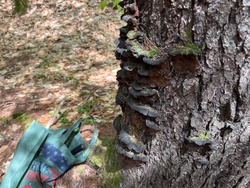
You are walking a conifer forest - spruce, fir, pine, hemlock - and there is a large fallen trunk beside the trail, bark sloughing, bare wood grey. Growing straight out of its flank is a hard shelf, sometimes hoof-shaped, sometimes a flat bracket, big enough to sit on if it is old. From a few metres away the diagnostic feature is already visible as a stripe: a band of orange-red or lacquer-red running parallel to the growing edge, with a paler cream to white rim outside it and darker, duller crust behind it. That banded gradient - dark inside, red belt, pale margin - is the whole species in one look, and it is the reason for the name.
Reading the Upper Surface
Get your hand on it. The crust is hard, smooth and faintly resinous rather than felty or hairy, and on an old specimen it is concentrically furrowed with growth zones, like contour lines. Colour grades outward through the fruit body's life history: the oldest tissue near the attachment is greyish-black to dull dark brown, sometimes cracked; then a broad zone of brown to reddish-brown; then the red belt; then a soft cream, buff or pure white active margin. On young conks the whole thing may be little more than a white knob with a reddish flush, and on very old ones the red can be almost overrun by dark crust, so look right at the edge.
The shape is variable and depends on how the log lies. On a vertical trunk it forms brackets with a broad attachment; on a leaning or rolled log it can be strongly ungulate, like a horse's hoof, sometimes thicker than it is wide. Sizes of 5-30 cm across and 3-15 cm thick are ordinary, and the margin is blunt and rounded, not thin and sharp.
The Pore Surface
Turn the log or crouch to look underneath. The pore surface is flat to slightly convex, white to cream or pale straw, and it should look finely and evenly stippled. Press a fingernail into it: it bruises to a dull yellowish or pale brownish stain, but slowly and mildly, not instantly. The pores themselves are small and round to slightly angular, roughly four to six per millimetre, so individual holes are just at the edge of what an unaided eye can resolve - a hand lens turns them into a neat honeycomb.
Cutting It Open
This is the step that settles the identification, and it needs a strong knife or a saw because the tissue is hard. Cut a vertical wedge from margin to attachment. Two things should be visible. First, the context - the sterile flesh between crust and tubes - is pale wood-colour to pale buff, corky-tough and fibrous, and it stays pale rather than going cinnamon or deep brown. Second, the tube layer is stratified: because the conk is perennial and adds a new tube layer each growing season, you see several stacked bands of tubes, each a few millimetres deep, sometimes separated by thin plates of pale context. Counting those layers gives a rough age.
The crust deserves its own test. It is resinous, and on the cut surface it often looks like a thin varnish line. Old field practice is to touch it with a flame, whereupon the crust melts and beads rather than merely charring, which is a behaviour few other brackets share.
Spore Print and Season
Spores are shed from the pore surface, so a print is easy if you can get the pore face horizontal. Set a fragment pore-side down on dark paper - the deposit is white to very pale cream and shows up poorly on white - cover it, and give it several hours to overnight. Under the microscope the spores are small, smooth, thin-walled and cylindric to narrowly ellipsoid, roughly 6-8 by 3.5-4.5 micrometres, without any pore or ornament.
Because the fruit body is perennial, it is present in every month of the year, which is itself an identification clue: a hard, zoned bracket found on a snowy log in midwinter is far more likely to be a perennial polypore than an annual one. New growth and the freshest white margins appear through the warm season, and heavy spore release comes in autumn, when the pore surface may look faintly frosted.
Substrate and Ecology
Look at what it is growing on. This species is overwhelmingly a conifer decayer, working dead trunks, stumps, large fallen branches and standing snags, though it will take birch and other hardwoods where conifers are scarce. It causes a brown cubical rot: the decayed wood turns reddish-brown, loses its stringiness, and breaks into rectangular blocks that crumble between the fingers. If you can pull a handful of brown crumbly cubes out of the log beneath the conk, that is a strong corroboration. It also colonises wounds on living trees and can persist for years on the same log, sometimes producing several conks in a vertical row.
Separating the Look-alikes
Artist's bracket. Superficially similar shelving habit, but the pore surface bruises brown instantly and distinctly when scratched - enough that people draw on it - the crust is dull, dry and not resinous, and the context is a soft brown, not pale. Most decisively, its spore deposit is brown, and a mature specimen usually coats its own upper surface with a cocoa-coloured dust.
Tinder conk. Also hoof-shaped and perennial, but it is grey to greyish-brown throughout with no red belt, its crust is hard and dry rather than resinous, its context is a soft, felty, tawny-brown fibrous mass, and it is a birch and beech specialist.
Resinous polypore. Confusingly similar name and a reddish-brown, sometimes exuding surface, but it is annual, soft and watery when fresh, with a velvety upper surface, and it collapses into a thin blackish crust rather than persisting as a hard perennial hoof.
Other red-belted segregates. Several closely related brackets differ in fine details rather than in gross form; regionally, the pale-context, resinous-crusted, conifer-inhabiting brown-rot bracket with a red belt is the group you are in, and separating within it relies on host and spore measurements rather than field appearance.
Bracket-forming crust fungi and thin annual shelves. Anything with a papery, flexible fruit body, a sharp margin, or a single tube layer is not this species. The stratified tubes plus corky-hard texture rule out most annuals immediately.
Field Checklist
Hard perennial bracket on conifer wood; concentrically zoned resinous crust with a red-orange belt inside a pale margin; white to cream pore surface with tiny round pores; pale corky context; layered tubes in section; white spores; brown cubical rot in the log. That is the full set.
Common questions
Does the red belt always show?
How do I tell it from the artist's bracket?
What wood does it grow on and what does it do to it?
Can I estimate its age?
Full reference entry for Red-belted Conk
Cap and fruiting body, spore print colour, substrate, season, ecological role and the species most often confused with it.
Open the Red-belted Conk entry →