Identification guide
Sulphur Tuft Identification Guide
A practical walk-through of Hypholoma fasciculare: tight clusters on dead wood, sulphur caps with tawny centres, gills that pass through green, and a dark purple-brown spore print.
The First Impression
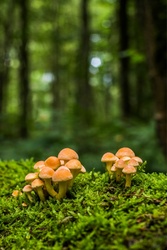
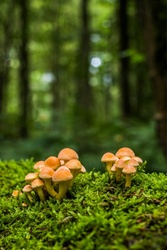
Sulphur Tuft is one of the first woodland fungi most people learn to recognise on sight, and once you know the gestalt you can name it from several metres away. The scene is almost always the same: a rotting stump, a fallen trunk or a buried root in damp woodland, carrying a dense, crowded tuft of small to medium mushrooms with bright sulphur-yellow caps that flush tawny or orange in the middle. The caps in a single clump face outward at every angle, the stipes are curved and fused at the point of attachment, and there may be several clumps marching along the same log.
The colour is the hook, but the growth habit is the diagnosis: fasciculate, meaning many fruitbodies rising from a common base on wood, not a scattered troop on soil. Note that the wood may be invisible. Clusters appearing to grow in grass or leaf litter are usually attached to a buried root or a stump that has rotted below the surface, so probe gently before deciding a collection is terrestrial.
Reading the Cap
Individual caps are 2–6 cm across, hemispherical or bell-shaped at first, then convex and finally almost flat, often with a slight broad umbo. The surface is dry, smooth and matt to faintly silky — never viscid, never scaly. Colour is the key: a clear sulphur-yellow toward the margin grading into a warmer tawny, orange-brown or brick tone over the disc. Older caps darken overall and can look ochre-tan.
Look at the cap edge on a young specimen with a lens. There are usually a few fine, pale, cobwebby veil remnants hanging from the margin, sometimes with dark spore dust caught in them. These fragments are the remains of a partial veil and they help distinguish the genus from smooth-margined lookalikes.
The Gills — the Colour Sequence
This is where Sulphur Tuft is most instructive, because the gills change colour predictably as the fruitbody matures, and knowing the sequence lets you age a specimen:
- Young — crowded, narrow, adnate, bright sulphur-yellow, matching the cap margin
- Intermediate — a distinct olive to yellow-green tint develops, which is unusual among woodland agarics and very informative
- Mature — the spores darken the surface to smoky purple-brown, though a greenish or yellowish tone often lingers at the gill edge
That greenish middle stage is the single character most often used to split Sulphur Tuft from its two commonest relatives. The gills are crowded, thin and narrowly attached, never decurrent and never truly free.
Stipe, Base and Flesh
The stipe is 4–10 cm long and only 0.4–1 cm thick, slender, often strongly curved or sinuous because the fruitbodies compete for light within the cluster, and hollow with age. It is sulphur-yellow at the apex and grades to rusty-brown or orange-brown toward the base. The surface carries fine silky longitudinal fibrils.
There is no true ring, but on many specimens a faint fibrillose ring zone shows as a darker band a little above the middle, coloured by falling spores. At the base, several stipes converge into a common fused mass attached directly to the wood; there is no volva, no bulb and no rooting pseudorhiza in the usual sense, though a short tapering extension into the substrate is common.
Split a fruitbody lengthwise. The flesh is thin, pliant and yellow throughout, a little browner in the stipe base, and it does not change colour on exposure. The odour is weak and unremarkable — mild, slightly earthy or fungal.
Taking a Spore Print
Because the mature gill colour is the diagnostic feature, a print is worth the wait. Cut a fully expanded cap free and place it gills-down on white paper, cover, and leave for two to four hours; heavy droppers are done in one. The deposit is dark purple-brown to chocolate-purple, best judged by scraping the powder into a small heap and viewing it against white in good daylight. Under a microscope the spores are smooth, ellipsoid, about 6–8 × 4–4.5 µm, with a small germ pore.
That print colour is decisive: it separates Sulphur Tuft cleanly from the rust-brown-spored Gymnopilus and Pholiota and from the white-spored Armillaria, all of which can form yellowish clusters on wood.
Substrate and Season
Hypholoma fasciculare is a wood-rotting saprotroph with an exceptionally wide substrate range: stumps, fallen trunks, buried roots and sawn timber of both broadleaves and conifers. It is a vigorous early coloniser and often forms long-lived colonies that refruit on the same stump for years. Fruiting peaks from late summer to late autumn but scattered clusters appear in almost any mild month, making it one of the fungi you can find nearly year-round in temperate woodland. Damp, shaded woodland, plantation edges, parkland and gardens with old stumps all qualify.
Separating the Look-alikes
- Conifer Tuft (Hypholoma capnoides) — the closest match in shape and habit, but the gills go from whitish to grey or smoky-grey, never green, and the cap is a paler yellow-tan with less orange in the centre. Almost always on conifer wood.
- Brick Tuft (Hypholoma lateritium) — larger and stouter, with a distinctly brick-red to rusty-orange cap centre and a pale, almost whitish margin often hung with veil fibres; gills whitish then greyish-olive to purple-brown.
- Honey Fungus (Armillaria spp.) — clustered on wood but with a persistent membranous ring, darker fibrillose scales on a honey-brown cap, gills that stay whitish to pale flesh, and a white spore print.
- Spectacular Rustgill (Gymnopilus junonius) — much bigger and burlier, tawny-orange, with a ring, and a rust-brown spore print that dusts the ring and the surrounding wood.
- Scalycaps (Pholiota spp.) — usually viscid or conspicuously scaly caps, clustered on wood, and again a rust-brown print.
- Sheathed Woodtuft (Kuehneromyces mutabilis) — two-toned hygrophanous cap drying from the centre outward, a distinct ring, scaly stipe below the ring, and a cinnamon-brown print.
Field Checklist
Dense fused clusters on wood; sulphur cap with tawny disc; crowded gills passing yellow to green to purple-brown; slender curved yellow-to-rusty stipe; ring zone but no true ring; yellow unchanging flesh; dark purple-brown spore print.
Common questions
What makes the gills of Sulphur Tuft distinctive?
It looks like it is growing in the ground — is that possible?
What spore print colour should I expect?
What wood does it grow on and when does it fruit?
Full reference entry for Sulphur Tuft
Cap and fruiting body, spore print colour, substrate, season, ecological role and the species most often confused with it.
Open the Sulphur Tuft entry →