Identification guide
White Coral Jelly Identification Guide
Recognising the frilled translucent white rosettes of Tremella fuciformis on humid hardwood branches, including the black host fungus that confirms the identification.
The Setting and the First Glance
Warm, humid broadleaved forest after heavy rain. The species is at home across subtropical and tropical Asia, Australasia and the Americas, and it fruits during the wet season on dead hardwood branches lying in leaf litter or still hanging in the canopy. Thin branches of 2-8 cm diameter are the usual substrate.
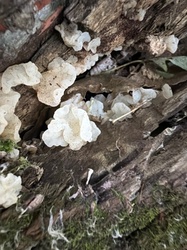
What stops you is something that does not look like a fungus at all: a white, glistening, translucent rosette perched on a stick, resembling a crumpled flower, a piece of pale lettuce, or set gelatine poured over bark. It is also known as snow fungus, and the name captures the look on a dark wet branch.
Reading the Fruit Body
There is no cap, gill layer or stipe here, so the read is structural.
Size and outline. A well-grown fruit body is 3-10 cm across and forms a rosette of many thin lobes radiating from a single small attachment point where the fungus emerges from a crack in the bark.
Lobes. This is the key architectural character. The lobes are thin, roughly a millimetre thick, broad, leaf-like or petal-like, and they stand free of the branch rather than lying flat against it. Their margins are wavy, crisped and often themselves further lobed, so the whole thing has a frilled, ruffled outline.
Surface and colour. Smooth, slippery and shining, with the fertile layer covering both faces of every lobe. Colour is white to ivory, sometimes very faintly yellowish, and the thinner lobes are semi-transparent enough that you can see bark through them. Old material dulls to dingy cream.
Response to moisture. In dry conditions the fruit body shrinks to a hard, horny, yellowish-white crust only a few millimetres thick, clinging to the bark and easy to walk past. Wet it, or wait for rain, and it swells back to full size within an hour or two. That rehydration behaviour is a reliable confirmation you can perform in the field with a water bottle.
Cut and Feel
Pinch a lobe. It is gelatinous but elastic and slippery, and it resists then splits cleanly when torn. Cut through the base and the section is uniform: no firm core, no embedded granules, no distinct outer skin or inner layer. There is no colour change on cutting and no liquid released beyond water.
Taking and Reading a Spore Print
Jelly fungi print poorly unless humidity is maintained. Detach a lobe, set it on a glass slide or a piece of dark paper, and enclose it in a covered container overnight.
The print is white and usually thin. The microscopic characters are the ones that settle the genus. Spores are broadly ellipsoid to nearly spherical, smooth, colourless, roughly 6-9 by 5-7 micrometres. The basidia are globose and divided lengthwise into four cells by cruciate septa. Those cross-partitioned basidia are the signature of Tremella and the wider Tremellales, and they immediately distinguish this fungus from the ascomycete jellies, which produce spores in sacs instead.
The Ecological Test That Settles It
Tremella fuciformis does not digest wood. It is a mycoparasite, drawing its carbon from the mycelium of an ascomycete living in the same branch, usually Annulohypoxylon archeri or a close relative in the Hypoxylaceae.
That fact converts into a field test. Once you have found the white jelly, scan the same branch within twenty to fifty centimetres of it. You should find the host fungus as a black or dark grey-brown crusty stroma on the bark, often as small hard hemispherical cushions with a pimpled surface. Where a frilly white jelly and a black pyrenomycete crust share a stick, the identification is far more secure than morphology alone could make it, and the absence of any such host should make you look harder at the alternatives.
Substrate and Season
Dead attached and recently fallen hardwood branches, in humid forest, secondary woodland and shaded plantation edges. Fruiting is tied to rainfall rather than to a calendar month: in wet tropical climates it can appear almost continuously, and at the cooler margins of its range it is a late summer and autumn fungus that follows heavy rain.
Separating It from Look-alikes on Morphology Alone
Tremella mesenterica and Tremella aurantia have the same gelatinous, lobed, branch-dwelling architecture but are bright yellow to orange, so colour alone divides them at ten paces.
Phaeotremella frondosa, formerly Tremella foliacea, is the closest structural match: the same rosette of thin wavy lobes, but in brown, reddish-brown or amber rather than white.
Exidia thuretiana is white and gelatinous, but its fruit bodies are low, blob-like cushions glued broadly to the bark surface with folded upper faces, not thin free lobes standing away from the branch. It is also a cold-season fungus of northern temperate woodland.
Ductifera pululahuana is white and gelatinous but forms discrete rounded pustules and cushions rather than a frilled rosette.
Sparassis species build a much larger ruffled cauliflower-shaped mass, but the flesh is firm and elastic rather than gelatinous and translucent, and they grow at the bases and roots of trees rather than out on branches.
Auricularia species are ear or cup shaped, brownish, tougher, and finely velvety-hairy on the outer surface.
Various small Tremella species parasitise other fungi and can look similar in miniature, so noting the host is worth the extra minute.
White slime moulds are opaque and chalky, do not wobble, and mature into dry powdery spore masses rather than shrinking to a translucent crust.
A Practical Field Sequence
Confirm a dead hardwood branch in humid conditions. Check for thin, free, wavy, translucent white lobes radiating from a single point, rather than flat cushions. Test the texture: gelatinous and elastic, uniform in section. Search the same branch for a black crusty pyrenomycete stroma. Print a lobe overnight in a humid box and confirm white. If a microscope is available, look for the cruciate septate basidia that place it in Tremella.
Common questions
What shape characters define Tremella fuciformis?
Where does it grow?
Why should I look for a black crust on the same branch?
How do I separate it from other white jelly fungi?
Full reference entry for White Coral Jelly | Tremella fuciformis
Cap and fruiting body, spore print colour, substrate, season, ecological role and the species most often confused with it.
Open the White Coral Jelly | Tremella fuciformis entry →