Identification guide
Wrinkled Fieldcap Identification Guide
A practical walk-through for identifying Agrocybe rivulosa on garden and park woodchip: the cracked-mud cap wrinkling, the ringed stem, dark brown gills and the ways to rule out its Agrocybe and Stropharia neighbours.
The Setting and the First Impression
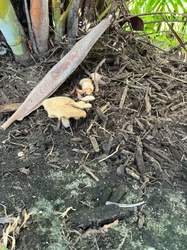
You will almost certainly meet this one on mulch. A freshly chipped border in a park, a woodchip path through a new planting, a heap of arborist chippings by a car park: within weeks of the chip going down, troops of pale cream to buff mushrooms push through, sometimes dozens at a time, sometimes so densely that caps are forced against one another and grow lopsided. From a few paces the impression is of a firm, dry, pale toadstool with a proper ring on the stem, sitting on wood chips rather than grass. Get closer and the cap surface is the giveaway: instead of being smooth it is crazed with a network of raised veins and shallow channels, like drying mud or a wrinkled brow.
Working Through the Cap
Start with size and shape. Caps run from about four to eleven centimetres, hemispherical and tight when young, then broadly convex, finally flattening out, sometimes with a low broad hump. Colour is pale: cream, pale ochre, buff, drying to nearly white at the margin while the centre keeps a warmer tan. The surface is dry and matte, never slimy.
Now examine the wrinkling properly, because it is the character the name is built on. The lines are not cracks through the flesh but folds and ridges in the cuticle itself, strongest over the disc and radiating outward, and they deepen as the cap expands and dries. Young buttons can be almost smooth, so if you only find buttons, look for older caps in the same troop before you commit. The margin is often slightly incurved when young and may carry a few hanging scraps of veil tissue.
Gills, Stem and Base
Turn the cap over. The gills are crowded, moderately broad and adnate to narrowly attached, and they change colour dramatically as spores mature: pale clay or greyish at first, then dull brown, and finally a deep cocoa to almost blackish brown, usually with a paler, finely fringed edge that shows under a lens. That progression from pale to dark brown, with no purple tone in it, matters for the look-alikes.
The stem is five to twelve centimetres long, whitish to pale cream, firm, fibrous and often longitudinally lined. Its most useful feature is the ring: a well-formed, membranous, hanging collar set high on the stem, sometimes with a double edge or a grooved upper face, and very often stained rusty brown where falling spores have collected on it. That spore-stained skirt is one of the fastest confirmations in the field. Dig, do not pull. The base is slightly swollen, roots down among the chips and carries conspicuous white mycelial cords which bind wood fragments into a solid plug.
Flesh and Colour Change
Slice a whole fruit body from cap to base. The flesh is white to very pale cream, firm and thick over the disc, thin towards the margin, and the stem flesh is fibrous and can be hollowing in older specimens. Nothing changes colour. There is no reddening, no blueing, no latex, and bruised surfaces stay pale apart from slow, dull brownish handling marks on the stem. A stable white interior beneath a wrinkled pale cap and above a ringed stem is exactly what you expect.
Taking a Spore Print
Cut a mature cap, one that has flattened and whose gills have already gone dark, and set it gills down on white paper under a cup for two to four hours. This species drops abundantly and quickly. The print is a rich dark brown, often described as tobacco brown, with no violet or purple cast. Do the print on white paper rather than black, because separating dark brown from purple-brown is the single most valuable test in this habitat. Under a microscope the spores are smooth, ellipsoid, thick-walled and have an obvious truncate germ pore at one end.
Substrate, Season and Spread
The substrate is close to obligate in practice: fresh to moderately weathered hardwood chip and bark mulch. Garden borders, municipal plantings, path surfacing, landscaped verges and chip heaps are the places to search, and the fungus follows the mulch rather than the trees. It is saprotrophic, breaking down the lignin-rich chip, and it typically colonises a load of mulch in its first year or two, fruiting heavily and then fading as the chip rots down and other fungi take over.
The season is long, from late spring through summer and into autumn, with the biggest flushes after warm rain. This is a species that has expanded its European range very rapidly in recent decades, carried around by the movement of chipped wood, so its presence in a new district is more about landscaping activity than about local woodland.
Separating the Look-alikes
Spring fieldcap, Agrocybe praecox, is the nearest relative and shares the pale cap, brown spores and ring. It fruits earlier, typically spring into early summer, tends to be smaller and more slender, its cap is smooth or at most finely cracked rather than boldly wrinkled, and its ring is thinner and often collapses onto the stem. Agrocybe putaminum also occurs on chip but has no ring at all and a warmer ochre-brown cap. Agrocybe dura is a grassland fungus whose whitish cap breaks into flat scaly patches rather than folding into ridges.
The most important separation is from the wine cap, Stropharia rugosoannulata, which shares woodchip and can be similar in size. Its cap is wine-red to reddish-brown when young, its gills go pale grey then purple-grey to blackish-purple, its spore print is purple-black rather than brown, and its ring is thick and splits into a star-shaped collar with radiating grooves. Print colour settles it in a couple of hours.
Poplar fieldcap, Cyclocybe cylindracea, grows in tight clusters directly from the trunks and stumps of poplar and elm, not from loose chip, and has a browner cap with a smoother surface. Scalycaps in the genus Pholiota have viscid or scaly caps and rusty-brown prints. Webcaps have a cobwebby veil, rusty spores and grow from woodland soil in partnership with trees, so both habitat and veil type exclude them.
Field Checklist
- Pale cream to buff cap with a network of raised wrinkles, strongest at the centre
- Membranous hanging ring, often dusted rust-brown with spores
- Gills pale clay to deep cocoa brown, edge paler and fringed
- Whitish rooting base with white mycelial cords binding the chip
- Flesh white and unchanging
- Spore print dark tobacco brown, never purple
- Fresh hardwood chip and bark mulch, late spring to autumn
Common questions
How do I distinguish it from the wine cap that shares the same mulch?
Is the wrinkled cap always obvious?
What substrate does it need?
Why does it turn up in places it was never recorded before?
Full reference entry for Wrinkled Fieldcap
Cap and fruiting body, spore print colour, substrate, season, ecological role and the species most often confused with it.
Open the Wrinkled Fieldcap entry →