Identification guide
Yellow Fieldcap Identification Guide
How to catch and identify Bolbitius titubans before it collapses: the egg-yellow slimy button, the fading grooved cap, the rusty gills and the ephemeral fragile stem, plus how to rule out Conocybe and the inkcaps.
A Fungus You Have to Catch Early
This species is a study in timing. Walk a manured pasture, a rich lawn, a heap of rotting straw or a damp woodchip path on a warm morning after overnight rain and you will find small, glossy, egg-yellow eggs pushed up on thin white stalks. They look almost artificial, like drops of yolk balanced on wires. Come back to the same patch in the evening and they will be flat, grey, split and drooping, or gone altogether. Identification therefore depends on either finding young material or, more usually, reading a population that contains all the stages at once, which is why you should always scan the ground around the first one you see.
Reading the Cap Through Its Stages
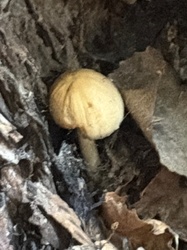
Start with a button. The cap is one to four centimetres, egg-shaped to narrowly bell-shaped, and coated in a distinctly slimy, viscid layer that picks up grass fragments and glistens in low sun. Colour at this stage is a vivid chrome to egg yellow, deepest at the very centre.
Then watch what expansion does. The cap opens to a broad bell and finally to a flat, often upturned disc, and as it does the yellow drains outward and away, leaving a grey to olive-buff margin with only a yellow to ochre patch remaining over the centre. At the same time the margin becomes deeply grooved and pleated, so that the lines of the gills show through the paper-thin flesh as radiating furrows almost to the disc. Old caps split between the grooves and the margin turns up and back on itself. A fully expanded fruit body may be barely thicker than tissue paper.
Gills, Stem and Base
The gills are crowded, narrow, and either free or only narrowly attached to the stem. Follow them through the day as well: they begin pale yellowish or cream, pass through cinnamon and end a warm rusty brown as the spores mature. In collapsing caps they can look soft and greasy and may stick together, but they do not dissolve into black ink, and that distinction matters for the look-alikes.
The stem is three to ten centimetres tall and only two to five millimetres thick, so it looks far too slender for the cap it carries. It is white to pale lemon yellow, hollow, brittle and easy to snap, and under a lens the upper part is finely mealy or powdery while the lower part carries scattered white fibrils. There is no ring and no ring zone at any stage. Excavate the base: it is very slightly swollen, sometimes with a few white threads binding dung fibres or straw, but it has no volva, no bulb and no rooting tap.
Flesh and Colour Change
Slice a fresh cap. The flesh is watery, pale yellowish under the cuticle and almost nonexistent towards the margin. Stem flesh is white and hollow-centred. Nothing changes colour when cut or bruised. Ageing brings a general grey-brown darkening as the fruit body collapses, but there is no reddening, blueing or blackening reaction to record. Handling a fresh cap simply leaves you with a smear of slime on your fingers.
Taking a Spore Print
Work fast and choose the right cap. A fully expanded but not yet collapsing specimen with rusty gills will print in one to two hours; a very young yellow button may not print at all. Because the cap is so thin and the stem so weak, cut the stem short and lay the cap gills-down on white paper with a small coin or pebble on top to keep it flat, then cover it.
The print is rusty brown to warm ochre-brown. Get this and half the possible confusions disappear. Under a microscope the spores are large for such a small fungus, smooth, ellipsoid, honey-coloured in water and with a broad truncate germ pore at the apex.
Substrate, Season and Ecology
This is a nutrient-rich ground fungus rather than a wood fungus in the usual sense. It fruits on dung and dunged pasture, on rotting straw and old bedding, on heavily manured lawns and vegetable beds, on compost, and very commonly on woodchip and bark mulch in gardens and parks. What links those substrates is a high nitrogen content and a plentiful supply of partly rotted plant fibre, which it decomposes.
Season is long, from spring through to late autumn, with flushes triggered directly by rain and warmth rather than by time of year. Fruiting is typically scattered to gregarious, with many individuals appearing across a small area over a few consecutive mornings and each one lasting less than a day. If you want the young slimy stage, search early.
Separating the Look-alikes
Conecaps in the genus Conocybe share the slender fragile build, the rusty print and the same rich grassy habitats. Separate them on the cap: a conecap has a dry, matte, conical to bell-shaped cap in tawny, cinnamon or ochre-brown, never a slimy chrome-yellow one, and it does not develop the wide grooved and pleated margin of a mature Yellow Fieldcap. If the cap is dry to the touch and never was yellow, you are not in the right genus.
Bolbitius reticulatus is the nearest relative. It grows on rotting broadleaf wood rather than on dung or grass, and its cap is grey to lilac-grey with a wrinkled, veined surface rather than clear yellow.
Agrocybe pediades and its allies grow in similar grassland but have firmer, dry, ochre-tan caps with a thicker flesh, a much sturdier stem and a dark brown rather than rusty print.
Mottlegills such as Panaeolus species also fruit on dung. They have dry grey-brown caps, gills that are conspicuously mottled black and grey as spores ripen unevenly, and a black spore print.
Inkcaps, especially the small Parasola and Coprinellus species, are the closest match in overall look because they too are fragile, pleated and short-lived. Take a print: theirs is black or blackish brown. Many also autodigest, with the gills dissolving into dark liquid at the margin. Yellow Fieldcap withers and collapses without inking, and its print is rust brown, not black.
Field Checklist
- Small fragile mushroom on dung, manured grass, straw, compost or woodchip
- Young cap egg-shaped, glossy and slimy, bright chrome to egg yellow
- Expanded cap flat, grey-buff with a yellow centre and a deeply grooved pleated margin
- Gills crowded and narrow, pale yellow then cinnamon to rusty brown, not inking
- Stem very slender, hollow, whitish to pale yellow, mealy above, without a ring
- Spore print rusty brown; spores large and smooth with a germ pore
- Spring to autumn, appearing after rain and lasting less than a day
Common questions
Why do specimens in one patch look so different from each other?
How do I separate it from a small inkcap?
What substrates does it favour?
Is the yellow colour always present?
Full reference entry for Yellow Fieldcap
Cap and fruiting body, spore print colour, substrate, season, ecological role and the species most often confused with it.
Open the Yellow Fieldcap entry →