Identification guide
Yellow-staining Mushroom Identification Guide
A structured field key to Agaricus xanthodermus that works from silhouette to spore print, with an emphasis on the ring architecture, gill sequence and separation from other white Agaricus species.
Where the search begins
Think of this species as a fungus of human landscapes. Its strongholds are amenity grassland and disturbed nutrient-rich soil: the mown verge between pavement and road, the shrub bed in a supermarket car park, the strip of rough grass along a hedge, cemetery turf, a compost-enriched allotment path. It appears from midsummer to the first hard frosts and often in quantity, sometimes producing thirty or forty fruit bodies in a single arc. In woodland it is scarce; if you are under closed canopy, weigh the alternatives more heavily.
The five-second silhouette
Before touching anything, read the shape from the side. Immature fruit bodies of Agaricus xanthodermus are not domed. The cap top is flattened and the sides drop away almost vertically, producing a squared-off, drum-like or marshmallow profile with a visible shoulder edge. Most other white Agaricus buttons in the same grassland are rounded or egg-shaped. This shape cue will not clinch an identification on its own, but it reliably tells you which of the mushrooms in a mixed patch deserve the knife first.
Layer one: the cap
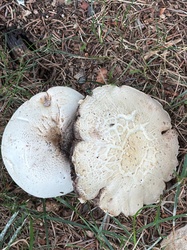
Diameter runs from five to fifteen centimetres, and vigorous specimens on rich soil can exceed that. The surface is dry, white to slightly grey-white or ivory, matt to faintly silky, and it stays predominantly white rather than developing the tawny fibrillose scales of the woodland Agaricus species. Ageing caps discolour to a dingy pale grey-brown at the disc and may crack into low, flat, appressed scales in dry weather. The margin is inrolled in youth and often carries torn white veil fragments once it has expanded.
A useful preliminary is the margin rub. Draw a thumbnail firmly across the outer edge of the cap and hold it in the light. A prompt bright yellow flush appearing along the scratch is a positive indication. This test is quicker and less destructive than sectioning the base, so use it as a screen and reserve the knife for candidates that pass it.
Layer two: the gills and the print
The gills are free, leaving a clear gutter between their inner ends and the stem apex. They are crowded, narrow and soft. Their colour sequence through the life of the fruit body is diagnostic in itself:
- Button stage: pale greyish white with at most a washed-out pinkish tint, never a strong rose colour.
- Expanding: dull greyish pink to lilac-pink.
- Mature: rich chocolate brown.
- Old: dark umber to almost black.
A spore print seals the genus. Take a fully opened cap, remove the stem cleanly at the gill line, place the cap gills-down on white paper, cover it with a bowl to stop draughts, and leave it two to four hours in a cool place. The deposit is dark chocolate brown to blackish brown, never white, cream, pink or rusty. Free gills plus a ring plus a dark brown print is the Agaricus signature.
Layer three: the stem, ring architecture and base
The stem is white, six to fifteen centimetres long, one to two centimetres thick, smooth above the ring and often minutely fibrillose or slightly scurfy beneath it, and hollow or stuffed with a soft pith at maturity. It broadens toward the bottom into a rounded to abruptly swollen bulb, sometimes with a slight rim where the bulb meets the stem proper.
Examine the ring closely rather than just noting its presence. It is large, membranous, superior and pendulous, hanging as a distinct collar. Turn the cap over and look at its underside: there are thickened, felty patches arranged in a broken radial pattern, the classic cogwheel or gear-tooth structure of the Agaricus arvensis relationship. In old fruit bodies the ring often collapses flat against the stem or is dusted brown by falling spores, so check young material for the full architecture.
Layer four: the section
Now do the definitive work. Excavate the whole fruit body, clean the soil from the bulb, and slice the entire mushroom vertically from cap centre to base with a single stroke.
What you are watching for is a rapid, saturated yellow reaction confined to the base. In Agaricus xanthodermus the flesh in the bulb turns brilliant chrome to egg yellow within seconds of exposure, forming a bright zone across the lowest part of the section while the cap flesh and mid-stem stay white. Over the following few minutes that yellow ages to a muddy ochre or brownish tone. Other Agaricus species can yellow, but their reaction is slower, softer, more ochre than chrome, and rarely so sharply confined to the bulb.
While the section is open, warm the fruit body in your hands and smell the cut base. The odour is distinctly chemical, phenolic and inky, sometimes compared to old-fashioned carbolic or wet ink, and it becomes markedly stronger with warmth. It is entirely unlike the warm earthy scent of Agaricus campestris or the sweet almond-aniseed of Agaricus arvensis and Agaricus augustus.
Microscopic notes
Spores are smooth, ellipsoid to broadly ellipsoid, thick-walled and brown in mass, measuring around 5 to 6.5 by 3 to 4.5 micrometres, with a small apical germ pore. Basidia are four-spored. Cheilocystidia are present on the gill edge as clavate to subglobose cells, often in clusters, and are worth checking when separating members of this section.
Working through the close relatives
- Agaricus moelleri and Agaricus phaeolepidotus belong to the same section and share both the instant yellow base and the inky odour. Separate them on the cap, which is covered with fine grey, brown or nearly black fibrillose scales concentrated at the disc over a paler ground, rather than the plain white of Agaricus xanthodermus.
- Agaricus arvensis is a larger, more graceful grassland species with a silky cream cap that yellows gently and warmly when rubbed, a tapered to clavate base without a sharply defined bulb, a very well developed cogwheel ring, and a sweet aniseed odour.
- Agaricus campestris has a tapering base with no bulb, a thin simple ring that often vanishes, gills that are bright rose pink from an early stage, and no yellowing anywhere.
- Agaricus bitorquis is a compact, thick-fleshed urban species with a low cap and a distinctive double or sheathing ring, and no colour change.
- Agaricus silvicola grows in woodland, is slender with a bulbous base and a yellowing surface, but again smells of aniseed and lacks the concentrated chrome flash in the bulb.
- Leucoagaricus leucothites mimics a white Agaricus in the field but its gills stay white to faintly pink into maturity and its spore print is white.
- Amanita species with white caps also have free gills and a ring, but they leave a white print and possess a volva, either a membranous sac or a rimmed bulb, and show no yellow reaction.
The final check
If your specimen has a white flat-shouldered cap on amenity grassland, free gills running grey-pink to chocolate, a big pendulous cogwheel ring, a chocolate-brown spore print, an inky phenolic smell and a bulb that flashes chrome yellow the moment it is cut, the determination is secure. Photograph the intact fruit body, the underside, and the fresh section within the first minute so the colour reaction is preserved in the record.
Common questions
Which features together confirm Agaricus xanthodermus?
How do I tell it from Agaricus moelleri and its relatives?
What habitats does it favour?
How does it obtain nutrients?
Full reference entry for Yellow-staining Mushroom
Cap and fruiting body, spore print colour, substrate, season, ecological role and the species most often confused with it.
Open the Yellow-staining Mushroom entry →