
Community find
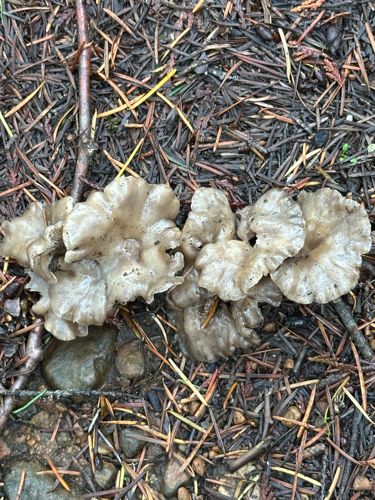
Amber Jelly Roll
Exidia recisa
- Group
- Jelly Fungus
- Season
- Appears throughout the year, but is most common and noticeable during cooler, wet weather, especially in late autumn through early spring.
- Habitat
- Typically found growing on dead hardwood branches and logs, especially on oak and alder. It prefers decaying wood in damp, shaded conditions.
- Key characteristics
- The fruit body is typically amorphous to somewhat cushion-shaped or lobed, often with wrinkles or folds. It is gelatinous to rubbery, opaque to translucent, and becomes firmer when dry. Color is often amber, yellow-brown to dark brown, sometimes reddish-brown. It typically grows to 1-5 cm wide and 1-2 cm thick. The surface is smooth and shiny when moist. There is no distinct stalk; it attaches broadly to the substrate.
- Look-alikes
- Similar species include other Exidia species, such as Exidia glandulosa (Witches' Butter), which is typically black and often has distinct wart-like structures. Tremella mesenterica (Witch's Butter or Yellow Brain Fungus) is bright yellow to orange. Auricularia auricula-judae (Wood Ear) has a more distinct ear-like shape and is typically reddish-brown.
- Ecological role
- This fungus is saprophytic, meaning it obtains nutrients by decomposing dead organic matter, primarily dead wood. It plays an important role in the recycling of nutrients in forest ecosystems by breaking down woody debris.