Community find
Chaga mushroom
Inonotus obliquus
- Group
- Canker / Hymenochaetoid fungus
- Spore print
- White to pale yellow (rarely observed since spores are produced in concealed, short-lived sexual fruiting bodies beneath bark).
- Size
- Sclerotium masses typically range from 10 to 40 cm (4 to 16 in) across.
- Season
- Perennial; visible year-round on host trees.
- Habitat
- Parasitic on living birch trees (Betula spp.), occasionally found on beech, alder, or oak.
- Distribution
- Circumboreal in the Northern Hemisphere, prominent in boreal forests of Russia, Northern Europe, Canada, and the Northern United States.
- Key characteristics
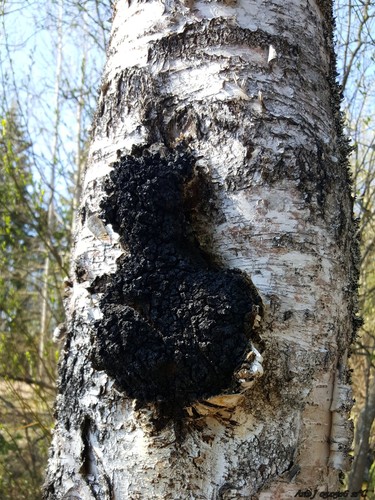
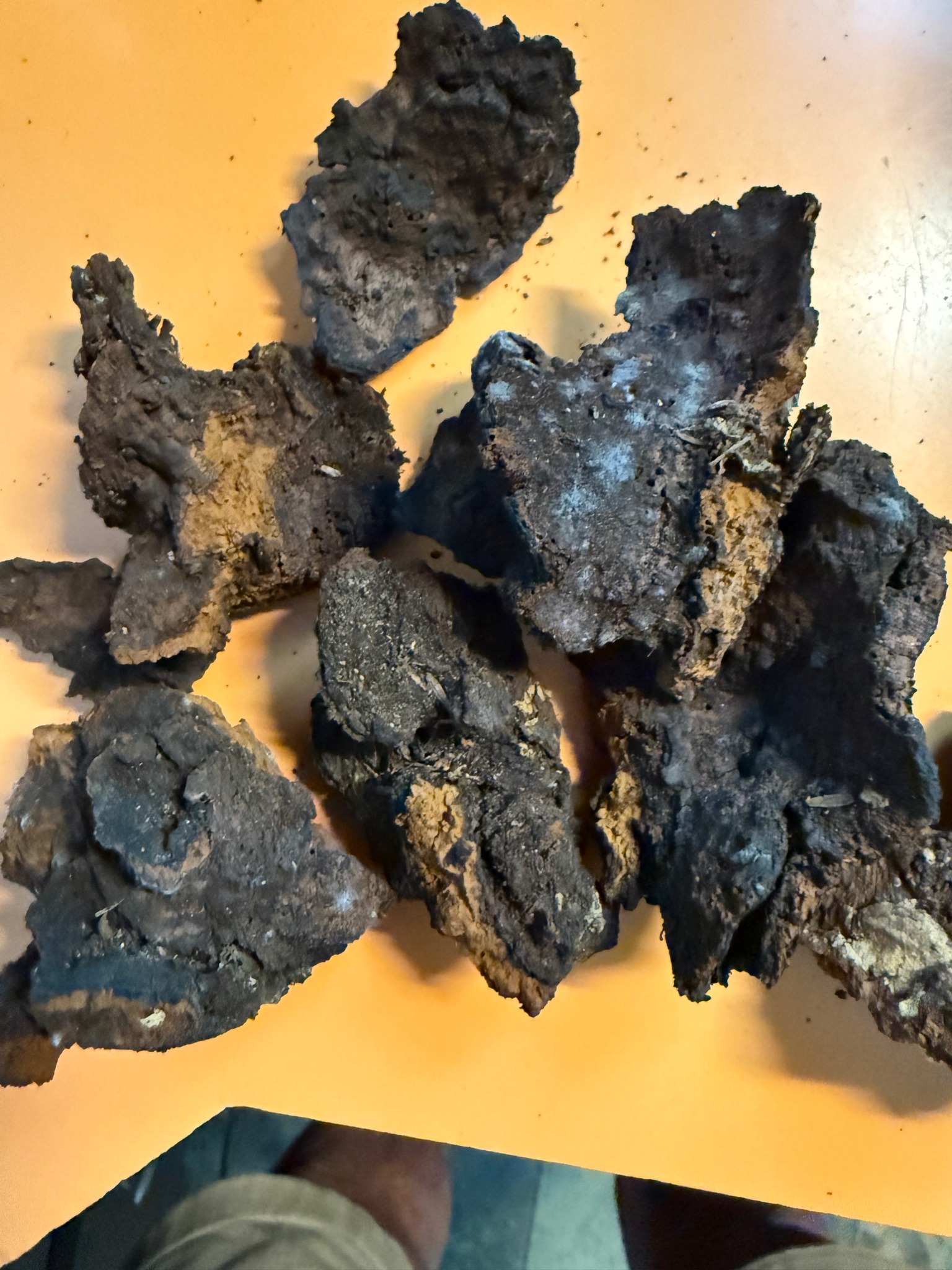
- Irregular, charcoal-black cracked exterior resembling burned charcoal; golden-brown to dark orange interior with a hard, woody, fibrous texture.
- Fruiting body
- The visible growth is actually a sterile mycelial mass or sclerotium/canker, displaying a deeply cracked, blackened outer surface caused by high melanin levels and a corky, golden-brown interior. The true fertile fruiting body develops rarely under bark after the host tree dies.
- How to recognise it
- Look for charcoal-like black crust with a rusty yellowish-brown or golden interior growing specifically from living birch trees.
- Look-alikes
- Tree burls (growth swellings without the charcoal-like crust or brownish interior) and Phellinus species.
- Ecological role
- Parasitic, causing white rot in host trees, eventually saprophytic after tree death.
- Notes
- The dense black exterior of Chaga is caused by extremely high concentrations of melanin. Traditionally, dried pieces of the sclerotium were used as a tinder to catch sparks for fire-starting due to how slowly it smolders.