Community find
Dryad's Saddle / Pheasant's Back
Cerioporus squamosus (formerly Polyporus squamosus)
- Group
- polypore
- Spore print
- White
- Size
- Cap diameter: 5 to 30 cm; Stipe: 2-8 cm long and 1-4 cm thick.
- Season
- Primarily spring (April to June), though it can occasionally fruit in much smaller numbers during the autumn.
- Habitat
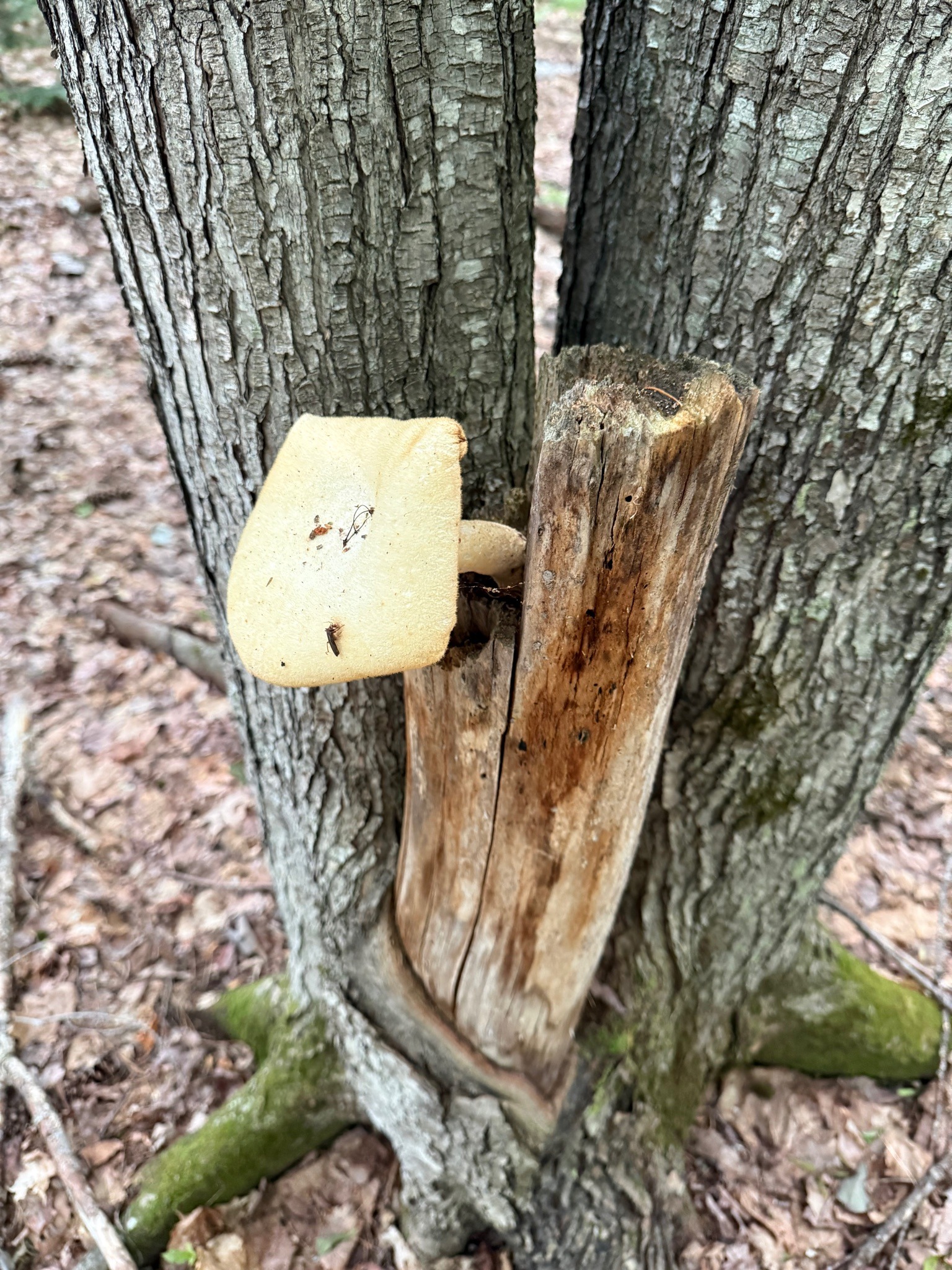
- Found growing on the dead or living wood of hardwood trees, particularly elms, maples, and buckeyes. It causes a white heart rot in living trees.
- Distribution
- Widespread throughout North America, Europe, and parts of Asia and Australia.
- Key characteristics
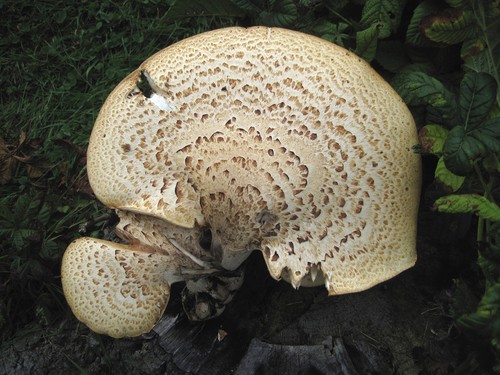
- Fan-shaped or kidney-shaped cap with a yellowish to brown surface covered in dark, feather-like scales (squamules). The underside features large, angular, or hexagonal pores. It typically has a short, thick, lateral stipe that is often blackish at the base.
- Fruiting body
- Cap: 5-30 cm wide, thick, tough, fan or funnel-shaped, yellowish-white background with concentric rows of brown scales. Hymenophore: Pores on the underside are white to creamy, decurrent (extending down the stem), and notably large (1-3 mm wide). Stipe: 2-10 cm long, eccentric or lateral, becoming dark brown or black toward the base.
- How to recognise it
- Look for the large hexagonal pores on the underside and the distinctive watermelon or cucumber-like scent when the flesh is cut. The dark scales on a light background and its preference for hardwoods in the spring are key.
- Look-alikes
- Cerioporus varius (Elegant Polypore) is much smaller with a smooth cap. Neofavolus alveolaris (Hexagonal-pored Polypore) is smaller and usually more orange-toned.
- Ecological role
- It is both a weak parasite on living hardwoods and a saprophytic decomposer of dead logs and stumps, playing a role in recycling nutrients by breaking down lignin.
- Notes
- The common name 'Dryad's Saddle' refers to Greek mythology, where Dryads (tree nymphs) were thought to use these sturdy fungi as saddles. It was famously described by British mycologist William Hudson in 1778.