Dryad's Saddle
Cerioporus squamosus
Also called pheasant's back mushroom, scaly polypore, hawk wing
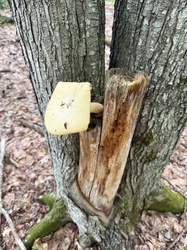
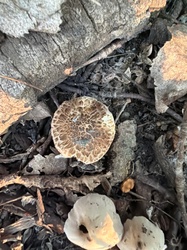
A large fan-shaped bracket patterned with concentric brown scales like a pheasant's plumage, set on a short off-centre stem with a black base.
Overview
Dryad's Saddle is one of the largest and most conspicuous spring bracket fungi of temperate hardwood forest, sometimes reaching 60 cm across and standing out from a distance because of the bold, feather-like scale pattern on its cap. Long known as Polyporus squamosus, it is now usually placed in Cerioporus, within the Polyporaceae.
It sits at an interesting midpoint in polypore form. Unlike shelf-like conks it has a genuine, if off-centre, stem, and unlike most brackets its pores are large, angular and clearly visible without a lens, running down the stem in a decurrent sheet. Its texture when young is soft and pliable, hardening to a tough leathery consistency within days.
Its appearance in spring, when very few large fungi are fruiting, and its habit of erupting from wounds high on living hardwoods make it a familiar early-season landmark for woodland walkers.
How to identify it
Cap
The cap is 8–60 cm across, kidney-shaped, fan-shaped or almost circular, and flat to broadly funnel-shaped with a depression toward the stem. It is pale cream, ochre or tan, overlaid with large, flattened, dark brown scales arranged in concentric rings radiating outward — the pattern that gives the alternative names Pheasant's Back and Hawk Wing. Young caps are soft and slightly moist; old ones become dry, brittle and curled at the margin.
Pores
The underside bears a white to cream pore surface with large angular to elongated pores, roughly 0.5–2.5 mm wide and easily seen with the naked eye — much coarser than in most polypores. The pore layer is shallow, 1–4 mm deep, and runs decurrent down one side of the stem rather than stopping at its junction.
Stipe
The stem is short, thick and lateral to eccentric, 2–8 cm long and up to 4 cm thick, pale above where the pores descend and abruptly blackened, felted and often net-marked toward the base. This black stem base is a reliable feature and separates the species from most other large stemmed polypores at a glance.
Flesh & spore print
Flesh is white, thick and firm, becoming corky and then tough with age, and does not change colour when cut. There is a distinct, pleasant farinaceous odour often likened to watermelon rind or cucumber. The spore print is white, from large, smooth, cylindrical spores.
Where and when it grows
It grows on hardwoods, either as brackets erupting from wounds, pruning cuts and broken limbs high on living trees, or on stumps and fallen trunks. Elm was historically the classic host, and the fungus became abundant on dying elms; maple, sycamore, ash, beech, poplar, willow and walnut are also frequently colonised. It commonly fruits in overlapping clusters of two to several brackets from a single point.
The main flush is in spring and early summer — often the first large fungus of the year in deciduous woodland, parkland and along riversides and hedgerows — with a smaller second flush possible in autumn. It is widespread across Europe, temperate Asia, Australia and much of North America.
Ecological role
Cerioporus squamosus causes a white rot, breaking down both lignin and cellulose so that infected heartwood becomes pale, soft and stringy. It acts as a weak parasite on living trees, entering through wounds and hollowing the trunk and major limbs, and then persists as a saprophyte on the same wood once the tree falls. Its association with declining elms made it one of the most visible fungi of that decline in Europe.
By hollowing living hardwoods it creates cavities and soft heartwood that support cavity-nesting birds and a wide range of saproxylic insects. The fruiting bodies themselves are heavily used by beetles and fly larvae, and older brackets on the ground are often riddled with insect galleries within a week or two of maturing.
Similar species
Hexagonal-pored Polypore (Neofavolus alveolaris) has the same large angular pores and a scaly orange cap but is far smaller, rarely more than 10 cm across, with strikingly hexagonal, honeycomb-like pores. Black-footed Polypore (Picipes badius) shares the blackened stem base but has a smooth, shiny, chestnut to reddish-brown cap with no scales at all and very fine, almost invisible white pores.
Train Wrecker (Neolentinus lepideus) can look similar in scaliness and stature, but it has true gills with jagged, saw-toothed edges instead of pores, and grows on conifer wood. Tuberous Polypore (Polyporus tuberaster) has a smaller, scaly cap and a central rather than lateral stem, and arises from an underground sclerotium.
Common questions about Dryad's Saddle
What makes Dryad's Saddle easy to recognise?
When is the best time to look for it?
Which trees does it grow on?
Does it smell of anything?
Guides
Dryad's Saddle found by the community
Photos submitted through the app and matched to this entry.