Community find
Dryad's Saddle
Cerioporus squamosus (formerly Polyporus squamosus)
- Group
- Polypore
- Season
- It is most commonly found from spring to early summer, but can also appear in mild autumns. Its growth is often triggered by wet periods.
- Habitat
- This fungus is saprophytic and sometimes weakly parasitic, typically growing on dead or dying hardwood trees, particularly elm, maple, oak, and beech. It can be found singly or in clusters on logs, stumps, and living trees where it causes white rot. It prefers temperate regions.
- Key characteristics
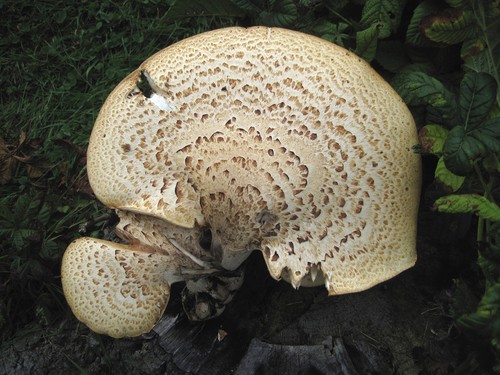
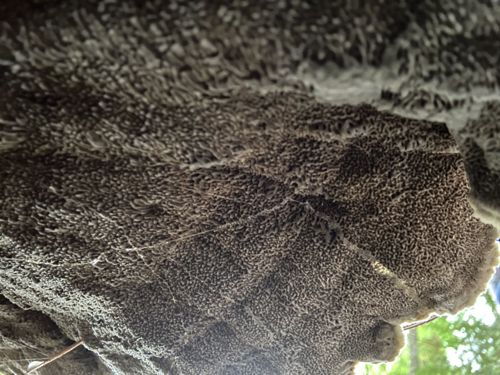
- The fruit bodies are semicircular or kidney-shaped, often fan-shaped or shelflike, attached laterally to the substrate. The cap surface is typically yellowish to brownish, covered with large, flattened, concentric scales that are darker in color. The pore surface on the underside is white to cream-colored, with angular to irregularly shaped pores that are quite large, visible to the naked eye. The stem (stipe) is usually short, thick, and lateral, often black and velvety at the base, and can be tough. The flesh is white, rigid, and becomes corky with age. When young, it has a distinct smell often described as watermelon rind or cucumber.
- Look-alikes
- Similar species include other polypores. Neolentinus lepideus (the Scaly Lentinus) has gills instead of pores. Some other Cerioporus species might look somewhat similar but usually lack the prominent scales. It can also be confused with other shelf fungi, but its distinctive scales and large pores usually help in identification.
- Ecological role
- Cerioporus squamosus is a saprophytic fungus, meaning it plays a crucial role in the decomposition of dead hardwood. It helps break down lignin and cellulose in wood, returning nutrients to the ecosystem. It can also be a weak parasite on living trees, especially those that are already stressed or damaged, contributing to their eventual decay.