Community find
Fairy Ring Mushroom
Marasmius oreades
- Group
- Gilled mushroom
- Season
- This mushroom typically fruits from spring through autumn, especially after periods of rainfall. It is quite resistant to drying out and can often be found during drier spells.
- Habitat
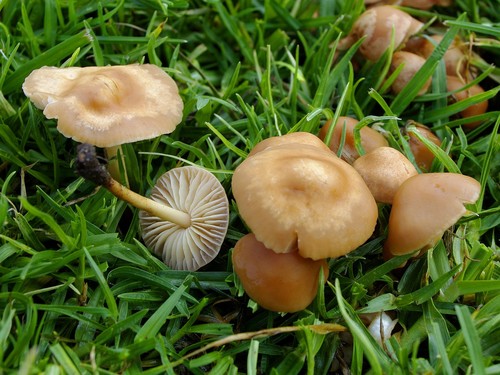
- Marasmius oreades is a saprophytic fungus, commonly found in lawns, pastures, and other grassy areas. It often grows in rings, known as "fairy rings", due to the outward growth of its mycelial network.
- Key characteristics
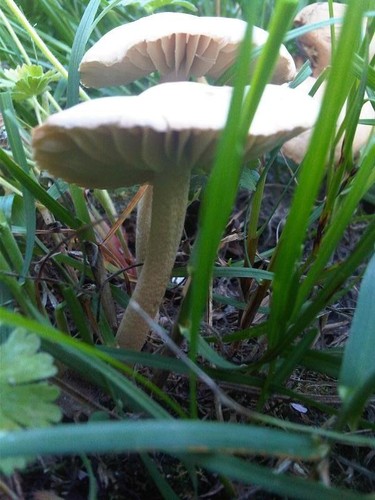
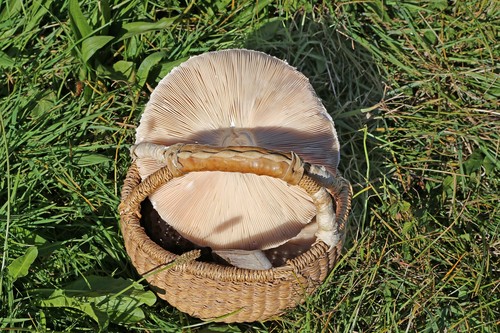
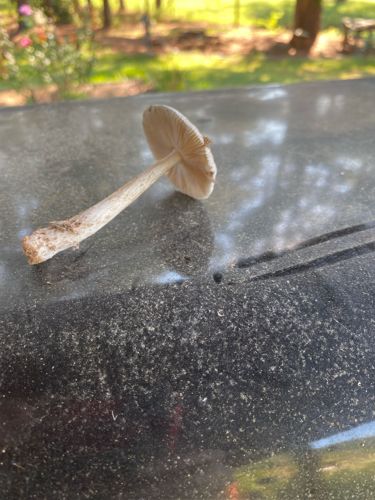
- The cap of Marasmius oreades is typically 1-5 cm in diameter, convex to broadly umbonate (having a central bump), and can flatten with age. Its color varies from buff to tan or reddish-brown, often fading to a paler cream or whitish color from the center outwards with drying. The surface is smooth and dry. The gills are attachment-free or narrowly attached to the stem, widely spaced, and cream to pale buff. The stem is slender, tough, hollow, and often twisted, measuring 3-10 cm long and 2-5 mm thick. It is whitish to pale brown. The spore print is white.
- Look-alikes
- Several similar-looking species exist. The "deadly galerina" (Galerina marginata) can be mistaken for it, but Galerina marginata typically grows on wood and has a brownish spore print and a ring on its stem. Other Marasmius species can also resemble it, but M. oreades is distinguished by its tough, wiry stem and widely spaced gills.
- Ecological role
- Marasmius oreades is a saprophyte, meaning it obtains nutrients by decomposing dead organic matter, primarily grass roots and other plant debris in soil. This decomposition process helps recycle nutrients back into the ecosystem, contributing to soil health and fertility, particularly in grasslands and lawns.