Deer Mushroom
Pluteus cervinus
Also called fawn mushroom, fawn pluteus, deer shield
A soft grey-brown wood-dwelling mushroom with free gills that turn pink as they mature, no ring and no volva, and a pink spore print.
Overview
The Deer Mushroom is the most frequently encountered member of Pluteus, a genus defined by three characters that together are unusual: gills that are completely free from the stem, a pink spore print, and a wood-inhabiting habit with no ring or volva. Once those three are checked, the genus is essentially settled.
Its common names come from the cap colour, a soft fawn or deer-hide grey-brown, streaked with fine darker radiating fibrils that are best seen in raking light. It is a generalist, appearing on almost any decaying hardwood, and it has one of the longest fruiting seasons of any temperate agaric, turning up from early spring through to hard frosts.
Under the microscope the genus shows another distinctive trait: large, thick-walled cystidia on the gill faces, tipped in P. cervinus with two to four short hooks or horns. These metuloid cystidia are a standard confirming character for the species and its immediate relatives.
How to identify it
Cap
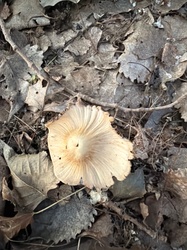
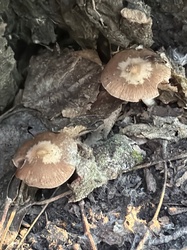
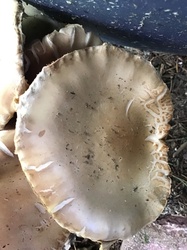
The cap is 3–15 cm across, bell-shaped to convex at first and expanding to nearly flat, often with a low broad umbo. Colour ranges from pale fawn and grey-brown through deep sepia to almost blackish-brown, and the surface is smooth, slightly greasy when moist, and marked with fine, dark, radially arranged fibrils that are densest at the centre. The margin is smooth and not striate.
Gills
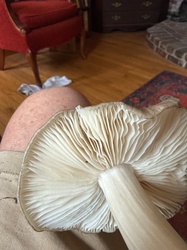
Gills are crowded, broad, soft, and completely free from the stem, leaving a clear gap or collar around it. They are white when young and turn a distinct pink to salmon-pink as the spores mature, eventually taking on a brownish-pink cast in old specimens. There is never a partial veil, so no ring tissue is ever present on young gills.
Stipe
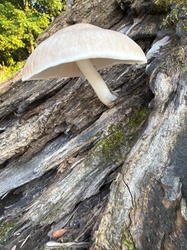
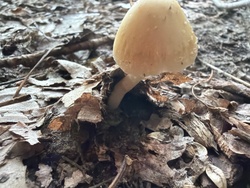
The stem is 4–12 cm long and 0.5–1.5 cm thick, roughly equal or slightly swollen at the base, white to pale greyish and longitudinally streaked with fine brown or blackish fibrils. It is firm, solid, and has no ring and no volva; the base is simply rounded or slightly enlarged where it enters the wood, without any sac or cup.
Flesh & spore print
Flesh is white, soft and unchanging when cut, with a faint radish-like or slightly earthy smell. The spore print is pink to salmon-pink; spores are smooth and broadly ellipsoid, and the gill faces bear abundant thick-walled cystidia crowned with two to four short hooked projections.
Where and when it grows
It fruits on decaying hardwood in all forms: fallen logs, stumps, buried roots, sawdust heaps, wood chip mulch in gardens and parks, and occasionally conifer debris. Fruiting bodies grow singly or in small scattered groups, sometimes directly from soil where a buried piece of wood lies beneath, and beech, oak, birch, poplar and willow are all commonly used.
The species is common throughout Europe, temperate Asia and North America, and it has one of the longest seasons of any agaric, appearing from March or April right through to November or later in mild conditions. Wood chip mulch in urban landscaping has made it an extremely frequent garden and park mushroom.
Ecological role
Pluteus cervinus is a saprophyte causing a white rot of hardwood. It degrades lignin along with cellulose, leaving the wood pale, soft and fibrous, and it colonises material that is already partly decayed, so it typically follows the pioneer bracket fungi in the decay sequence rather than initiating decomposition itself.
Its flexibility about substrate — anything from a fallen beech trunk to a bed of fresh landscaping chips — makes it one of the most reliable indicators of decaying wood in both wild and managed settings, and the very long fruiting season means it contributes spores to the air across most of the year. Soft-fleshed fruiting bodies are heavily used by fly larvae and beetles, feeding into the invertebrate community of decaying wood.
Similar species
Other Pluteus species are the nearest matches and are separated chiefly on cap surface and colour: Willow Shield (Pluteus salicinus) is smaller with a grey cap tinted blue-green, especially at the stem base, and Wrinkled Shield (Pluteus umbrosus) has a strongly wrinkled, dark-veined cap and dark gill edges. All share free pink gills and a pink print.
Volvariella and Volvopluteus species also have free pink gills and a pink print, but they emerge from a distinct membranous sac-like volva at the stem base, which Pluteus completely lacks — always check the base by digging it out rather than snapping the stem. Entoloma species give a pink print too, but their gills are attached to the stem, usually sinuate or adnexed, and they grow from soil rather than wood, with angular spores under the microscope. Young Agaricus species have free gills but these turn pink then chocolate-brown, and they carry a conspicuous membranous ring.
Common questions about Deer Mushroom
What three features place a mushroom in Pluteus?
How do I separate it from a Volvariella?
It is growing from soil, not wood — is that possible?
When does it fruit?
Guides
Deer Mushroom found by the community
Photos submitted through the app and matched to this entry.