Community find
Fairy Ring Mushroom
Marasmius oreades
- Group
- gilled mushroom
- Season
- Spring, summer, and fall, particularly after rainfall.
- Habitat
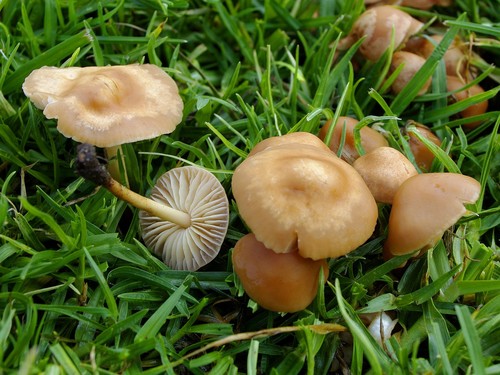
- Typically found in grassy areas such as lawns, meadows, pastures, and along roadsides. It often grows in distinct arcs or rings, known as "fairy rings". It favors disturbed ground.
- Key characteristics
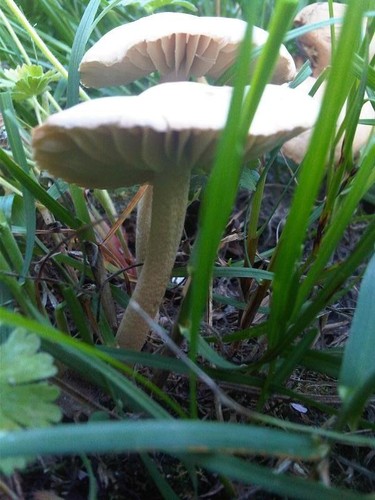
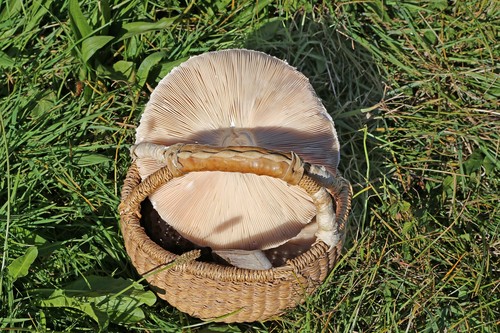
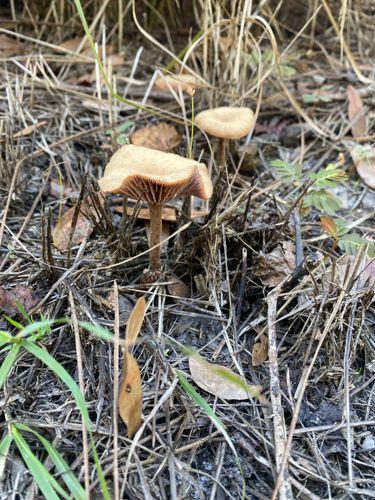
- Cap: 1-5 cm wide, bell-shaped to convex, flattening with age, sometimes with a central umbo; smooth, dry, and often rugulose (wrinkled) when dry. Color ranges from buff to tan or reddish-brown, fading when dry (hygrophanous). Gills: Free to adnate, widely spaced, and pale cream to buff. Stems: 2-10 cm long, slender, tough, cartilaginous, often twisted, and colored similarly to the cap, sometimes paler.
- Look-alikes
- There are several similar-looking species. 'Melanoleuca cognata' has more crowded gills and grows in different habitats. Some 'Clitocybe' species can appear similar but often have decurrent gills and a different odor. Care must be taken to distinguish it from species like 'Galerina marginata', which is a deadly poisonous mushroom; 'M. oreades' can be distinguished by its tough, flexible stem, widely spaced gills, and growth habit.
- Ecological role
- Saprotrophic, decomposing organic matter in soil and contributing to nutrient cycling in grassy ecosystems. Its ability to form fairy rings indicates its extensive mycelial network in the soil.