Community find
Fly Agaric
Amanita muscaria
- Group
- gilled mushroom
- Spore print
- White
- Size
- Cap diameter: 8–20 cm (3–8 in); Stipe height: 5–20 cm (2–8 in); Stipe diameter: 1–2 cm (0.5–1 in).
- Season
- Late summer to late autumn, often following periods of heavy rain.
- Habitat
- Typically found in woodlands, forming mycorrhizal relationships with both deciduous and coniferous trees like birch, pine, and spruce.
- Distribution
- Originally native to temperate and boreal regions of the Northern Hemisphere, it has been unintentionally introduced to many parts of the Southern Hemisphere.
- Key characteristics
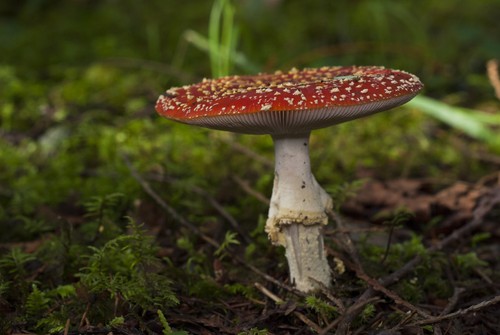
- Bright red to orange cap covered with white, warty pyramidal scales; white gills and a white stem with a ring and a bulbous base with a volva.
- Fruiting body
- Cap is initially globose, then hemispherical to flat; surface is scarlet red with white universal veil remnants (warts). Hymenophore consists of free, white, crowded gills. Stipe is white, cylindrical, featuring a white pendulous ring and a basal bulb encased in woolly rings of veil material.
- How to recognise it
- Look for the distinctive red cap with white warts, white free gills, and a large basal bulb with concentric rings of veil remnants. Always check the base of the stem.
- Look-alikes
- Amanita caesarea (lacks white warts), Amanita pantherina (browner cap), and Amanita parcivolvata (lacks a ring).
- Ecological role
- Mycorrhizal; it forms a symbiotic relationship with tree roots, aiding in nutrient and water uptake for the tree while receiving sugars in return.
- Notes
- This species is the iconic 'toadstool' frequently depicted in folklore, fairy tales, and video games. It is also well-known for its relationship with the reindeer in northern cultures and its use in historical fly traps, where crumbled pieces were placed in milk to attract and stun houseflies.