Community find
Giant Funnel
Leucopaxillus giganteus
- Group
- Gilled mushroom
- Season
- It is typically found from late summer to late autumn, often after periods of rain.
- Habitat
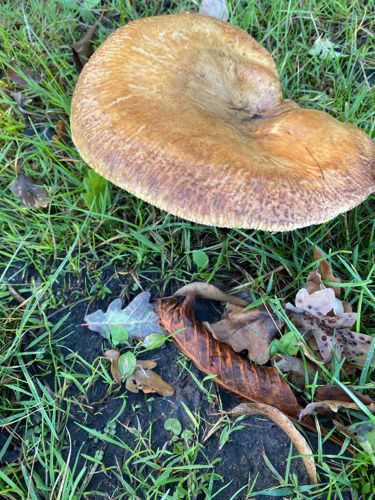
- The Giant Funnel is a saprobic fungus, meaning it obtains nutrients from decaying organic matter. It typically grows terrestrial (on the ground) in troops, arcs, or rings, often in grassy areas, meadows, pastures, open woodlands, or at the edges of forests. It can also appear in gardens and lawns, often associated with rich, disturbed soil. It is found solitary or, more commonly, gregariously.
- Key characteristics
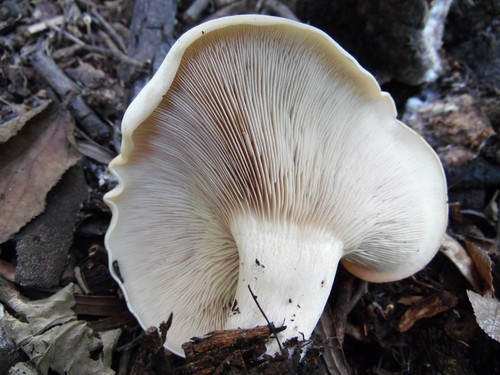
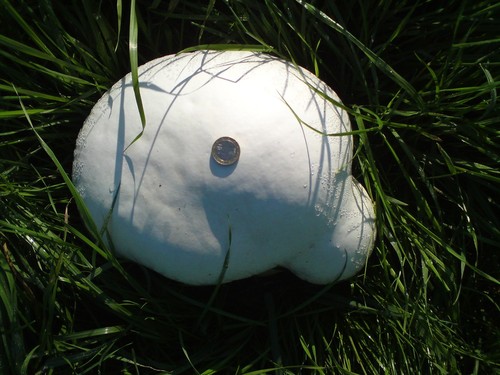
- The cap of the Giant Funnel is typically large, ranging from 10 to 50 cm (4 to 20 inches) in diameter, and can sometimes be even larger. It is initially convex to flat, eventually developing a deeply funnel-shaped or infundibuliform (trumpet-like) depression in the center with an inrolled margin. The color is usually white to cream, sometimes with yellowish to tan shades, especially towards the center or with age. The surface is smooth or slightly velvety. The gills are crowded, narrow, and run down the stalk (decurrent). They are white to cream colored, sometimes becoming slightly yellowish with age. The stem is short, stout, and solid, eccentric (off-center) or central, with a color similar to the cap. There is no ring or veil. The flesh is thick, firm, and white, with a farinaceous (mealy) or slightly unpleasant odor and taste. The spore print is white.
- Look-alikes
- Similar looking species include Clitocybe nebularis (Clouded Agaric), which is generally smaller, more uniformly grey, and does not have the strongly decurrent gills to the same extent. Leucopaxillus candidus is another large white funnel-shaped mushroom, but it tends to be more consistently white and often has a slightly different smell.
- Ecological role
- As a saprobic fungus, Leucopaxillus giganteus plays a crucial role in the decomposition of organic matter in its habitat. It breaks down dead plant material, releasing nutrients back into the soil, thus contributing to nutrient cycling and the overall health of the ecosystem.