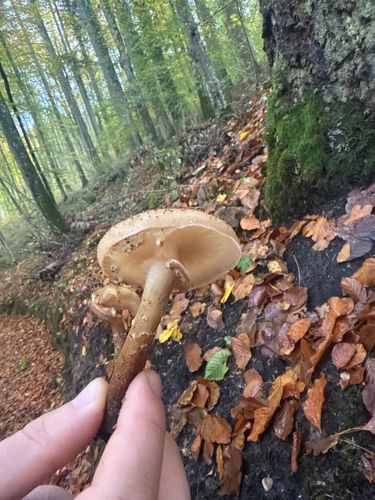
Community find
Honey Mushroom
Armillaria mellea
- Group
- gilled mushroom
- Season
- Late summer to late autumn, often fruiting after significant rainfall.
- Habitat
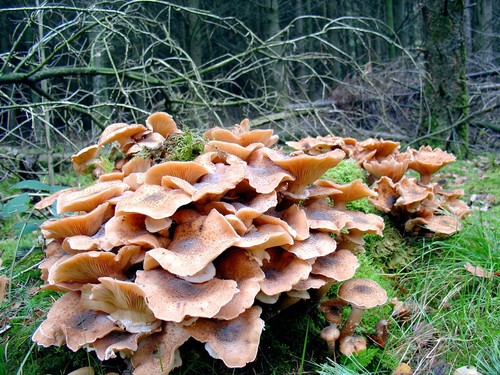
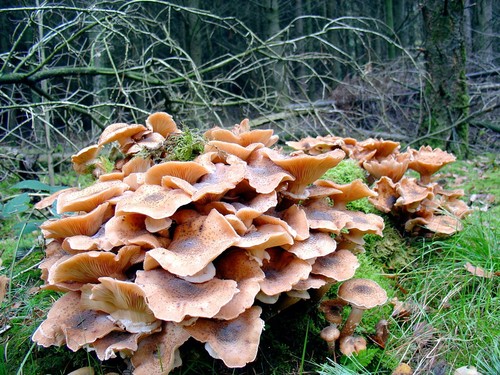
- Typically found in dense clusters at the base of trees or on buried wood, both deciduous and coniferous. It is a parasitic and saprophytic fungus found in woodlands, forests, and sometimes even in gardens and urban areas.
- Key characteristics
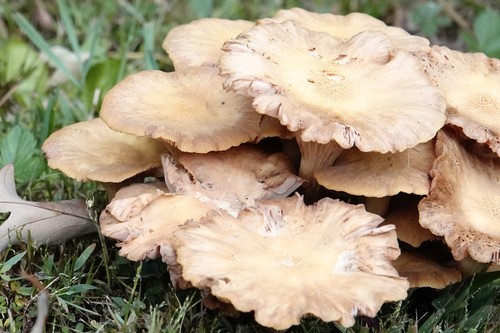
- Cap: Typically 3-15 cm wide, convex to flattened, often with a central uplift (umbo) when young, ranging from honey-yellow to yellowish-brown, sometimes with darker scales, especially when young. Gills: Attached to slightly decurrent, whitish to yellowish, darkening with age. Stem: 5-20 cm long and 1-3 cm thick, fibrous, uniform in width or slightly tapering towards the base, often with a persistent ring (annulus) that can be white to yellowish. The stem below the ring can be scaly or fibrous, often brownish. Spore print: White to pale cream.
- Look-alikes
- Several other Armillaria species exist and can be difficult to distinguish without microscopic examination. Galerina marginata (Deadly Galerina) is a deadly toxic mushroom that can sometimes resemble smaller, darker Honey Mushrooms and grows in similar habitats, but has a rusty-brown spore print and typically lacks the prominent ring of Armillaria mellea. Pholiota species can also look similar but often have a slimy cap and darker spore print. Desarmillaria tabescens (Ringless Honey Mushroom) lacks an annulus.
- Ecological role
- Armillaria mellea can be a significant forest pathogen, acting as a parasitic fungus that causes root rot on a wide range of woody plants, leading to weakened or dead trees. It also functions as a saprophyte, breaking down dead wood and contributing to nutrient cycling in forest ecosystems. Its mycelial cords (rhizomorphs) can spread extensively through the soil and under bark, facilitating its parasitic spread.