Community find
Leucopaxillus giganteus
Leucopaxillus giganteus
- Group
- Gilled mushroom
- Season
- It is typically found in late summer and autumn, roughly from August to October, depending on geographical location and local weather conditions.
- Habitat
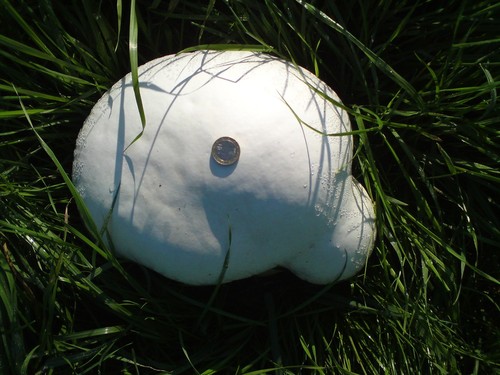
- This mushroom is typically found in grassy areas, fields, meadows, and sometimes at the edges of woodlands. It grows terrestrially, often in troops, arcs, or rings (fairy rings), and prefers disturbed ground or nutrient-rich soils. It is found on soil, not directly on wood.
- Key characteristics
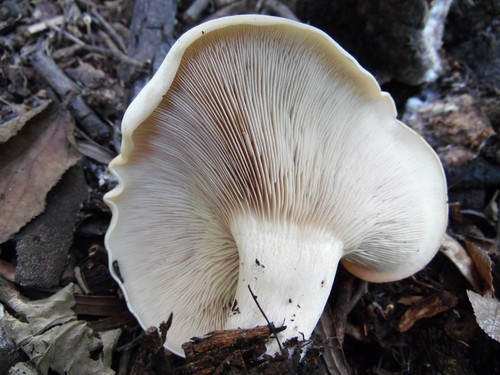
- The cap of Leucopaxillus giganteus can grow very large, often 10-30 cm (4-12 inches) or more in diameter, and is typically white to cream or pale tan, sometimes tinged with ochre. It is smooth, convex when young, becoming flat and eventually depressed or funnel-shaped with age. The margin is often inrolled when young and can become wavy or irregular with maturity. The gills are crowded, narrow, and run down the stem (decurrent), appearing white to creamy. The stem is stout and solid, typically shorter relative to the cap size, whitish or brownish, often tapering towards the base. Spore print is white.
- Look-alikes
- Similar looking species include some other large, white gilled mushrooms, such as Clitocybe nebularis (Clouded Agaric) which has a greyish cap and different gill attachment, and some large white Russula species which have brittle flesh and typically do not grow as large. Megacollybia rodmanii can also appear somewhat similar but usually has a more scaly cap and grows on wood.
- Ecological role
- Leucopaxillus giganteus is a saprobic fungus, meaning it obtains nutrients by decomposing dead organic matter. It plays an important role in nutrient cycling in its ecosystem, breaking down complex organic compounds in the soil, thereby returning essential nutrients to the environment. It is often found in grassland ecosystems where it helps to process plant debris.