Community find
Liberty Cap
Psilocybe semilanceata
- Group
- gilled mushroom
- Season
- Late summer to late autumn, usually after periods of rain and when temperatures are cool but not freezing.
- Habitat
- Typically grows solitarily or in small groups on rich grassy soil, especially in pastures, meadows, and lawns, often fertilized with animal dung, but does not directly grow on dung.
- Key characteristics
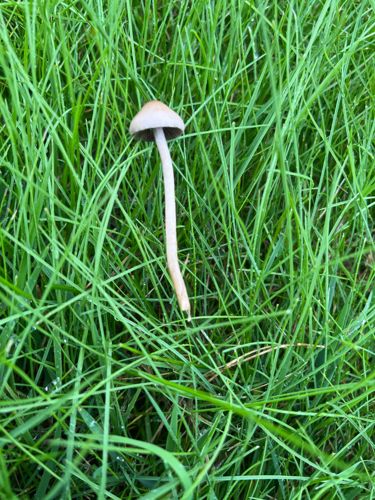
- The cap is conic to campanulate, often with a papilla (nipple-like projection) at the apex, measuring 0.5-2.5 cm wide. Its color varies from light brown to tan, becoming paler to whitish when dry, and often translucent-striate when moist. The gills are adnate to adnexed, close to subdistant, and initially pale, becoming brownish with age. The stipe (stem) is slender, long (3-12 cm), and fragile, typically whitish to pale brownish, and often discolors to blue-green near the base with handling or age. Spore print color is dark purplish-brown.
- Look-alikes
- Look-alikes include various species of Panaeolus, Protostropharia, and other Psilocybe species. Key distinguishing features of Psilocybe semilanceata include its prominent papilla, the striate margin when moist, and its slender, often wavy stipe that discolors blue-green at the base when bruised.
- Ecological role
- Saprophytic; it obtains nutrients by decomposing organic matter in soils, contributing to nutrient cycling in grasslands and pastures.