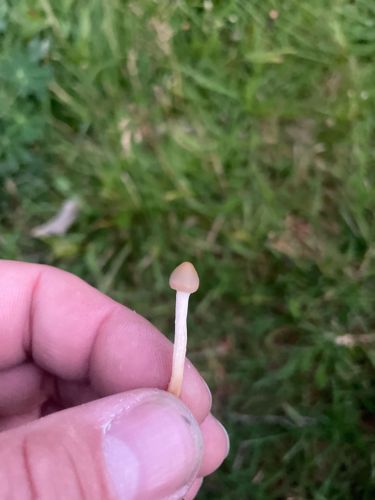
Community find
Mica Cap
Coprinellus micaceus
- Group
- Gilled mushroom
- Season
- Spring through autumn, sometimes into early winter during mild periods, especially after rain.
- Habitat
- Grows in dense clusters on decaying hardwood, wood chips, buried wood, or soil enriched with organic matter. Commonly found in urban settings like lawns, parks, and disturbed areas.
- Key characteristics
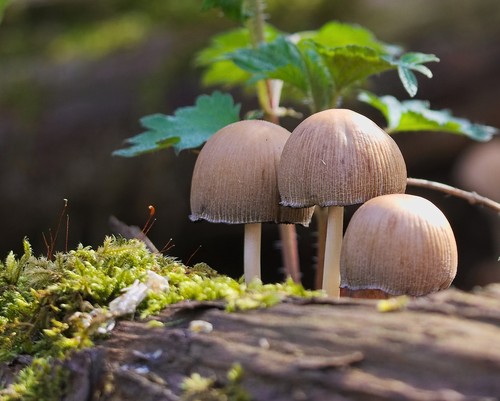
- Caps are typically bell-shaped to conical, becoming more convex with age, and are usually pale yellowish-brown to orange-brown. They are often covered in tiny, glistening, granular particles (resembling mica) when young, especially in dry weather. The gills are crowded and initially whitish, becoming dark brown to black as spores mature, eventually deliquescing (melting into a black inky liquid). The stem is slender, fragile, whitish, and often hollow. Spore print is dark brown to black.
- Look-alikes
- Similar species include other Coprinellus species, such as Coprinellus disseminatus (Fairy Inkcap), which are smaller and have a more delicate appearance, and Coprinellus plicatilis (Pleated Inkcap), which has a distinctly pleated cap and grows singly or sparsely. Distinguishing features are often the glistening particles on young caps of C. micaceus and its tendency to grow in large clusters.
- Ecological role
- This mushroom is saprophytic, meaning it obtains nutrients by breaking down dead organic matter, primarily wood. It plays a significant role in nutrient cycling and decomposition in forest and urban ecosystems.