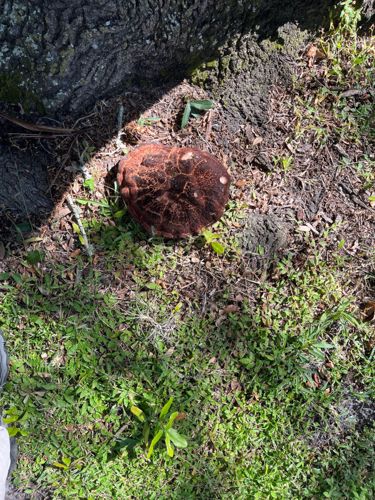
Community find
Old Man of the Woods
Strobilomyces floccopus
- Group
- Gilled mushroom
- Season
- It is typically found in late summer and fall, primarily from July to October, depending on the region and weather conditions.
- Habitat
- Strobilomyces floccopus is a mycorrhizal fungus, meaning it forms a symbiotic relationship with the roots of certain trees. It is typically found growing solitarily or scattered on the ground in deciduous and coniferous forests, often near oak or pine trees.
- Key characteristics
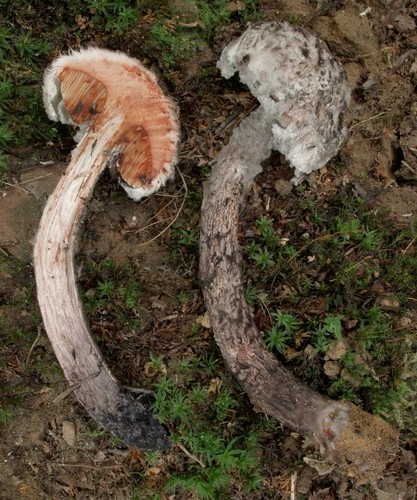
- The cap of Strobilomyces floccopus is typically 5-20 cm (2-8 inches) in diameter, convex to nearly flat, and covered with large, coarse, blackish-brown to black scales over a whitish or grayish background. The flesh is thick, whitish, and stains reddish when cut, then slowly to black. The pores on the underside of the cap are whitish to gray, changing to reddish or black upon bruising. The stem is solid, central, often stout, 6-15 cm (2.5-6 inches) long and 1-3 cm (0.5-1 inch) thick, often shaggy or scaly, and similar in color to the cap. A prominent ring or remnants of a partial veil are often present on the stem.
- Look-alikes
- Other species in the genus Strobilomyces, such as Strobilomyces confusus, may look similar but often have slightly different scale patterns, spore characteristics, or colors. Some species of Boletellus might also be mistaken, but their cap surfaces are usually not as shaggy or scaly.
- Ecological role
- Strobilomyces floccopus is a mycorrhizal fungus, forming beneficial symbiotic associations with the roots of trees, primarily oaks and pines. This relationship aids the trees in nutrient and water uptake, while the fungus receives carbohydrates from the tree. It contributes to the overall health and nutrient cycling in forest ecosystems.