Community find
Pleated Inky Cap
Parasola plicatilis
- Group
- Gilled mushroom
- Season
- It is typically found from spring through autumn, especially after rain, throughout its range.
- Habitat
- This mushroom is commonly found growing solitarily or in groups on well-fertilized lawns, grasslands, disturbed ground, gardens, and decaying organic matter.
- Key characteristics
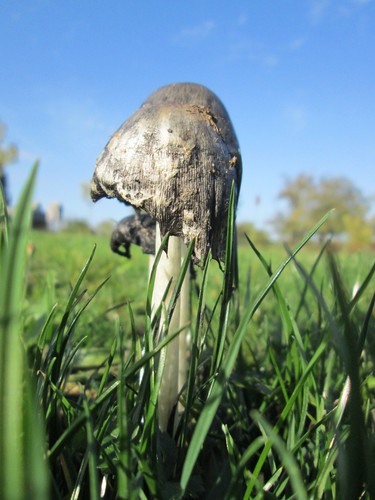
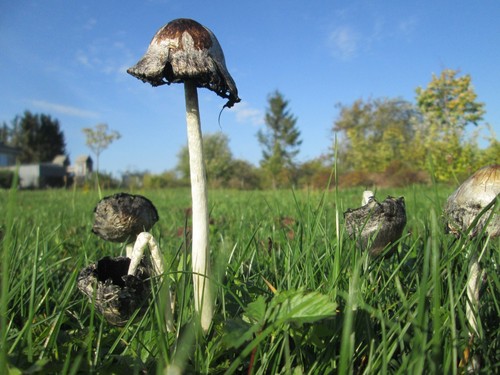
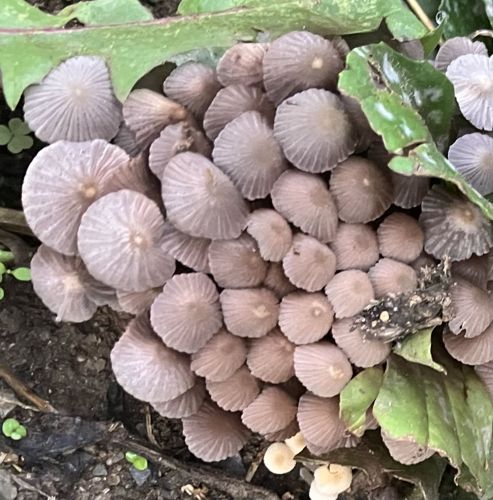
- The cap is typically 1-3 cm in diameter, round to bell-shaped when young, expanding to a flattened, almost disc-like shape with radial grooves or 'pleats' that extend from the center to the margin. It is very thin-fleshed and often translucent. The color ranges from pale grayish-brown to ochre-brown, fading to gray or whitish with age or in dry conditions. The gills are adnexed or free, narrow, and closely spaced, initially white, becoming grayish and then black with age, although they do not deliquesce (turn to an inky liquid) as dramatically as many other inky caps. The stem is slender, fragile, hollow, and whitish, typically 3-10 cm tall and 1-3 mm thick. It often has a slightly bulbous base.
- Look-alikes
- Similar looking species include other members of the genus Parasola, such as Parasola auricoma, which differs microscopically and sometimes has a few sparse hairs on its cap. Other small, pleated Coprinoid mushrooms can look similar, but P. plicatilis is distinguished by its distinctively pleated cap and the absence of a velum (partial veil remnants) on the cap or stem and its non-deliquescing gills. Some species of Coprinellus also share a similar form, but often deliquesce more noticeably.
- Ecological role
- Parasola plicatilis is a saprobic fungus, meaning it obtains nutrients by decomposing dead organic matter. It plays an important role in nutrient cycling by breaking down decaying plant material, contributing to soil health and fertility.