Community find
Turkey Tail
Trametes versicolor
- Group
- Polypore
- Season
- It is found year-round, as its fruiting bodies are tough and persist through various weather conditions. It is most conspicuous during warmer, wetter months when new growth occurs, but can be seen throughout the winter.
- Habitat
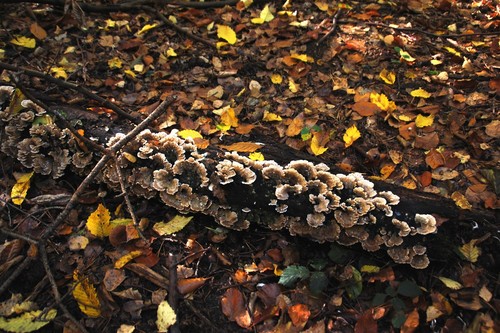
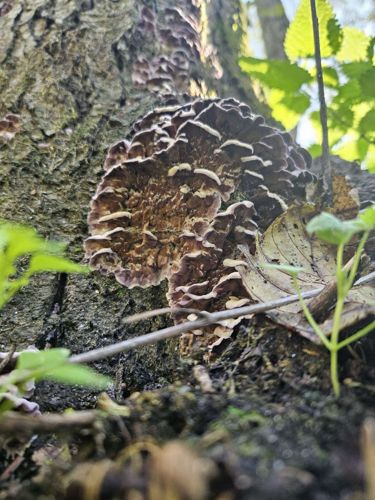
- Turkey Tail is a very common and widespread fungus that grows saprophytically on dead hardwood, less commonly on conifers. It can be found on logs, stumps, and fallen branches in forests, woodlands, and urban areas. It often grows in crowded, overlapping clusters.
- Key characteristics
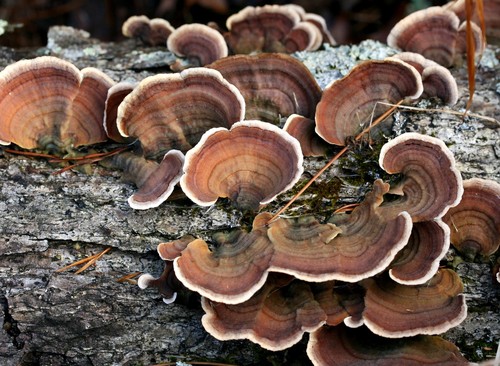
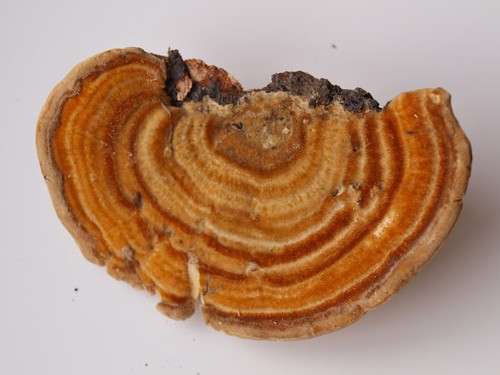
- The cap of the Turkey Tail fungus is typically thin, leathery, and fan-shaped or undulating, often growing in shelves or layers. It measures 1-10 cm across and up to 0.5 cm thick. The upper surface is zoned with concentric bands of various colors, including brown, grey, reddish-brown, bluish-grey, and sometimes green (due to algae), often with a velvety or finely hairy texture. The margin is usually wavy or lobed and often lighter in color. The underside features a white to cream-colored pore surface with very small, almost invisible pores (3-8 pores per millimeter). There is no distinct stem; it grows directly on the substrate.
- Look-alikes
- Several species can be mistaken for Turkey Tail. Stereum ostrea (False Turkey Tail) lacks pores on its underside, instead having a smooth or slightly wrinkled surface. Trametes hirsuta has a uniformly hairy, often greyish-white upper surface and larger pores. Trametes pubescens has a very finely hairy to smooth cap and typically paler colors. Distinguishing features include the presence of pores (true polypores like Turkey Tail have them) versus a smooth underside, and the specific texture and coloration of the cap zones.
- Ecological role
- Trametes versicolor is a saprophytic fungus, meaning it obtains nutrients by decomposing dead organic matter. It plays a crucial role in woodland ecosystems as a primary white-rot decomposer, breaking down lignin and cellulose in dead wood. This process recycles nutrients back into the soil, making them available for other organisms and contributing to soil health and forest regeneration. It aids in the breakdown of fallen logs and branches, helping to clear the forest floor.