Community find
Velvet Shank
Flammulina velutipes
- Group
- Gilled mushroom
- Season
- It is most commonly found in late autumn through winter, and often into early spring, even surviving frosts and thaws. It is one of the few mushrooms that fruits in cold weather.
- Habitat
- This mushroom is saprophytic, growing in clusters on dead or dying hardwood trees, often on elm, oak, and beech. It can also be found on buried wood.
- Key characteristics
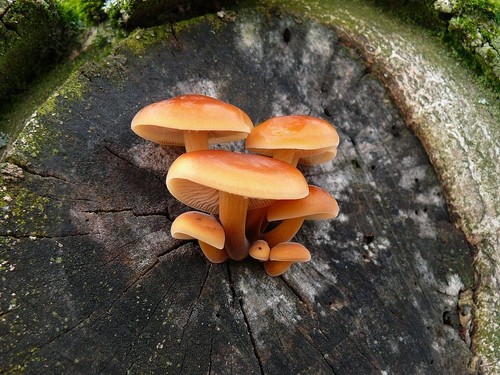
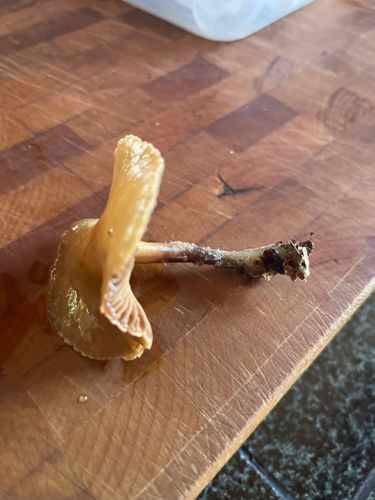
- The Velvet Shank has a viscid or slimy cap, typically honey-yellow to orange-brown in color, often darker at the center. It is convex, flattening with age, and can be 2-10 cm in diameter. The gills are pale yellow or whitish, broadly attached to the stem. The stem is distinctively dark, velvety brown to black, especially towards the base, and tough, growing 2-10 cm tall and 0.3-1 cm thick. It lacks a ring. The spore print is white.
- Look-alikes
- Galerna marginata (Deadly Galerina) is a deadly toxic mushroom that can be mistaken for Flammulina velutipes due to similar coloring and growth on wood. Key distinctions include Galerina marginata having a membranous ring on the stem, a dry (not slimy) cap, and a brownish spore print. Another similar species is Gymnopilus junonius, which is generally much larger, has a rusty-orange spore print, and grows on decaying wood.
- Ecological role
- As a saprophyte, Flammulina velutipes plays a crucial role in breaking down dead wood, returning nutrients to the ecosystem. It contributes to the decomposition of hardwood trees.