Identification guide
Artist's Conk Identification Guide
A field walkthrough for recognising the broad perennial bracket of Ganoderma applanatum, from its dusty grey crust to the white pore surface that darkens under a scratch. Includes section-cutting, spore deposit and separation from thick-crusted and lacquered relatives.
What You Notice First
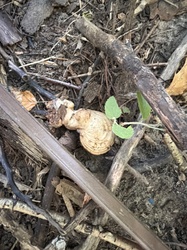
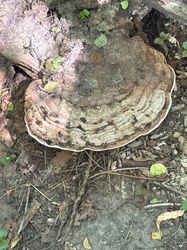
You are usually walking hardwood woodland — beech, maple, poplar, elm — when something shelf-like catches your eye at knee height or lower on a standing dead trunk, a cut stump, or the base of a living tree. From a distance it reads as a grey, dusty ledge, broad and flat, and very often there is a fine cocoa-coloured powder lying across its own upper surface and over everything beneath it: leaves, bark, other brackets on the same trunk. That powder is spore deposit, and it is one of the earliest and most dependable clues that you are dealing with a Ganoderma rather than some other bracket.
The second impression is bulk and permanence. Artist's Conk is perennial. It does not appear overnight and rot away in a fortnight; a large specimen may be a decade old, thirty to sixty centimetres across, woody, and quite immovable. If you push at a bracket and it will not flex at all, you are in the right group.
Reading the Upper Surface
Get your eye level with the bracket and look across it. The top is dull — matt, never varnished — in shades of grey, greyish brown, or dirty buff, usually mottled where spore dust has settled. Concentric furrows and low ridges run parallel to the margin and record successive seasons of growth. The inner zones near the attachment are darkest and most weathered, often greened with algae; the outermost band is paler and cleaner.
Now press the crust with a thumbnail. On this species it is thin, around a millimetre, and dents or chips without much effort; a knife slices through it easily. That small test is the first thing to reach for when separating Artist's Conk from its thick-crusted relatives.
The margin repays a look too. On an actively growing bracket the outer rim is a rounded white to cream band, sometimes a couple of centimetres wide. In winter or drought that band hardens and takes on the grey of the rest of the upper surface.
The Pore Surface and the Drawing Test
Turn the bracket over, or crouch to see underneath. The pore surface should be flat, even, and chalk-white to very pale cream when fresh. Draw a fingernail or a twig across it. On a living, actively growing specimen the scratched line turns dark chocolate brown instantly and stays that way — the character the common name commemorates, and close to diagnostic in combination with everything else here. On very old, frost-killed or weathered brackets the surface may already be dull brown and no longer respond, so try to test a bracket with a white growing margin.
Through a hand lens the pores are minute and round, roughly four to six to the millimetre, so fine that from arm's length the surface looks solid. There should be no gills, no spines, and no maze-like slots.
In Europe you may also find neat conical pimples projecting downward from the pore layer. These are galls induced by a small fly whose larvae develop in the tubes, and because that insect is effectively restricted to this fungus, their presence is a strong supporting hint.
Cutting a Section
If the bracket is loose, already fallen, or you can sacrifice a wedge, cut it vertically from margin to attachment with a stout knife. The section tells you almost everything.
The context — the flesh above the tubes — is brown to cinnamon-brown, fibrous, slightly punky rather than rock-hard, and typically shot through with irregular whitish pockets and streaks of mycelium. Below the context sits the tube layer, and here the perennial habit becomes visible: not one tube layer but several stacked strata, each a few millimetres deep, usually divided from the next by a thin brown line of context laid down between seasons. Counting those layers gives a rough minimum age for the bracket.
Spore Print and Spore Deposit
You rarely need to make a deliberate print, because the fungus makes one for you. From late summer into autumn a mature Artist's Conk sheds spores in enormous quantity, and a cocoa-brown to reddish-brown film settles on the top of the bracket itself, on lower brackets, and on the leaf litter below. Wipe a little onto white paper: the colour is a warm brown — never white, never rusty orange, never black.
For a controlled print, cut a wedge that includes the pore surface, rest it pore-side down on white paper somewhere still, cover it with a bowl, and leave it six to twelve hours. Under a microscope the spores settle the genus: ellipsoid, truncated at one end, double-walled, with fine pillars between the two walls, roughly 6–9 by 4.5–6 micrometres.
Substrate, Host and Season
Artist's Conk is a white-rot fungus of heartwood. It colonises dead hardwood readily — logs, stumps, fallen trunks — and also works as a butt rot in living trees, where the brackets emerge low on the bole or from exposed roots. Beech, maple, poplar, willow, elm and oak are all frequent hosts across the northern temperate zone. Conifer records exist but are far less usual, so a hardwood host supports the identification.
Because the bracket is perennial there is no season for finding it; it is there in every month of the year. Season affects only its behaviour — the white growing margin advances in late spring and summer, and the spore fall is heaviest from midsummer into autumn.
Separating It from Look-alikes
Thick-crusted Ganoderma (the G. australe / G. adspersum group). The single most confusable relatives. Their crust is several millimetres thick, resists a thumbnail, and grates rather than slices under a knife. The context tends to be deeper, more uniformly dark, and less flecked with white, and the whole bracket is lumpier and more hoof-like. Crust thickness tested in section is the practical field character.
Lacquered Ganoderma (G. lucidum, G. tsugae and allies). Obvious once seen: the upper surface is glossy, as though varnished, in red-brown to mahogany tones, usually with a distinct lateral stalk. They are annual and corky-soft when fresh, not decades-old and stony.
Tinder bracket (Fomes fomentarius). Also grey and concentrically banded, but strongly hoof-shaped rather than shelving, thickest against the trunk and rounded below. Its pore surface is pale brownish and does not blacken sharply where scratched, and the context is tawny and felty-fibrous instead of brown with white pockets.
Red-belted bracket (Fomitopsis pinicola). Carries a resinous crust with a bright orange to red band inside the white margin, a pale cream context, and a cream pore surface. The crust softens and melts under a flame.
Rust-fleshed brackets (Phellinus, Fomitiporia and relatives). Cut one and the context is rusty yellow-brown throughout, the pore surface is brown from the outset, and scratching leaves no dark line.
Turkeytail and other thin brackets (Trametes). Annual, leathery, only a few millimetres thick, white-fleshed, and without stacked tube layers.
A Quick Field Checklist
Flat woody shelf on hardwood; matt grey, concentrically furrowed top with a thin dentable crust; white pore surface that writes dark brown under a scratch; brown context flecked with white; stacked tube strata in section; cocoa-brown spore dust on everything nearby. All six together leave very little room for anything else.
Common questions
What single feature most quickly confirms Artist's Conk in the field?
How can I tell it apart from the thick-crusted Ganoderma species?
What trees and substrates should I search?
When is the best time of year to look for it?
Full reference entry for Artist's Conk
Cap and fruiting body, spore print colour, substrate, season, ecological role and the species most often confused with it.
Open the Artist's Conk entry →