Identification guide
Dryad's Saddle Identification Guide
A field walkthrough for Cerioporus squamosus: the big spring bracket with concentric brown scales, huge angular decurrent pores and a black-booted lateral stem on wounded hardwoods.
First Impressions
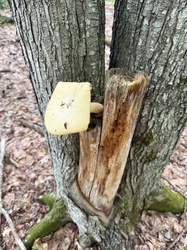
Dryad's saddle announces itself. In late spring, when the woodland floor is still mostly bare of fungi, you round a corner and see a fan the size of a dinner plate jutting from the side of a dead elm or a maple wound, often at head height, often in overlapping tiers running up the trunk. Individual caps of 20–30 cm are routine and exceptional ones exceed 50 cm.
Two things register immediately: the concentric rings of large flat brown scales on a pale tan background, laid out like the feather pattern on a pheasant's back, and the fact that the whole structure is a bracket with a short side-stalk, not a mushroom standing on the ground.
Because it fruits early and grows large, it is one of the easiest big fungi to learn, and it is a useful marker species: where you see it, there is decaying hardwood in or under the tree.
Reading the Cap
The cap is fan-shaped, kidney-shaped or nearly circular with a depression where the stalk joins, and it is flat to shallowly funnel-shaped rather than domed. Young specimens are thick and rounded; mature ones spread out and thin toward the rim.
- Ground colour: cream, straw or ochre-tan, sometimes almost white when young.
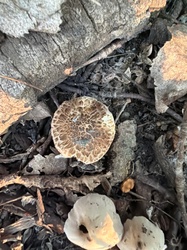
- Scales: large, flat, appressed, dark brown to reddish-brown, broadly triangular or oblong, arranged in concentric zones that radiate outward from the point of attachment. They lie flat rather than standing up, and they are markedly bigger than the fine fibrils seen on most brackets.
- Surface: dry, not viscid, the flesh beneath faintly leathery when fresh and increasingly tough with age.
- Margin: thin, even, incurved when young, often becoming wavy or split in older fruitbodies, and frequently paler than the disc.
Older, weathered caps bleach, lose scale definition, and can be mistaken for other brackets, so look for a fresher specimen on the same tree before committing.
The Pore Surface
Flip it over, or crouch under it. The undersurface is the second half of the identification and it is genuinely distinctive.
- Colour: white to cream, ageing to pale buff or straw; it darkens and browns where handled or damaged.
- Pore size: large — typically 1–3 mm across, easily seen with the naked eye. Most polypores have pores you need a lens for; these you can count.
- Pore shape: clearly angular, sometimes almost hexagonal or elongated near the stem, giving a honeycomb texture.
- Attachment: the pore layer runs decurrently down onto the stalk, so the boundary between cap and stem is a gradual transition rather than an edge.
- Tube depth: shallow, roughly 1–4 mm, and the tube layer is not separable from the cap flesh as a distinct mat.
Large angular decurrent pores plus concentric brown scales is, in practice, a complete identification for this species.
Stipe and Base
The stalk is short, thick and lateral or eccentric — attached off to one side, or occasionally near the middle in specimens growing from the top of a stump. It is 2–8 cm long and up to 4 cm thick, sometimes barely a stub on brackets that emerge from a vertical trunk.
The key detail is the base. The stalk is white or cream above, where the pores run down it, and becomes dark brown to velvety black toward the base, as though it had been dipped in ink. That black boot is present even in young material and is a fast confirmation when a bracket has weathered.
Flesh and Colour Change
Cut into the cap. The flesh is white, thick, fibrous and tough, up to a few centimetres deep at the point of attachment and thinning quickly toward the rim. It is soft-corky when fresh and dries hard and papery. It does not change colour on exposure — no blueing, no reddening, no darkening beyond a slow dulling to cream as it dries.
Fresh material has a distinctive smell, mealy or rind-like, strong enough to notice from arm's length in a large fruitbody. There is no latex and no gel layer.
Taking a Spore Print
Polypores print perfectly well; you just have to hold them still.
- Cut a section of cap that includes a good area of pore surface — a whole large cap is unwieldy.
- Lay it pore-side-down on black card or dark glass, since the print is white and vanishes on white paper.
- Prop it level with a small object so the pore surface is horizontal and fully in contact with the air below it.
- Cover with a box or bowl and leave overnight; polypores release spores more slowly than gilled fungi.
The print is white to very pale cream. Freshly expanded specimens in spring release spores in enormous quantities — you can sometimes see a fine white dust settled on leaves directly beneath a large bracket in the field, which is a nice confirmation in itself. Under the microscope the spores are conspicuously large and cylindrical-ellipsoid, smooth and hyaline.
Substrate, Season and Ecology
This is a wood-decay fungus of broadleaf trees, and it is one of the few large fungi that peaks in spring and early summer, with a lesser flush in autumn. That seasonality alone eliminates a lot of confusion.
Hosts include elm above all, plus maple, box elder, ash, sycamore, beech, willow, poplar and horse chestnut. It fruits from:
- wounds and pruning scars on living trees, where it acts as a weak parasite of heartwood;
- standing dead trunks and snags;
- stumps and large fallen logs, sometimes for several years running.
It causes a white rot, degrading lignin as well as cellulose, which leaves the decayed wood pale, soft and stringy. Ecologically it is a major agent of trunk hollowing in mature hardwoods, and hollowing trees created by this kind of decay become nest and roost sites for birds, bats and invertebrates. Fruiting bodies are also heavily used by beetles and fly larvae, so a mature cap often shows tunnelling in the flesh.
Separating It From the Look-Alikes
Polyporus tuberaster. The closest relative in appearance: scaly tan cap, angular pores, white flesh. It is smaller, usually more circular with a central stalk, has finer scales, and typically grows from the ground, arising from a hard buried mass of compacted soil and mycelium rather than directly from an obvious log.
Neofavolus alveolaris. Shares strikingly large hexagonal decurrent pores but is much smaller (2–8 cm), orange to reddish-tan, has only fine scurf rather than big flat scales, and grows on small dead hardwood sticks.
Cerioporus varius. Similar black-based stalk, but the cap is smooth and unscaled, chestnut-tan, and the pores are tiny.
Neolentinus lepideus. Scaly cream cap of a similar look, but the underside has gills, not pores, and it grows on conifer wood and treated timber.
Ganoderma applanatum and other perennial brackets. Hard, crusted, shelf-like, no stalk, minute pores, brown flesh, and they persist year after year rather than appearing fresh each spring.
Sarcodon and other scaly ground fungi. Scaly caps, but the underside bears spines or teeth, and they grow from soil as mycorrhizal partners of trees.
Field Checklist
- Large fan or kidney-shaped bracket on hardwood
- Concentric rings of big flat brown scales on tan
- Pores white, angular, 1–3 mm, running down the stalk
- Short lateral stalk with a black velvety base
- Flesh white, tough, fibrous, unchanging
- White spore print, read on dark card
- Spring to early summer peak on elm, maple, ash and other broadleaves
Common questions
What are the quickest characters to confirm Cerioporus squamosus?
When and where does it fruit?
Is it damaging the tree it grows on?
How do I take a spore print from something this big?
Full reference entry for Dryad's Saddle
Cap and fruiting body, spore print colour, substrate, season, ecological role and the species most often confused with it.
Open the Dryad's Saddle entry →