Green-spored Parasol
Chlorophyllum molybdites
Also called green-spored lepiota, false parasol, green-gilled parasol
A large lawn parasol of warm regions, unique among the big scaly agarics in dropping a green to grey-green spore print and in having mature gills that dull from white to sage green.
Overview
Chlorophyllum molybdites is the species that gives the genus Chlorophyllum its name, which translates as green leaf, in reference to its gill colour. It is a robust, parasol-shaped agaric of open grassland, closely matching the Shaggy Parasol in stature and general appearance but set apart by a single unmistakable character: green spores.
The species is a warm-climate fungus, abundant across the southern and central United States, Mexico, Central and South America, the Caribbean, much of Africa, southern Asia and Australia, and it has spread into new areas with irrigated turf and imported topsoil. In many warm cities it is the most conspicuous large mushroom of watered lawns after summer storms, appearing overnight in extensive fairy rings.
Because the green colour develops only as the spores mature, young fruit bodies with white gills are extremely difficult to distinguish from other big parasols on appearance alone, which is why a spore print is the standard way of confirming the identification. It sits alongside C. rhacodes and C. brunneum in a genus otherwise characterised by white-spored species.
How to identify it
Cap
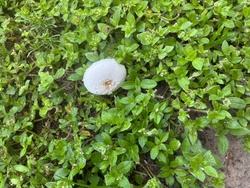
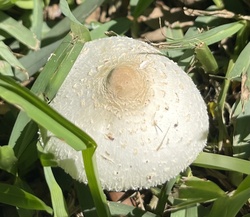
7-30 cm across, at first hemispherical or egg-shaped, later broadly convex to flat with a low central boss. The surface is white to cream and dry, broken into fairly small, flat, pale brownish to pinkish-buff scales that are densest at the centre and thin out toward the margin, often leaving the outer cap almost bare and white. The margin can be finely fringed with veil remnants.
Gills
Free from the stem with a clear collar, crowded and broad. White at first, then cream, and finally acquiring a distinct dull sage or grey-green cast as the spores ripen. Old or bruised gills may develop brownish stains. The green tint is the diagnostic character, but it appears late and can be faint on dry or immature fruit bodies.
Stipe
5-25 cm tall, 1-2.5 cm thick, smooth and unpatterned, whitish, discolouring brownish where handled, tapering upward from a swollen, sometimes rimmed basal bulb. The ring is thick, double-edged, felty beneath, and movable along the stem.
Flesh and spore print
The flesh is white and firm, sometimes flushing very faintly pinkish or brownish where cut, but without the strong saffron-to-red sequence of the Shaggy Parasol. The spore print is the clincher: greyish green to dull olive-green, unlike the pure white print of every other large parasol. To read it, leave a mature cap gill-side down on white paper for several hours.
Where and when it grows
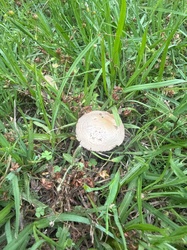
This is a fungus of open, sunny, often irrigated turf: suburban lawns, sports fields, golf courses, parks, roadside verges, cemeteries and improved pasture. It tolerates compacted, fertilised and heavily managed ground and rarely occurs inside closed woodland. Fruit bodies typically appear in large arcs and complete fairy rings, sometimes many metres across, and dozens may emerge together within a day or two of heavy rain.
The distribution is centred on warm temperate, subtropical and tropical regions worldwide. In North America it is common from the mid-Atlantic and Midwest southward and is especially abundant in the southern states; it is widespread in Latin America, sub-Saharan Africa, Australia and southern and southeastern Asia. Fruiting runs through the warm, wet months, principally summer into early autumn, and can be repeated several times in a season.
Ecological role
Chlorophyllum molybdites is saprotrophic, living on dead organic matter in the upper soil rather than on living plants. Its mycelium permeates the thatch layer of grass roots, clippings and leaf debris, breaking down cellulose and returning nitrogen and minerals to the soil. Turf where the ring passes is often visibly greener because of this nutrient release.
The fairy ring habit reflects a single mycelium expanding radially at a steady rate from an original point of establishment, fruiting at its actively growing outer edge. Because the fungus needs only accumulated organic matter and warmth, it establishes easily in newly laid turf and imported soil, which has allowed it to colonise landscaped ground well beyond its original range.
Similar species
The Shaggy Parasol, Chlorophyllum rhacodes, is the nearest match in shape and also has a smooth stem and movable double ring, but its cap scales are much coarser and more upturned, its flesh reacts strongly saffron then reddish brown when cut, and it drops a white spore print. Macrolepiota procera is taller and slimmer with a solid dark central cap disc and unmistakable snakeskin banding on the stem, again with white spores.
White lawn Agaricus species such as Agaricus campestris can look similar from above but have gills that are attached-to-free and turn pink then chocolate brown, a dark brown spore print, and no collar between gills and stem apex. Leucoagaricus leucothites is smaller, has a smooth or only faintly scaly white cap, and prints white to very pale pink. In every case the green print of C. molybdites is decisive, so mature caps should be printed rather than judged on cap appearance.
Common questions about Green-spored Parasol
How do I confirm a Green-spored Parasol?
Do the gills always look green?
Where does it grow?
Is it associated with trees?
Guides
Green-spored Parasol found by the community
Photos submitted through the app and matched to this entry.