Identification guide
Green-spored Parasol Identification Guide
A field walkthrough for Chlorophyllum molybdites, the big scaly lawn parasol whose gills and spore print turn green. Covers the scaled cap, the movable double ring, the bulbous ringless base and how to separate it from Macrolepiota, Chlorophyllum rhacodes, Agaricus and Amanita.
Rings on the Lawn After Warm Rain
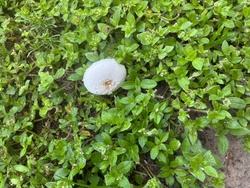
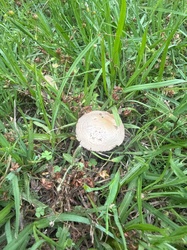
This is the mushroom people photograph in their own gardens. Two or three days after a heavy warm-season downpour, a suburban lawn, playing field or park verge produces a line, arc or complete ring of large white parasols, sometimes dozens of them, sometimes shoulder to shoulder. They are big - caps commonly the width of a hand and occasionally the width of a dinner plate - white with brown scales, and they stand well clear of the grass on a long straight stem carrying a thick collar.
The setting is half the identification. Chlorophyllum molybdites is a grassland saprotroph of rich, disturbed, mown ground: lawns, sports fields, golf courses, pastures, roadside verges, park turf and garden borders. It is common in warm temperate and subtropical regions and only rarely appears inside woodland.
Reading the Cap
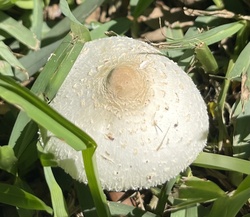
Young fruit bodies emerge as smooth, pale, egg-shaped or nearly spherical buttons with a solid brown cap surface. As the cap expands to 6-30 cm across - broadly convex, then flat, sometimes with a low broad umbo - the brown cuticle breaks up. What is left is a white to cream ground covered with flat, appressed scales, buff to pinkish-brown or tan, which are largest and most crowded over the centre and become sparse and small toward the margin, where white flesh shows plainly between them.
Two details are worth confirming with a lens. First, the disc usually keeps an unbroken brown patch - the last remnant of the intact cuticle. Second, the scales are flat and pressed down rather than upturned, coarse or shaggy. The whole surface is dry, and the margin often carries fine white fibrils where the partial veil tore away.
The Gills and Their Slow Colour Shift
Slice a fruit body vertically and study the gills, which are the reason the species has its name.
They are free - stopping short of the stipe and leaving a clear channel around it - close, broad, and soft. In young fruit bodies they are white or cream, and here is the trap: they stay white for a long time. As spores mature the gill faces take on a dull grey-green, olive-green or sage tint, usually starting in patches and near the gill edges, and often becoming obvious only in fully expanded, weathered specimens. Damaged areas may also stain dingy brownish.
Because the green can be faint or absent in a young cap, never treat white gills as evidence against this species. Instead, find the oldest, most expanded cap in the group and check that one, or take a spore print.
Stipe, Ring and Base
The stipe is 5-25 cm long and 1-2.5 cm thick, straight, smooth and cylindrical, tapering slightly upward, hollow or stuffed at maturity. It is white at first, discolouring pale brown or dingy from the base upward with age or handling. There is no snakeskin banding or girdling pattern on it - the surface is essentially plain.
The ring is prominent: a thick, double-edged collar set high on the stipe, white above and often brownish on its underside, and, in mature fruit bodies, movable - you can slide it up and down the stem with a fingertip.
At the bottom, the stipe swells into a bulb. That bulb is smooth and simple: there is no sac, no cup, no free-rimmed volva, no series of concentric rings or belts, and no deep rooting extension. Mycelial threads bind grass roots and soil around it. Digging out the intact base is essential, because the presence or absence of a volva is a primary genus-level character.
Flesh and Colour Change
Cut through the cap and stipe and watch for several minutes. The flesh is white and thick over the disc, thinning toward the margin. In some collections it slowly discolours pinkish-brown, brownish or dull reddish where cut, particularly in the stipe; in others it barely changes at all. What you should not see is the immediate, vivid saffron- to blood-red flush that runs through cut Chlorophyllum rhacodes within seconds.
Taking and Reading the Spore Print - the Test That Settles It
This is the decisive step and it is easy to get wrong.
Choose a fully expanded cap, cut the stipe off flush with the gills, and lay the cap gills-down. Use a surface that lets you judge a pale-to-mid tone: half white card and half dark card, or a sheet of clear glass over white paper. Cover with a bowl to keep humidity in and leave it two to six hours, or overnight for a slow specimen.
Then scrape the deposit into a small ridge or heap with a knife blade before judging the colour. A thin, scattered deposit of Chlorophyllum molybdites spores looks dirty white; concentrated, it reads clearly grey-green, olive-green or dull sage. That green print separates it from every white-spored parasol and from the dark chocolate-brown print of Agaricus.
Under a microscope the spores are thick-walled, roughly 8-13 by 6-8 micrometres, with a truncate apex and a small germ pore.
Substrate, Season and Ecology
The species is a saprotroph, decomposing organic matter in rich grassland soil rather than partnering with tree roots. It fruits in summer and early autumn in warm weather, characteristically a few days after heavy rain, and often in enormous arcs and fairy rings where the mycelium has been spreading outward beneath the turf for years. The same ring typically reappears in the same lawn season after season, expanding slightly each time.
Separating the Look-alikes on Morphology Alone
- Chlorophyllum rhacodes and C. brunneum. Similar size and scaly cap, but the scales are coarser, shaggier and often upturned, the cut flesh reddens strongly and quickly, and the spore print is white. C. brunneum additionally has an abruptly flattened, rimmed bulb at the stipe base. They favour richer, woodier substrates - mulch, compost heaps, conifer litter - more than open lawns.
- Macrolepiota procera (Parasol). Much taller and more slender, with a distinctive brown snakeskin banding pattern on the stipe, darker and more raised cap scales, gills that stay whitish to cream, and a white spore print.
- Leucoagaricus leucothites. Smaller, with a smooth white cap lacking scales; gills whitish then pinkish, print white to pale pink.
- Agaricus species. Gills pass from pink to chocolate-brown, the spore print is dark brown, the ring is usually not freely movable, and cut flesh in many species bruises yellow or red.
- Amanita species. The critical structural difference is at the base: a volva, sac or rimmed cup formed from the universal veil, plus gills and a spore print that stay white. Always dig the base out to check.
- Leucocoprinus species. Much smaller, fragile, often bright yellow, with a strongly pleated cap, usually in flowerpots and greenhouse soil.
Common questions
Why are the gills sometimes still white?
How do I take a spore print that shows the green?
Where does it grow?
Why does it form rings?
Full reference entry for Green-spored Parasol
Cap and fruiting body, spore print colour, substrate, season, ecological role and the species most often confused with it.
Open the Green-spored Parasol entry →