Identification guide
Mower's Mushroom Identification Guide
A practical guide to Panaeolus foenisecii, the small two-toned brown lawn mushroom, with the mottled gills and roughened dark brown spores that place it correctly.
The Setting
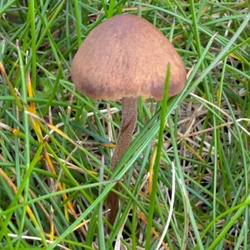
This is the small brown mushroom that appears on your lawn overnight after warm rain. Its habitats are all grassy and all short: mown lawns, playing fields, road verges, golf roughs, grazed paddocks, cemetery grass and garden turf. It is a saprotroph living on grass thatch, dead roots and clippings, so it needs an accumulation of decaying grass rather than dung or wood, although it is perfectly happy in a well-grazed field where thatch and manure are mixed.
Fruiting runs from late spring through autumn, peaking in warm, humid spells. The fruit bodies are ephemeral: they push up a day or two after rain, mature within twenty-four hours and are often shrivelled and gone by the following evening. Groups are scattered rather than clustered, with dozens of individuals spread through the sward rather than tufted at one point.
First Impression
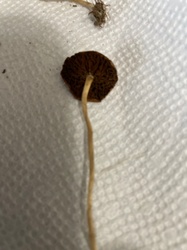
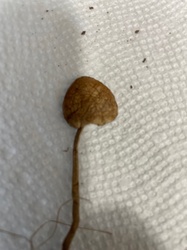
Small, plain, brown and slightly taller than it looks like it should be. Total height is usually 4 to 8 cm with a cap only 1 to 3 cm across, on a thread-thin stem. The detail that first identifies it, even at a glance, is that the cap is often two-toned: a dark centre with a paler outer band, or the reverse, because it dries unevenly from the middle outwards. Watching a small brown lawn mushroom change colour zone by zone over an hour on a sunny morning is a useful practical demonstration of hygrophaneity.
Reading the Cap
The cap is 1 to 3 cm across, hemispherical to bell-shaped or broadly conical, and it never opens out completely flat. Its surface is smooth and dry, not viscid or greasy, and never slimy.
When fully moist it is dark red-brown to warm mid-brown. As it dries the colour fades to dull tan, clay-buff or pale greyish-brown, and the drying front usually leaves a darker zone somewhere on the cap, giving the characteristic banded or two-tone effect. In age the margin may become slightly wrinkled or finely cracked. There are no white veil fragments hanging from the margin and no toothed fringe of tissue, which is a point of separation from several relatives.
Reading the Gills
Gills are adnate to adnexed, fairly close, and moderately broad. Their colour progression is the most useful gilled character in this group. They begin pale greyish-brown, then, as the spores ripen unevenly across each gill face, they become distinctly mottled, blotched with darker and paler patches like camouflage. Finally they turn a dull dark brown with a slightly purplish cast. Under a hand lens the gill edges are visibly paler, whitish and minutely fringed.
That mottling is the hallmark of the Panaeolus group and is worth learning, because it is visible in the field on any half-mature specimen.
Reading the Stipe
The stem is 4 to 8 cm long but only 1.5 to 3 mm thick, equal along its length, hollow, and brittle enough to snap cleanly. It is pale tan to greyish-brown, usually paler and finely frosted or pruinose in the upper portion and darker towards the base, where a few white fibrils bind grass and soil. There is no ring, no ring zone and no volva, and the surface is otherwise smooth.
Flesh and Colour Change
The flesh is thin and brownish and unchanging when cut. There is no bruising reaction of any kind, no latex, and no distinctive odour. Absence of reactions is a genuine data point in a group where relatives can discolour.
Taking and Reading a Spore Print
This is the step that settles the identification, and it is worth doing properly. Cut a mature cap and lay it gills down on white paper, half on a piece of foil if you want contrast, cover with a glass or bowl and leave two to four hours; these small caps drop quickly.
The deposit is dark brown to purplish-brown. It is not jet black, and it is not rusty or cinnamon-toned. That intermediate dark brown is exactly what you should expect and it does most of the work of separating this species from lookalikes.
Under a microscope the spores are large for such a small mushroom, roughly 12 to 17 by 7 to 9 µm, broadly ellipsoid and slightly pointed at one end, with a truncate germ pore at the apex. Critically, the spore wall is ornamented, roughened and finely warted rather than smooth. That roughening is why the species is often placed in the genus Panaeolina, and it is unmistakable at 400x.
Separating It From Look-alikes
Panaeolus papilionaceus occurs in grassland and on dung, has a similar bell-shaped cap, but hangs whitish, toothed veil fragments from the cap margin, gives a jet black spore print, and has smooth spores.
Panaeolus cinctulus is larger, favours compost heaps, mulch, manured ground and enriched grass, usually shows a distinct dark marginal band on the drying cap, and again drops a black print with smooth spores.
Psathyrella species such as P. candolleana are more fragile with brittle whitish stems that shatter easily, often retain veil fragments at the cap margin, and give a dark purple-brown to blackish print. Their gills darken evenly rather than developing the patchy mottling.
Conocybe species such as C. apala have very slender, fragile stems, narrowly conical caps and a rusty or ochre-brown spore print, an obvious colour difference from the dark brown of this species.
Agrocybe pediades is another small grassland mushroom but is stockier, has a tacky, more evenly ochre cap and a rusty snuff-brown print.
Bolbitius titubans is yellow when young, extremely fragile and collapsing, with a rusty print.
Marasmius oreades shares lawns but has a pale tan, broadly umbonate cap, widely spaced pale gills that are nearly free, a tough pliant stem that will not snap cleanly, a white spore print, and a tendency to grow in rings and arcs.
In short: mottled gills plus a dark brown, not black, print plus a lawn is a solid identification, and the roughened spores confirm it.
Common questions
What spore print colour should this species give?
Why do the gills look blotchy?
What is it actually feeding on in a lawn?
How do you tell it from a Fairy Ring Champignon on the same lawn?
Full reference entry for Mower's Mushroom
Cap and fruiting body, spore print colour, substrate, season, ecological role and the species most often confused with it.
Open the Mower's Mushroom entry →