Identification guide
Spectacular Rustgill Identification Guide
A step-by-step field routine for the big tawny-orange clustered mushroom of stumps and trunk bases, from the golden fibrillose cap down to the rust-dusted ring and ferruginous spore print.
The Moment You Spot It
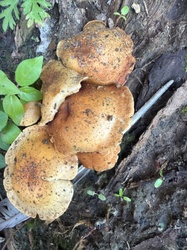
The Spectacular Rustgill announces itself from several metres away. What catches the eye is a mass of warm orange-tawny caps stacked in a tight tuft at the foot of a broadleaf stump, along an old trunk base, or apparently rising straight out of the turf where a buried root runs beneath. In a good autumn a single clump may carry twenty or more fruit bodies, the largest caps as wide as a spread hand, with smaller ones wedged underneath and deformed by the crush of their neighbours. The colour is golden rather than dull brown, closer to the tone of ripe apricot skin or old varnish, and the whole cluster tends to glow against dark bark and green moss. Once the spores begin to drop, everything below the top layer of caps takes on a rusty dusting. That single detail, the rust-frosted upper surfaces of the lower caps, is the most useful first impression this species offers.
Reading the Cap
Measure before you guess. Mature caps run roughly 5 to 15 cm across, and outsized specimens on a rich stump can reach 20 cm. The shape starts strongly convex, almost hemispherical, with the margin rolled inward, then broadens to shallowly convex or nearly flat, often retaining a low central hump. The surface is dry, never slimy, and under a hand lens it is not smooth: fine appressed fibrils break up into small flattened scales, densest over the disc and thinning toward the rim, so the cap looks minutely streaked or felted rather than polished. Young margins may hang with a few pale veil shreds. Colour is deep golden-tawny to orange-brown, sometimes with a slightly darker centre, and it dulls to a duller cinnamon in old, weathered caps. Old specimens dry out unevenly and become blotchy, so always base your reading on a middle-aged cap in the same cluster.
The Gills
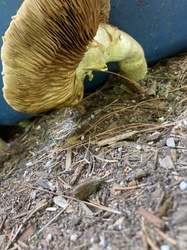
Tip the cap and look at the attachment first. The gills reach the stipe and are adnate, frequently running down it as a very short tooth. They are crowded, fairly narrow, and unequal, with several tiers of short intermediate gills between the full-length ones. Colour is the giveaway across time: pale yellow to buttery yellow while the cap is still domed, then progressively rusty-orange as the spores ripen, ending a strong ferruginous shade that no yellow-capped woodland mushroom with white spores can imitate. Gill faces often become speckled or unevenly mottled as spores mature in patches. The gill edges are finely uneven under a lens, slightly paler than the faces.
Stipe, Ring and Base
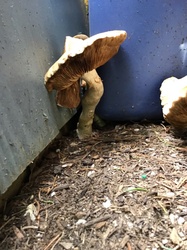
The stipe is stout and substantial, commonly 5 to 15 cm long and 1 to 3 cm thick, and it is rarely straight because crowded clusters push each stem into a curve. Many are noticeably swollen through the middle or club-shaped, tapering again where the fused bases knit together into a common tough mass attached to wood. The surface is fibrillose and yellowish-tawny, darkening to rusty brown toward the base where handling and age take their toll. High on the stipe sits a true membranous ring, thin and skirt-like, which usually collapses against the stem and becomes coated with fallen spores until it looks as if it has been dipped in rust powder. That combination of firm ring plus rust colour is diagnostic in the field; a clustered orange mushroom with a cobweb-like veil rather than a real ring belongs elsewhere.
Flesh and Colour Change
Slice a cap vertically through the stipe. The flesh is firm and pale yellow, thickest over the disc, and the stipe interior is fibrous and stringy, sometimes becoming hollow with age. There is no milk and no dramatic bruising reaction. Cut surfaces may slowly darken to a browner yellow over several minutes, and old or waterlogged flesh browns generally, but nothing turns blue, red or black. The odour is faint and slightly aromatic to mushroomy. Absence of any strong colour change, combined with the yellow flesh, helps rule out several honey-coloured woodland mimics.
Taking a Spore Print
Cut a fresh, fully expanded cap free at the top of the stipe and lay it gills down on white paper, covered with a bowl to keep humidity up. Two to four hours is usually enough with this species because it sheds heavily. The deposit is bright rusty-orange to ferruginous, thick and unmistakable. Use white paper rather than black; the rust tone reads far more clearly against a pale background. If you are in a hurry, look at the cap surfaces of the lower fruit bodies in the cluster, which have been catching spores from their neighbours for days.
Substrate, Season and Setting
This is a wood-decay fungus of broadleaved trees. Search stumps, trunk bases, exposed roots and old cut surfaces of oak, ash, beech, willow and many planted urban species; occasionally it appears on conifer wood. Because the mycelium works through buried roots, clusters often seem to be growing from soil or lawn, and tracing the base carefully with a knife will usually reveal wood underneath. The season runs from late summer well into autumn, and the tough clusters persist for weeks after they stop growing, going brown and papery on the stump. It fruits in parks and gardens as readily as in woodland, which is why it is such a frequently photographed species.
Separating the Look-alikes
Honey fungus, the Armillaria mellea group, shares the clustered habit on stumps and the ring, but its caps are honey-yellow to tan with a dark hairy scaly centre, its gills stay whitish to pale flesh-coloured and freckle brown with age, and the spore print is white. Black bootlace rhizomorphs under nearby bark seal it.
Sulphur tuft, Hypholoma fasciculare, is much smaller and thinner, sulphur-yellow with a rusty-brown disc, has greenish-yellow gills that mature purple-brown, has only a fibrillose veil zone rather than a firm ring, and drops a purple-brown print.
Scalycaps, Pholiota species such as P. squarrosa and P. aurivella, are either shaggy with upright recurved scales or distinctly slimy-capped, their gills mature a duller clay-brown, and their prints are brown rather than bright rust.
Smaller relatives such as Gymnopilus penetrans grow scattered on conifer wood, lack a ring, and are only a few centimetres across.
Galerina marginata forms smaller, thinner, hygrophanous ochre-brown clusters, usually on conifer wood, with a fragile ring and a duller ochre-brown print.
Where jack-o-lantern fungi occur, Omphalotus species can look similar in bulk and colour, but their gills are sharply decurrent, thin and blade-like, there is no ring at all, and the print is cream to pale.
Field Checklist
Large tawny-golden dry fibrillose cap; crowded yellow gills turning strong rust; stout swollen stipe fused into a tuft on wood; firm membranous ring stained rusty; yellow flesh without dramatic bruising; bright ferruginous spore print; late summer to autumn on broadleaf stumps and roots. Score six of those seven and you are on firm ground.
Common questions
What single feature confirms a Spectacular Rustgill in the field?
Why does it sometimes appear to grow from grass or bare soil?
Which trees does it favour?
How can I tell it from honey fungus growing on the same stump?
Full reference entry for Spectacular Rustgill
Cap and fruiting body, spore print colour, substrate, season, ecological role and the species most often confused with it.
Open the Spectacular Rustgill entry →