Identification guide
Two-colored Bolete Identification Guide
A step-by-step read of Baorangia bicolor under eastern oaks: rose-red dry cap, bright yellow pores, an unreticulated red-and-yellow stem, and the slow, mild blue bruising that sets it apart.
The find and the setting
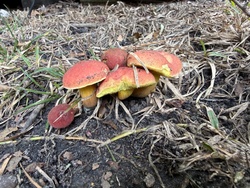
Two-colored Bolete is a fungus of warm, humid summer weather in eastern North American hardwood forest. You come across it on a leaf-litter slope under oaks, often mixed with hickory, beech or maple, sometimes right beside a woodland path where the litter is thin. The mushrooms push up singly, in scattered groups or in small clusters, and in a good July or August week they can be locally abundant.
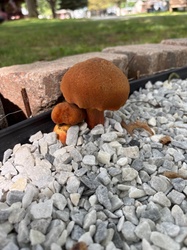
The first impression is of a solid, chunky bolete with a rosy red to brick-red cap sitting on a stout stem that is red for most of its length. When you crouch and tip it, a band of clear bright yellow shows at the top of the stem and again in the pore surface underneath. That red-and-yellow contrast is what the name refers to and it is the anchor of the identification, though several other boletes wear the same two colours, so the details below matter.
Reading the cap
A mature cap runs 5 to 15 cm across, occasionally larger. Young caps are firmly convex, almost hemispherical, becoming broadly convex to nearly flat with age. The margin is inrolled at first, then straightens; in old specimens it may become wavy or slightly upturned.
The surface is dry and unpolished, with a matt, faintly velvety or suede-like feel when young, becoming smoother and sometimes slightly greasy after rain, but never truly viscid or slimy. Colour is rose-red, brick red, dull crimson or, in older or sun-bleached material, pinkish-tan with paler patches. As the cap expands in dry weather it commonly cracks, and the cracks reveal pale yellow flesh underneath, giving a mosaic of red islands on a yellow ground.
Press the cap surface with a thumb. It may darken slightly or take on a faint bluish tone after a minute or two, but there should be no immediate strong reaction.
The pore surface
Turn the mushroom over. The tube layer is bright, clear yellow in young specimens, deepening to golden and finally to a dull olive-yellow as the spores mature. The pores are small, round to slightly angular, and roughly 1 to 2 per millimetre. The tubes are shallow to moderately deep and are depressed around the point where they meet the stem, so the whole layer curves away from the apex rather than running down it.
Now do the bruise test carefully, because its timing is diagnostic. Press a fingertip firmly into the pore surface and watch the clock. In Baorangia bicolor the yellow turns blue, but slowly and moderately: the change usually takes fifteen to thirty seconds to appear clearly, produces a soft blue to blue-green, and frequently fades back toward a dirty yellow-brown after several minutes. A pore surface that flashes deep navy blue within a second or two belongs to something else.
Stipe, base and flesh
The stem is 5 to 12 cm long and 1 to 3 cm thick, solid and firm, usually thickest in the middle or slightly swollen below and tapering a little to the base. Colour is the second half of the name: the lower two-thirds to three-quarters is a rose-red to brick-red that matches or slightly deepens the cap, while the top is a clear yellow that stands out as a distinct band just under the tubes. The extreme base is often yellow again, and in wet ground it may be stained with soil.
Look closely at the stem surface with a lens. It should be smooth to very finely dotted or minutely fibrillose, with no raised net. The absence of reticulation, that fishnet pattern of ridges near the stem apex, is an important negative character here.
Split the mushroom lengthwise from cap to stem base with a knife. The flesh is pale to bright yellow throughout, firm and dense in young specimens, softening with age. Watch the cut face: it should blue slowly and weakly, often only in the cap flesh directly above the tubes and in a band near the stem apex, sometimes barely at all in dry conditions. Note whether the stem base flesh contains any scattered carrot-red or orange dots; in this species it does not.
Spore print and season
Set a detached cap pore-side down on white paper, cover it with a bowl and leave it several hours. The print is olive-brown to dull yellow-brown, a typical bolete colour, and while it will not distinguish this species from its close relatives, it does confirm you are in the boletes rather than looking at some tough-fleshed imitator. Under the microscope the spores are smooth, spindle-shaped to narrowly ellipsoid, roughly 8 to 12 by 3.5 to 5 micrometres.
Fruiting runs from early summer to early autumn, peaking in July and August in most of its range, and always following warm rain. It appears earlier than many boletes and often continues into September where conditions stay humid.
Substrate and ecology
Baorangia bicolor is ectomycorrhizal. Its mycelium sheathes the fine root tips of living trees, exchanging soil water and mineral nutrients for sugars from the host, so it never fruits from wood or from dead organic matter alone. Oaks are the principal partners across its range, with beech, hickory and other hardwoods also recorded. It favours mixed deciduous and oak-dominated forest on well-drained soils, and it is far more common in the eastern half of North America than anywhere else. If you find something matching this description in pure conifer forest, treat the identification as unproven.
Separating it from its closest look-alikes
The red-cap-plus-yellow-pore combination is common in the boletes, so work through these systematically.
Boletus sensibilis is the classic confusion. Its cap tends toward brick to rusty red and often develops a slightly powdery bloom, but the decisive difference is the bruising reaction: the pores and flesh turn a deep, intense blue almost instantly on the lightest touch, far faster and darker than in Baorangia bicolor. It also carries a distinctive spicy aromatic odour that the Two-colored Bolete lacks.
Hortiboletus rubellus and its relatives are much smaller and more slender, with thin flesh, a darker blood-red to brownish-red cap, and, critically, scattered carrot-orange to red dots visible in the flesh of the stem base when it is split lengthwise.
Suillellus luridus and Neoboletus luridiformis both have orange to red pore mouths rather than the clear yellow of this species, and both blue instantly and dramatically. Suillellus luridus additionally carries a coarse raised network over the upper stem, and shows a red line at the junction of tubes and cap flesh when sectioned.
Rubroboletus species likewise have red to orange pores and typically paler, greyish to pinkish caps, with fast, strong blueing.
Baorangia and Butyriboletus species with yellow pores and a reticulate stem separate on that netting alone; run a fingernail up the stem apex and look for ridges.
Xanthoconium affine and other brown-capped, white-to-yellow-pored boletes lack any red on cap or stem and do not blue at all.
Finally, always check the stem colour distribution before deciding. In Baorangia bicolor the yellow apex is a fairly clean, narrow band and the red covers most of the stem; species in which the red is limited to a faint flush, or in which the whole stem is yellow with only red streaks, are something else.
Common questions
How quickly should the pores turn blue?
Is the stem netted?
Which trees does it grow with?
When is the fruiting season?
Full reference entry for Two-colored Bolete
Cap and fruiting body, spore print colour, substrate, season, ecological role and the species most often confused with it.
Open the Two-colored Bolete entry →