Identification guide
Violet-toothed Polypore Identification Guide
How to work a fallen hardwood log for the thin zoned bracket with a purple rim, and how the tearing, tooth-like pore surface and host tree separate it from turkey tail and its conifer-loving cousins.
First Impression and Setting
Violet-toothed Polypore is one of the fungi you learn early precisely because it is everywhere. Any walk through broadleaf woodland that includes a few fallen trunks, a stack of cut logs, or standing dead birch and beech will turn it up. The setting is dead hardwood, bark still attached or recently lost, in shade or half shade, at any time of year.
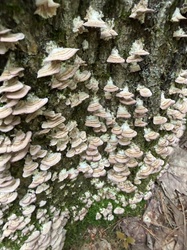
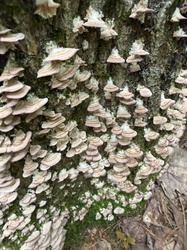
The first impression from two metres away is of a long rank of thin, pale, hairy shelves running in tiers down a log, often in overlapping rows of dozens or hundreds. They look grey-white, slightly shaggy, and unremarkable. The identification begins when you get close enough to see the outer edge, because the growing margin of a fresh bracket is washed with violet or lilac, a colour that no other common shelf fungus on hardwood carries in the same way.
Always check the underside before deciding anything. On this species the underside carries most of the diagnostic information and is usually still purple after the top has weathered to grey.
Reading the Bracket
Individual brackets are small and thin: roughly one to five centimetres out from the wood, up to about six centimetres wide, and only a millimetre or two thick. They are broadly attached without a stem, and the outline is semicircular, fan-shaped or kidney-shaped, often fusing sideways with neighbours into long ridged rows.
The upper surface is finely hairy or velvety, particularly toward the base, and it is marked with concentric zones. Those zones are subtle and mostly tonal, shades of white, cream, buff and grey, rather than the strongly contrasting bands of some relatives. Newly grown edges carry the violet flush, which fades within weeks; a bracket collected in late winter may show no purple on top at all.
Older brackets pick up a green film of algae, especially on the upper surface, and can look convincingly like a different fungus. Wipe a thumb across the top: the green comes off or thins, revealing grey-white beneath, and the underside is unaffected.
Texture matters. The bracket is thin, tough and flexible when moist, bending without breaking, and it becomes rigid and slightly brittle when dry. It is never fleshy, watery or soft.
The Spore-Bearing Surface
Turn a bracket over, or better, look at a whole row from below with a hand lens. In very young specimens the underside is a proper pore surface with small angular pores, roughly two to four per millimetre. As the bracket expands and matures, the pore walls split and tear, so the surface breaks down into irregular flattened teeth, ragged plates and maze-like fragments. Mature material can look almost spiny.
That progression from pores to teeth is the character the common name is built on, and it is the most reliable field mark. The colour of this surface starts a clear violet to lilac and fades gradually through pinkish-buff to pale tan or dirty cream in old, weathered brackets. A hand lens on the extreme growing edge will usually recover a trace of purple even on brackets that have overwintered.
Flesh and Sectioning
Cut a bracket vertically with a sharp blade. The flesh is very thin, under a millimetre, whitish to pale buff, tough and fibrous, and it is usually thinner than the tooth layer beneath it. Some sections show a faint darker line between the hairy upper surface and the flesh.
There is no colour change on cutting, no latex, no gel and no bruising reaction. The smell is faintly fungal or woody at most. Do not expect any dramatic chemistry here; the identification rests on structure, colour and host.
Taking a Spore Print
Bracket fungi print perfectly well if you give them the right orientation. Cut a bracket off the log with a slice of wood attached, and prop it so the tooth surface faces down over dark card, with the whole thing under a covered container in a humid place. Fresh, actively growing material may take a night or two; dry weathered brackets will give nothing.
The deposit is white. Under the microscope, the spores are small, smooth, colourless, cylindrical and slightly curved, roughly six to eight by two to two and a half micrometres, a shape often described as sausage-like. A white print plus a violet tooth surface on hardwood is a complete identification.
Substrate and Season
The substrate is the decisive ecological character: dead broadleaf wood, above all beech and birch, but also maple, oak, cherry, alder and many others. It colonises recently dead standing trunks, fallen logs, large branches and cut stacks, and it is a white rot fungus, breaking down lignin so that the residual wood becomes pale, soft and stringy.
Brackets are annual but persistent. New growth flushes mainly in autumn, but old brackets remain attached through winter and into the following summer, weathering and greening as they go, so the species is findable in every month.
Separating It from the Look-Alikes
Trichaptum abietinum is the conifer counterpart. It is smaller and thinner, often forming narrow crusted rows along the underside of pine and spruce logs with only a small projecting shelf, and its pore surface stays closer to pores or shallow teeth. Host tree does most of the separation: hardwood for biforme, conifer for abietinum.
Trichaptum fuscoviolaceum also grows on conifers and takes the tearing further, with the underside breaking into elongated plates and spines that can look almost gill-like.
Turkey Tail, Trametes versicolor, shares the log and the tiered habit but differs underneath: its pore surface stays a fine, even, white to cream layer of round pores that never tears into teeth, and it has no violet anywhere. Its upper surface is also more strongly and colourfully zoned, with sharply contrasting bands.
False Turkey Tail, Stereum ostrea and relatives, have a completely smooth undersurface with no pores or teeth at all, and are usually warmer orange-brown above.
Bjerkandera adusta has a smoky grey to almost black pore surface that stays poroid, and its brackets are thicker and less hairy.
Purplepore Bracket relatives with maze-like undersides, such as some Daedaleopsis forms, are thicker, corkier and lack the fine hairy zoned top.
A Field Checklist
Thin flexible bracket in overlapping tiers; hairy, faintly zoned grey-white top; violet growing margin when fresh; underside starting as small pores and tearing into irregular violet teeth; white spore print; dead hardwood, all year. Confirm the tooth surface and the host and you are done.
Common questions
The underside of my bracket is buff, not violet. Is it still Violet-toothed Polypore?
How do I separate it from Turkey Tail?
What wood does it grow on, and what does it do to it?
Why do old brackets look green?
Full reference entry for Violet-toothed Polypore | Trichaptum biforme
Cap and fruiting body, spore print colour, substrate, season, ecological role and the species most often confused with it.
Open the Violet-toothed Polypore | Trichaptum biforme entry →