Community find
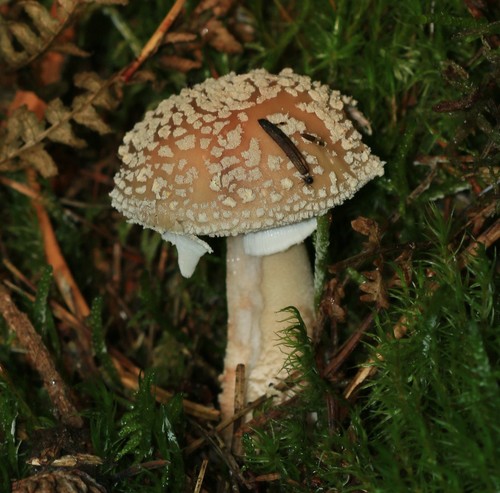
Brown Fly Agaric or European Brown Blusher
Amanita excelsa
- Group
- gilled mushroom
- Season
- Late summer through autumn, often peaking after periods of rain.
- Habitat
- Typically found growing solitarily or scattered in deciduous and coniferous forests. It forms mycorrhizal associations with various trees, commonly oaks and pines. Appears terrestrially on the forest floor, often amidst leaf litter or moss.
- Key characteristics
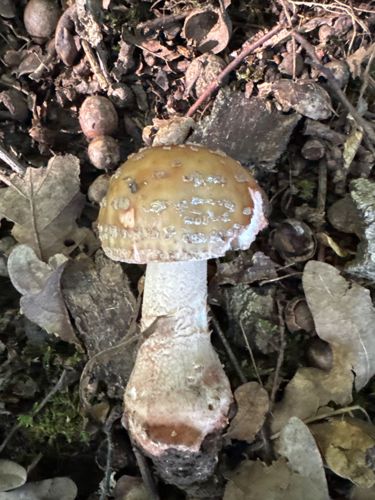
- Cap: Initially convex, flattening with age, often sticky or slimy when wet. Color ranges from yellowish-brown to reddish-brown, typically covered with patchy, grayish-white to yellowish volval remnants that resemble warts. Gills: Free or adnexed, white to cream, crowded. Stem (Stipe): White, often tapering upwards from a swollen base (bulb). It has a skirt-like ring (annulus) that can be fragile and may disappear with age. The base often shows concentric rings or scales from the universal veil (volva). Spore print: White or cream.
- Look-alikes
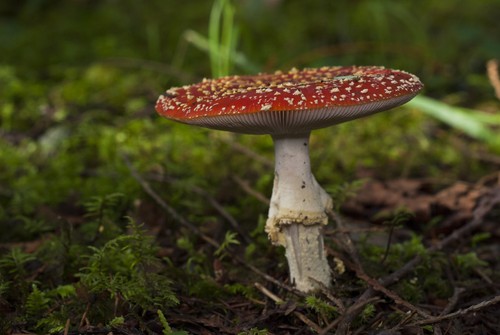
- Amanita muscaria (Fly Agaric): Known for its bright red or orange cap with white warts. Amanita rubescens (The Blusher): Similar cap color and warts but stains reddish where bruised or worm-eaten. Amanita pantherina (Panther Cap): Has a more distinctly brown cap, persistent white volval remnants, and a distinctive basal bulb, but lacks the reddish staining of A. rubescens and is generally more uniformly colored without the yellowish tones of A. excelsa. Distinguishing features often involve examining the cap color, stem base, and reaction to damage/age.
- Ecological role
- Mycorrhizal: Forms a symbiotic relationship with the roots of certain trees, particularly oak and pine. The fungus provides the tree with increased access to water and nutrients (especially phosphorus and nitrogen), while the tree supplies the fungus with sugars produced during photosynthesis. This interaction is crucial for the health and growth of both the fungus and the tree.