Community find
Flowerpot Parasol
Leucocoprinus birnbaumii
- Group
- Gilled mushroom
- Season
- It can be found throughout the year indoors in cultivated environments, but outdoors it is typically found in warm, humid conditions during summer and early autumn.
- Habitat
- This mushroom is commonly found in potted plants, greenhouses, and other areas with disturbed soil, especially where wood chips or bark mulch are present. It is a saprobic fungus, meaning it obtains nutrients from decaying organic matter.
- Key characteristics
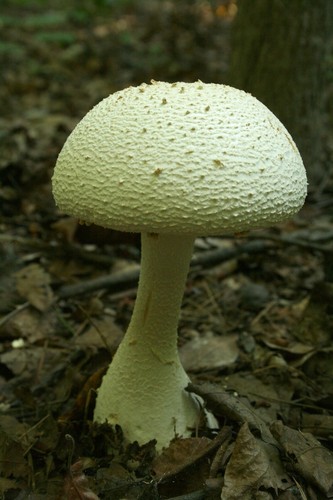
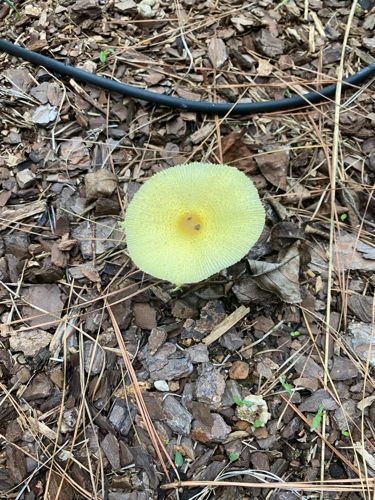
- The cap of Leucocoprinus birnbaumii is typically lemon yellow to bright yellow, ovoid to bell-shaped when young, expanding to convex or conical with an umbo, and can be up to 6 cm across. The surface is often granular or scaly. The gills are free from the stem, close, and also pale yellow. The stem is slender, hollow, and also yellow, ranging from 3 to 10 cm in height, with a movable, persistent ring that is often darker yellow. The spore print is white to creamy.
- Look-alikes
- There are some other yellow Leucocoprinus species, but L. birnbaumii is distinguished by its vibrant lemon-yellow color, granular cap surface, and typical association with potted plants. Leucocoprinus flavescens is similar but often paler and lacks the prominent granular texture.
- Ecological role
- Leucocoprinus birnbaumii is a saprobic fungus that plays a role in the decomposition of organic matter in soil and potting mixes, breaking down wood fragments and other plant debris. While often seen in potted plants, it generally does not harm living plants.