Community find
Flowerpot Parasol
Leucocoprinus birnbaumii
- Group
- gilled mushroom
- Season
- It can be found year-round in indoor environments like potted plants and greenhouses where conditions are consistently warm and humid. Outdoors, it typically appears during warmer, humid months.
- Habitat
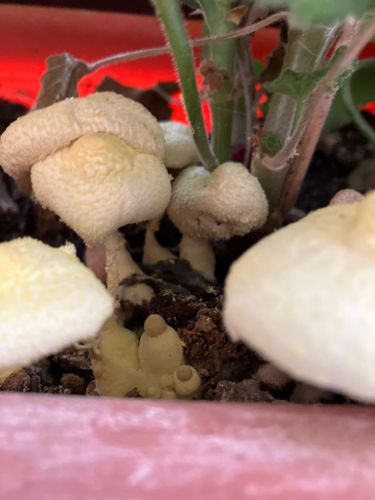
- This species is commonly found growing in potted plants, greenhouses, and other areas with disturbed soil, often in association with decaying wood chips or other organic matter. It thrives in warm, humid conditions.
- Key characteristics
- Leucocoprinus birnbaumii typically has a bright yellow to pale yellow cap, which can range from ovoid to bell-shaped to convex as it matures, often with a finely granular or powdery surface. The cap can be 2-6 cm in diameter. The gills are free, close, and also pale yellow. The stem is slender, yellow, and often has a fragile ring that may disappear with age. The flesh is soft and yellowish. Spore print is white.
- Look-alikes
- While its distinctive yellow color makes it fairly unique, some other small, yellow gilled mushrooms might be superficially similar. However, Leucocoprinus birnbaumii is distinguished by its vibrant yellow color, granular cap, and preference for potted plant environments. Other species within the genus Leucocoprinus can be similar but often vary in color or cap texture. For example, some Leucocoprinus species may be white or brownish, and lack the distinctive bright yellow coloration of L. birnbaumii.
- Ecological role
- Leucocoprinus birnbaumii is a saprophytic fungus, meaning it obtains nutrients from decaying organic matter. In potted plants, it helps break down organic components in the soil, contributing to nutrient cycling.