Community find
Golden Teacher
Psilocybe cubensis
- Group
- gilled mushroom
- Spore print
- Dark purple-brown to blackish
- Size
- Cap: 2-8 cm in diameter; Stipe: 4-15 cm long and 0.5-1.5 cm thick.
- Season
- Often found during periods of high humidity and rainfall, such as the monsoon season in tropical areas or late summer in subtropical zones.
- Habitat
- Found in subtropical and tropical environments, growing primarily on the dung of large herbivores such as cattle in humid pastures.
- Distribution
- Widely distributed throughout the Gulf Coast of the United States, Central and South America, Southeast Asia, and Australia.
- Key characteristics
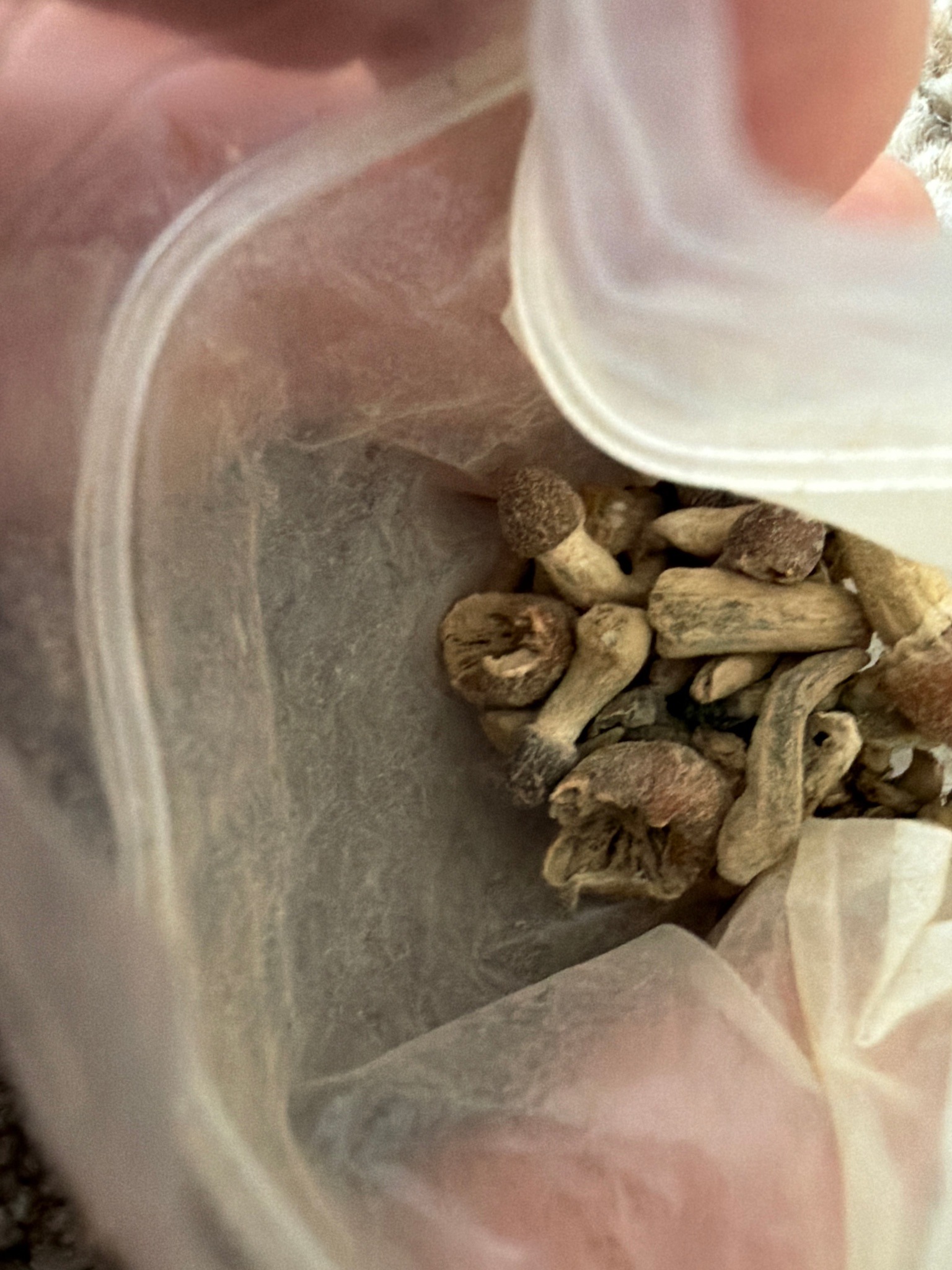
- The dried specimens show a brown to gold cap that becomes bell-shaped or convex, typically with a thick stem that may show blue-green bruising when handled or dried. Gills are closely spaced and transition from pale to dark purple-brown.
- Fruiting body
- In its fresh state, the cap is 2-8 cm broad, conic to convex, and viscid when moist. The stipe is 4-15 cm long, white to yellowish, often with a persistent ring-like veil. The dried specimens appear shriveled, tan-brown, and may exhibit blueish oxidation marks.
- How to recognise it
- Key features include the dark purple-brown spore print, the presence of a persistent annulus (ring) on the stem, and the distinct blue-green bruising when the tissue is damaged.
- Look-alikes
- Psilocybe cyanescens, Psilocybe azurescens, and several Panaeolus species which also exhibit dark spore prints and blue bruising.
- Ecological role
- Saprophytic, meaning it breaks down organic matter, specifically herbivore dung, back into simpler nutrients for the soil.
- Notes
- This species is one of the most widely cultivated fungi for research purposes. It was first described scientifically by Franklin Sumner Earle in Cuba in 1906, hence the name 'cubensis'.